
Our sun will reach this state in about 5 billion years and it is possible that it will swallow the planets closest to it, probably including the earth
In about 5 billion years our Sun will use up its hydrogen supply and swell. It will reach the state known as a red giant. The inner planets will be drawn into it when its rim crosses their orbits, and the outer planets will now orbit a much larger star. It is not known what exactly will happen to the planets, but a team that specialized in discovering planets outside the solar system recently discovered a planet orbiting a red giant.
The discovery of the red giant and its planet was made by Alex Walznan, who and his team discovered the first planet orbiting another star, namely a pulsar in 1992. Subsequent observations of the same system showed that there are other systems of planets orbiting pulsars.
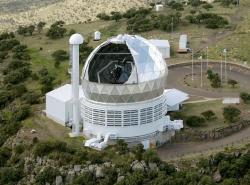
Walznen and his team, who used the Hobby-Eberly telescope - one of the largest and most powerful telescopes in the world - discovered a planet orbiting a red giant whose mass is twice that of the Sun but whose volume is 10 times greater. The planet orbits the red giant for 360 days. This discovery was made using the Doppler shift method. The planet's pull pushes the parent star back and forth in orbit. The change in the star's speed is what was discovered by the telescope.
This is an important discovery because it gives astronomers a sense of the fate that awaits us when our sun dies. In 2 billion years, life on Earth will no longer be possible, and in 5 billion years, our Sun will turn into a red giant. As it swells, its changing density and gravity will disrupt the dynamics of all bodies in the solar system. Planets will be pushed in and others will be thrown into space. Icy moons orbiting planets such as Jupiter and Saturn may enter and exit the habitable zone alternately.
The more data the astronomers gather about this period the better and a lot of information is indeed flowing. Waltznan and his team spent at least three years collecting data on 300 stars in an attempt to identify the best candidates for having solar systems.
For the news in Universe Today

One response
Amazing :
the planet that orbits the red giant for 360 days; As much as it reminds us - us, who set times in the concepts of ownership of life.