
The researchers used models that suggested the oceans were able to absorb less carbon dioxide, but this is the first study to quantify the changes directly through observations, says a Yale University researcher.
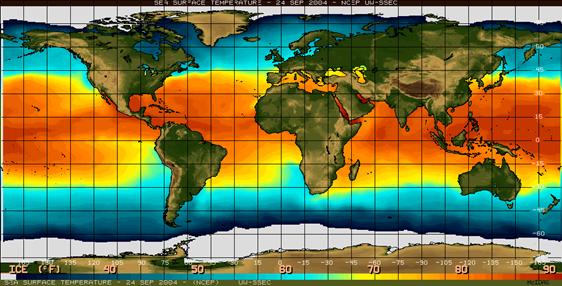
The oceans are absorbing less carbon dioxide, according to the findings of geophysicists at Yale University who examined data from the last 50 years. Today, the oceans absorb over 40% of the carbon dioxide emitted by human activity, which may increase the rate of climate change, according to the study that appeared in the November 25 issue of the journal Geophysical Research Letters.
Geoffrey Park, professor of geology and geophysics and director of the Yale Institute for Biosphere Studies, used data collected from atmospheric observatories in Hawaii, Alaska and Antarctica to study the interrelationships between fluctuations in global temperatures and the prevalence of carbon dioxide at interannual intervals. A similar study 20 years ago found a difference of five months between the temperature changes between years and the changes in CO2 levels. Park revealed that now the gap has increased from 5 to at least 15 months.
"No one has updated the twenty-year-old analysis," Parks said. "I expected to find some change in the time gaps, but the shift was so surprising in size. It's a big change."
A longer reaction time means that the carbon dioxide in the atmosphere does not fully adapt to the fluctuations of the temperature cycles before the next cycle begins, indicating that the oceans have lost some of their ability to absorb sulfur dioxide from the atmosphere. A lower absorption of carbon dioxide may be caused by changes in the cyclical currents in the oceans or as a result of an overall increase in the surface temperature of the water. "Think of the oceans as a glass of Coke. Hot Coke is less fizzy," Park said. "The same thing happens when the oceans warm.
An increase in carbon dioxide levels was the precursor to a rise in temperature during the last century, when the impact of human activity on the climate accumulated over many decades of fossil fuel burning and deforestation. However, these interrelationships are reversed on the mesoscale, when multi-year temperature cycles lead to multi-year cycles in carbon dioxide levels.
Park particularly found a strong correlation between sea surface temperature and carbon dioxide levels in tropical areas. On the contrary, in areas in the nation there are many trees and the biomass absorbs most of the carbon dioxide from the atmosphere, there was little or no correlation between the temperature and the interannual carbon dioxide levels. In other areas such as the vast forests of North America and Eurasia, the large annual cycle of carbon dioxide synchronizes with the increase or decrease in the amount of plants.
"The researchers used models that suggested the oceans were able to absorb less carbon dioxide, but this is the first study to quantify the changes directly through observations." Park says. "This reinforces the prediction that the oceans will not absorb most of the future emissions of carbon dioxide, and that the rate of climate change will increase."
For information on the Yale University website
On the same topic on the Hayadan website
- Is global warming inevitable?
- The forgotten acid in seawater
- Scientists managed to repel the arguments of the skeptics - the concentration of warm years is not accidental
- The sea is also suffocating from CO2
- Fertilizing the oceans

8 comments
The ice is on the way 🙂
for John
You're wrong again... when you refer to "tremendous prosperity" you are probably influenced by coral reef inventions
and everything around them, whose importance is indeed great, but: the amounts of "biomass" in cold areas are immeasurably large
Because of a clear preference for phytoplankton (plants) and zooplankton, a preference that results from inventions
More oxygen, more oxygen = more phytoplankton = more zooplankton = more fish = more predators
= total for greater biomass
Lasaf - How do you explain the fact that precisely in warm (tropical) oceans there is a tremendous prosperity of animals over cold oceans?
After all, if there was less oxygen in the water due to high temperature and therefore also less plankton (which is the building block of the food chain in the sea) there would be less life in the tropical oceans
to Yohani
The one who picks up death is the phytoplankton,
As the temperature rises, there is less oxygen in the water, so the living conditions are difficult
more and therefore there is less phytoplankton,
Hotter water dissolves less gases therefore even as the temperature rises
The oceans are more saturated... the water is able to dissolve less gases,
It is better that those who respond to each other ask before they respond... in ignorance
The abbreviation variable brackets are dense as one variable at one point in time and draw a line wherever they want...
Of course it's with the accepted ideology so it's going to be spread straight away
mozar.
The one who absorbs the carbon dioxide in the sea is the zooplankton - as the temperatures in the sea rise, more favorable conditions are created for the plankton to thrive and hence the absorption of carbon dioxide in the sea should actually increase.
There may be little need for scientific editing.
There may be little need for linguistic editing.