A distant neutron star is unexpectedly reawakening, releasing powerful X-ray radiation that may reveal what fuels the most extreme stars in the universe.

After years of dimming, neutron star P13 suddenly glowed back to life, its X-ray emission becoming a hundred times brighter. The dramatic comeback hints at major changes in the way material crashes onto the star's surface.
A research team has studied the long-term changes in X-ray emission from the neutron star NGC 7793 P13, which is thought to be fueled by supercritical absorption. In this process, a massive amount of gas falls onto the neutron star, creating powerful X-rays. The researchers have discovered a relationship between the star's X-ray brightness and its rotation speed, which may help to understand the mechanism behind supercritical absorption.
When gas is pulled inward by the intense gravity of a compact body such as a neutron star or black hole, a process known as accretion, it releases energy in the form of electromagnetic radiation. Developments in highly sensitive telescopes have revealed sources that glow with very strong X-ray emission.

One of the leading ideas is that these extreme emissions occur when unusually large amounts of gas flow over a compressed body through a phenomenon called supercritical adsorption. Despite this progress, the physical processes that enable supercritical adsorption are still not well understood.
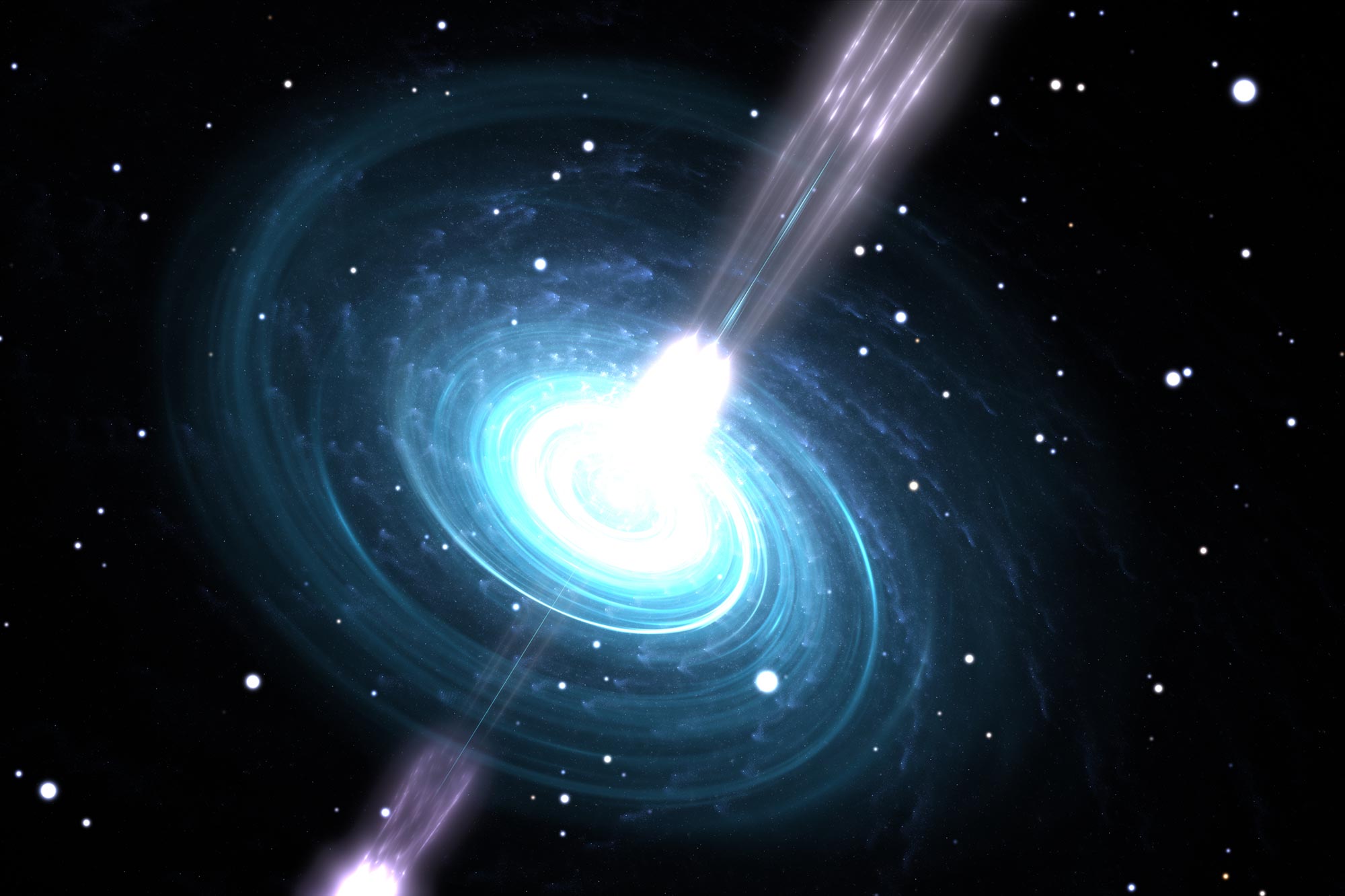
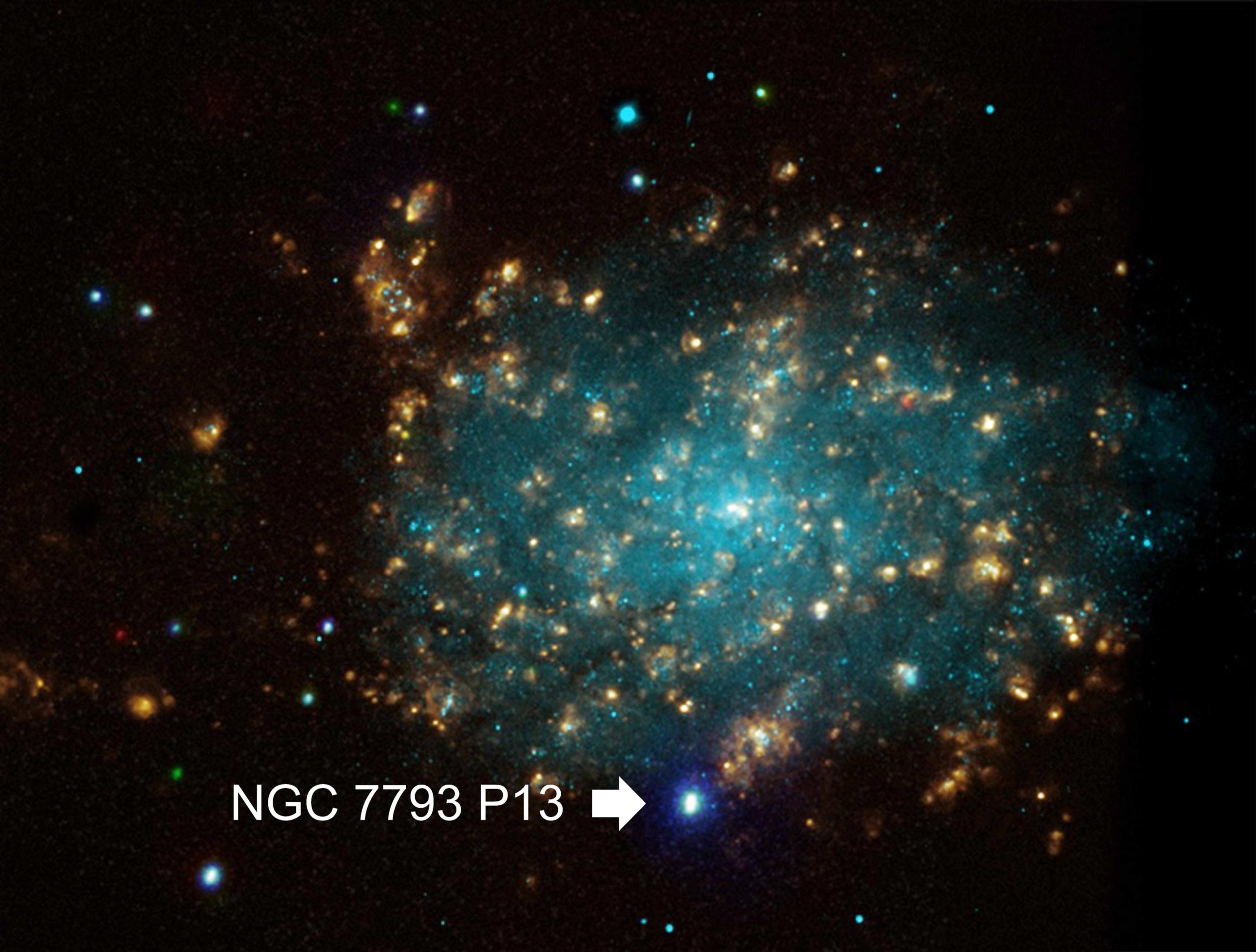
To investigate this mystery, the research team examined NGC 7793 P13 (hereafter: P13), a neutron star undergoing supercritical absorption in the galaxy NGC 7793 (about 10 million light-years from Earth). As material spirals toward the neutron star, its strong magnetic field directs the incoming gas toward the magnetic poles, where it forms tall, narrow structures called absorption pillars. These regions are thought to be the source of the intense X-ray emission.

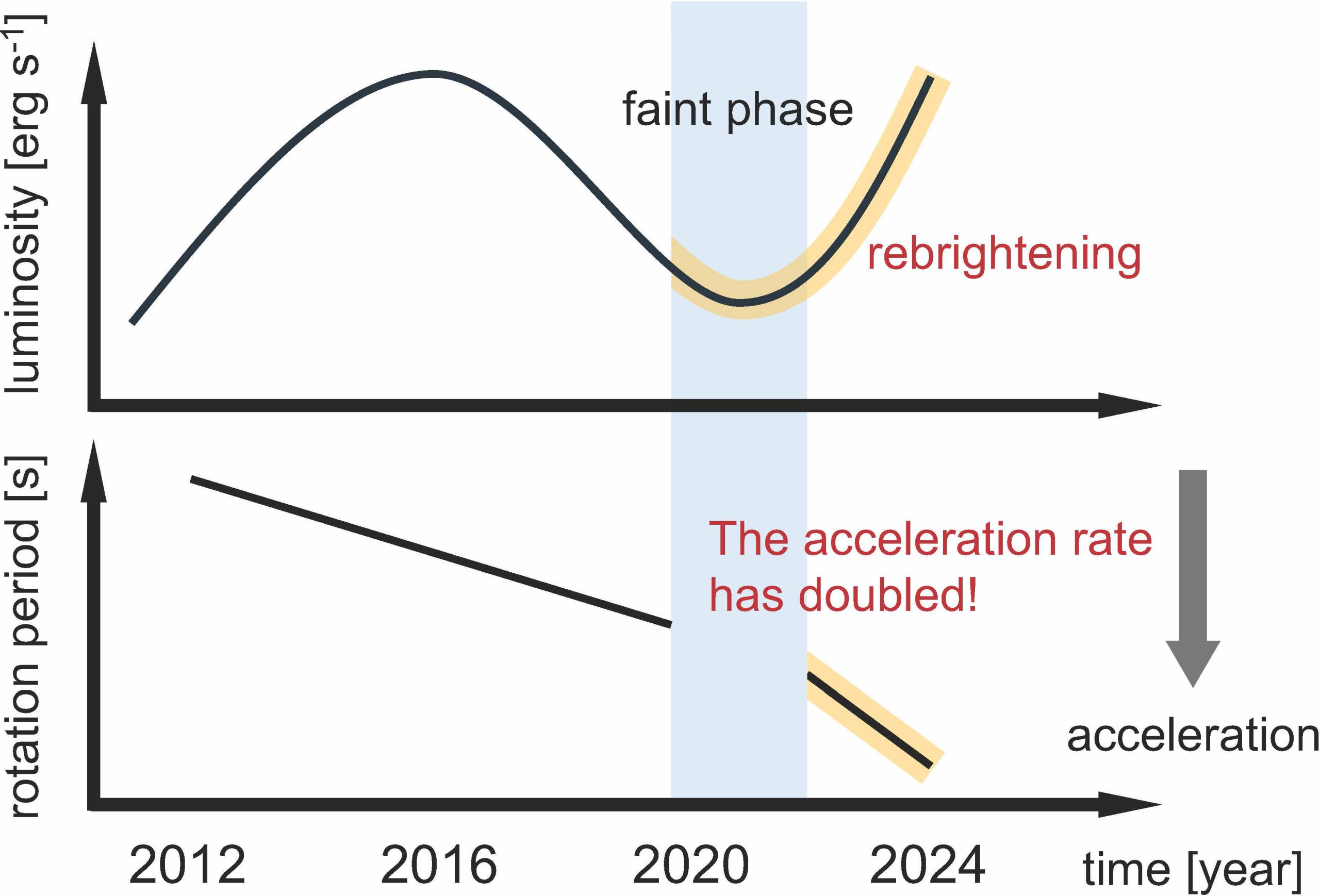
The luminosity and rotational speed have changed significantly. There is an inverse relationship between rotational speed and period; a shorter period indicates faster rotation. The slope represents the rate of acceleration of the rotational speed. Credit: Marina Yoshimoto (Ehime University)
As the neutron star spins, its X-ray emission can appear as regular, repeating pulses that follow its rotation. Previous research has shown that the rotation period of P13 is about 0.4 s and that the spin rate increases at a nearly constant rate.
Over a period of about ten years, the brightness of the system also changed dramatically, by a factor of more than a hundred. The spin behavior and X-ray brightness are useful indicators of the amount of material falling on the neutron star, but for P13, no clear relationship between these two measurements was detected.
The team studied the long-term evolution of P13's X-ray luminosity and rotation period from 2011 to 2024 and found that it was in a dim phase in 2021 and started to brighten again in 2022. In 2024, P13 reached a high luminosity, more than two orders of magnitude brighter than in 2021. In addition, during the rebrightening phase in 2022, the rate of acceleration of the rotational velocity increased by a factor of 2, and was maintained until 2024.
More on this subject on Hayadan.com - Science news: