
Microsoft and Purdue Collaboration Brings Topological Qubit System Building Closer
Microsoft Quantum recently published an article inNature In which they highlighted key advances in measuring quantum devices—a crucial step toward building a topological quantum computer. The research was conducted by Microsoft scientists and engineers, including those from the West Lafayette Quantum Lab, located at Purdue University. In the paper, the group described the operation of a critical device that serves as a basic building block for topological quantum computing. Their findings represent a significant milestone in the development of quantum computers, which have the potential to be far more powerful and robust than existing technologies.
“Our hope for quantum computing is that it will help chemists, materials scientists, and engineers working to design and manufacture new materials that are so important to our daily lives,” said Michael Manpre, scientific director of the Microsoft Quantum Lab in West Lafayette, and a distinguished professor of physics and astronomy, materials engineering, and electrical and computer engineering at Purdue University. “The goal of quantum computing is to accelerate scientific discoveries and translate them into useful technologies. For example, if quantum computers reduce the time and cost to develop new life-saving therapeutic drugs, that would have a real societal impact.”
Building the quantum plane precisely
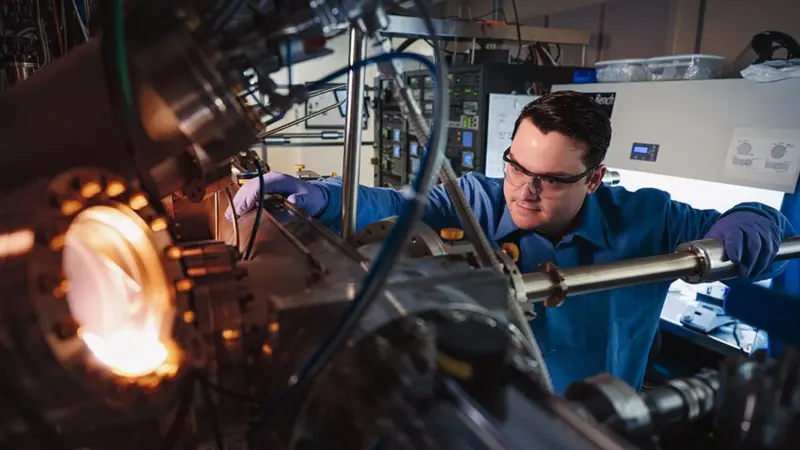
The Microsoft Quantum Lab team in West Lafayette advanced the layered materials that make up the quantum plane of the complete device structure where the tests were conducted. Microsoft scientists working with Manfra are experts in advanced semiconductor growth techniques, including molecular beam epitaxy, which are used to build the low-dimensional electronic systems that form the basis of qubits. They built the semiconductor and superconducting layers with atomic precision, tailoring the material properties to the device’s structural requirements.
Manpra, a member of Purdue’s Institute for Quantum Science and Engineering, noted the strong relationship between Purdue University and Microsoft, built over a decade, and the progress made at the Microsoft Quantum Lab in West Lafayette. In 2017, Purdue deepened its relationship with Microsoft through a multi-year agreement that included integrating Microsoft employees with Manpra’s research team at Purdue.
“The breakthrough in the measurement of the state of quasiparticles marks a milestone in the development of topological quantum computing and creates a defining moment in the hybrid architecture of semiconductors and superconductors,” said Purdue President Mong Chiang. “In addition to the recent success of the Purdue Computes strategic initiative, the deep collaboration that Professor Manfra and his team have forged with the Microsoft Quantum Lab in West Lafayette on the Purdue campus constitutes the most influential industry-research partnership at any American university today.”
Why topological quantum computing is different
Most quantum computers encode information using local properties, such as electron spin, to create qubits. However, these qubits are extremely sensitive to external factors such as heat, vibration, and interactions with other quantum particles, making them vulnerable to errors that require complex correction techniques.
Topological quantum computers take a different approach by spreading the information across multiple particles working together. This approach makes the state of a qubit much more stable, as changing it requires changing the state of all the particles involved. As a result, topological qubits are more resistant to interference and provide a more robust foundation for quantum computing.
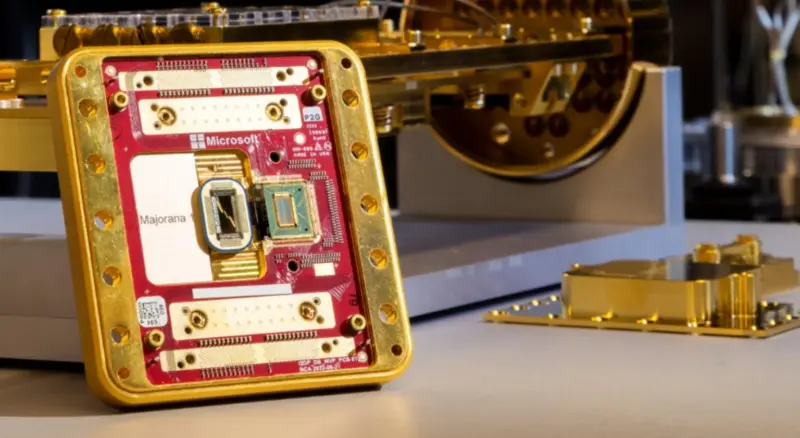
In the article inNature , the Microsoft team was able to accurately and quickly measure the state of the quasiparticles that make up the basis of the qubit.
“The device is used to measure a fundamental property of a topological qubit at high speed,” Manfra said. “The team is excited to continue to build on these positive results.”
Advancing semiconductor-superconductor technology further
“The team in West Lafayette pushed existing epitaxy technology to a new level of excellence for hybrid semiconductor and superconducting structures, ensuring a seamless interface between all the building blocks of Microsoft’s hybrid system,” said Sergey Gronin, a researcher at the Microsoft Quantum Lab.
“The quality of materials required for quantum computing chips requires constant improvements, so this is one of the biggest challenges,” Gronin added. “First, we had to adapt and improve the semiconductor technology to reach a new level that no one had been able to achieve before. But it was equally important to develop this hybrid system – to do this, we had to merge a semiconductor part with a superconductor part. That is, both components and the interface between them had to be improved.”
A unique opportunity for Purdue students
Although the work discussed in the article inNature Conducted by Microsoft employees, the exposure to industrial-scale research and development is also a unique opportunity for Purdue students in Manfra’s research group. John Watson, Jeffrey Gardner, and Saeed Palahi, who are among the paper’s authors, earned their doctorates under Manfra and now work for Microsoft Quantum in Redmond, Washington, and Copenhagen, Denmark. Most of Manfra’s former students now work for quantum computing companies, including Microsoft. Tyler Lindman, who works in the West Lafayette lab and helped build the required hybrid structures, is completing his doctorate at Purdue under Manfra’s supervision.
“Working in Professor Manfra’s lab, along with my work at Microsoft Quantum, has given me a significant advantage in my professional development, and has helped my academic research,” said Lindemann. “At the same time, many of the world’s scientists and engineers at Microsoft Quantum come from academic backgrounds, and being able to draw on their knowledge and experience is an invaluable resource in my doctoral studies. From both perspectives, this is a great opportunity.”
More on this subject on Hayadan.com - Science news:

One response
Not everyone is told the truth…
We are no longer the smartest bet on the planet for many years.. from the beginning in fact.. although they made us think that we are so developed.. when in fact.. we are just an experiment… This world is a screen of everything under test. The most interesting thing is.. that the state of aggregation in the fourth where the quantum computer chip exists has opened a window to other dimensions that you have no idea what Pandora's box you have opened. The same with CERN in Switzerland.. dealing with incomprehensible forces.. Everything is good. Think well. Create well, be good people because the end is not everything…