
Every year, the Earth is crossed by streams of dust left behind by comets and asteroids, and the sky is filled with shooting stars. A guide to the main meteor showers: when they arrive, from which body they were born, and how to watch them from Israel
What is a meteor shower?
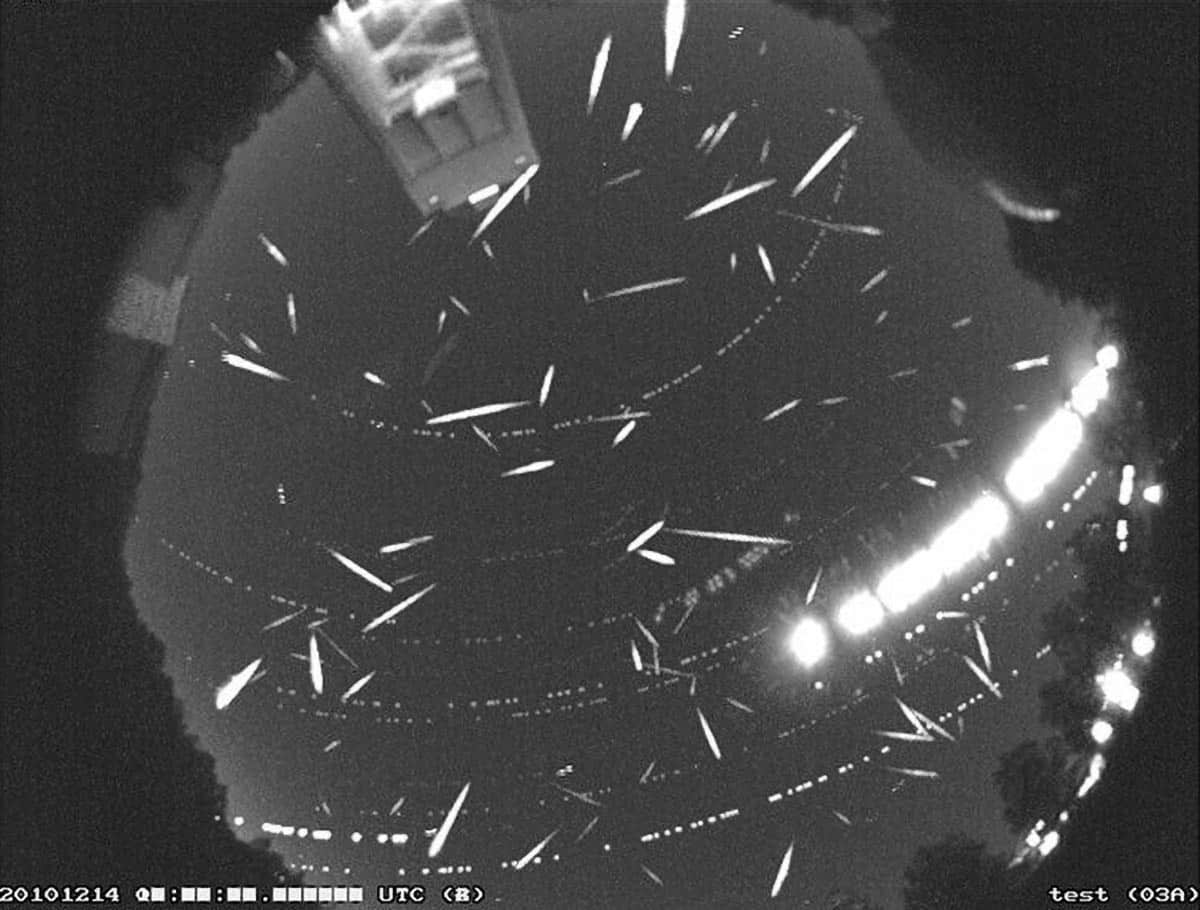
A meteor shower is a night when many more "shooting stars" are visible in the sky than usual. It originates from a stream of dust grains and tiny rock particles that orbits the sun. The Earth crosses the stream at about the same time each year, so the showers return on the same dates.
Most of the streams were born from comets. When a comet approaches the Sun, its ice evaporates. The escaping gas carries dust with it, and the dust spreads along the comet's path. Over hundreds and thousands of years, a "tunnel" of dust forms around the entire path. A few meters were born from asteroids, including the Geminids, the strongest shower of the year.
The grains themselves are very small. Most are the size of a grain of sand or smaller. However, they hit the atmosphere at speeds of 11 to 72 kilometers per second. At an altitude of about 80 to 120 kilometers, the air heats them until they evaporate. The air around them ionizes and glows, and that's the luminous streak we see.
Meteoroid, meteor and meteorite
Three similar terms describe different stages of the same body. Meteoroid It is a grain moving through space. meteor It is the streak of light created when the grain burns up in the atmosphere. A particularly bright meteor is called fire ball Or Bolid. meteorite It broke through the atmosphere and landed on the ground.
Meteorite particles are usually brittle comet dust. Therefore, they all burn up, and almost never reach the ground. Most meteorites found on Earth are fragments of asteroids that are not related to meteorites.
The starting point and rate of meteors
One-meter meteors appear to all come from one point in the sky. This point is called the The Radiant. In reality, the grains move in parallel paths. The feeling that they are spreading out from one point is an effect of perspective, like railroad tracks that appear to converge on the horizon. Each meter is named after the constellation in which its radiant is found. For example, the Perseids emerge from Perseus and the Geminids from Gemini.
The meter's power is measured inZHR, the peak hourly rate. This is the number of meteors an observer would see per hour in a completely dark sky, with the radiant directly overhead. In reality, fewer are seen, due to light pollution, moonlight, and the height of the radiant. When the rate reaches a thousand meteors per hour or more, we speak of a Meteor storm.
The annual calendar of meteor showers
| meter | activity period | Peak (approx.) | ZHR at its peak | Speed (km/s) | Mother's body |
|---|---|---|---|---|---|
| Quadrantids | December 28 to January 12 | January 3–4 | 80 and more | 41 | Asteroid 2003 EH1 |
| to fairs | April 14 to 30 | April 22–23 | 18 | 49 | Comet Thatcher (C/1861 G1) |
| Eta Aquarids | April 19 to May 28 | May 5–6 | 50 | 66 | Halley's Comet |
| Persians | July 17 to August 24 | August 12–13 | 110 and more | 59 | Comet Swift-Tuttle (109P) |
| Dragonids | October 6 to 10 | October 8–9 | 5, with rare outbreaks | 20 | Comet Giacobini-Ziner (21P) |
| Orionids | October 2 to November 7 | October 21–22 | 20 | 66 | Halley's Comet |
| Taurids (South and North) | September 20 to December 10 | November 5–6 and 12–13 | 5–7 | 27–29 | Comet Anka (2P) |
| Leonidas | November 6 to 30 | November 17–18 | 15 and above, with storms | 71 | Comet Temple-Tuttle (55P) |
| Geminids | December 4 to 20 | December 13–14 | 150 | 35 | Asteroid 3200 Phaethon |
| Orcids | December 17 to 26 | December 22–23 | 10 | 33 | Comet Tuttle (8P) |
In 2027, lunar conditions will be good at the peak of the Quadrantids, Atta Aquarids, and Orsids. However, a full moon will greatly interfere with the peak of the Geminids. At the peak of the Perseids, there will be a brief dark window before dawn, after moonset.
The prominent meters
The Perseids: The Summer Shower
The Perseids are the most well-known meteor shower in Israel. They arrive on warm summer nights and are easy to watch. Their parent body is the comet Swift-Tuttle, which orbits the sun once every 133 years. Its nucleus is about 26 kilometers wide, especially large among comets that approach Earth. According to NASA measurements, the Perseids produce more fireballs than any other meteor shower.
The Geminids: The Strongest Shower of the Year
The Geminids are the richest shower, with up to 150 meteors per hour under ideal conditions. Their parent body is not a comet but the asteroid 3200 Phaethon. Phaethon comes as close to the sun as about one-seventh the distance between Earth and the sun, and its surface heats up to several hundred degrees. Researchers David Jewitt and Jing Li recorded Phaethon suddenly brightening near the sun. They believe the heat cracked the rock and released dust. The Geminids' radiant rises in the evening, so they can be seen before midnight.
Leonids: The fastest
Leonids strike the atmosphere at about 71 kilometers per second, the fastest of the large meteors. Most years they are a modest meteor. But Comet Temple-Tuttle returns about every 33 years, and when Earth crosses its young dust trail, a storm is formed. The 1833 storm over North America is considered the starting point of modern meteor research. Strong storms were also observed in 1966 and from 1999 to 2002.
The Quadrantids: A Record of a Few Hours
The Quadrantids open the year. Their peak is sharp and brief, lasting only a few hours. The name comes from a constellation that no longer exists on official maps, "Quadrans Muralis." The parent body was only discovered in 2003: asteroid 2003 EH1, which is probably a comet that has fallen. In Israel, winter cloudiness often makes viewing difficult.
Two meters from Halley's Comet
Halley's Comet visits the inner solar system only once every 76 years. But the dust it leaves behind reaches us twice a year: in the Aquarids in early May and in the Orionids in October. Earth crosses the comet's orbit at two different points.
The Taurids and Draconids
The Taurids are slow and sparse, but are known for their fireballs. Some astronomers are checking to see if their stream also contains large objects, on the order of the size of the object that exploded over Tunguska in 1908. The Draconids are usually very faint, but sometimes erupt. In 2011, more than 400 meteors were observed per hour, and researchers estimated that a ton of material from Comet Giacobini-Ziner entered the atmosphere at that time.
How to watch a meteor shower from Israel
Stay away from the lights. Light pollution in cities wipes out most meteors. It's worth traveling to a dark place, such as the Negev, the Ramon Crater, or the Golan Heights.
Watch after midnight. After midnight, our side of the Earth faces the direction of Earth's motion in its orbit. Just as a car's windshield collects more raindrops, so more meteors are collected. The rate usually picks up until before dawn. The Geminids are an exception, and can be seen as early as evening.
Give up the telescope. Meteors appear in all parts of the sky and disappear in a second. The naked eye is the best tool. It is best to lie down on a comfortable chair or mattress and look at a wide area of sky, not necessarily in the direction of the radiant.
Let your eyes get used to it. The eye needs 20 to 30 minutes to adjust to the dark. Looking at a phone screen starts the process over.
Check the moon. A full or nearly full moon in the sky eliminates most faint meteors. In such a year, it is worth watching during the hours when the moon is below the horizon.
listen. Even on a cloudy night, you can "hear" meteors. The ionized trail a meteor leaves behind momentarily reflects radio waves. An FM receiver tuned to a distant station then picks up its transmission for a second.
What do meteor showers teach science?
Every meter is a free sample of material from a comet or asteroid, arriving to us without a spacecraft. By analyzing the light from meteors, researchers have identified organic materials in the Leonid dust. Automated camera networks around the world now record millions of meteors. From this data, orbits are calculated, new streams are identified, and asteroids that disintegrate near the sun are even discovered. Radars and satellites measure how many tons of space dust land on Earth, and how it affects the upper layers of the atmosphere.
Questions and Answers
Do meteors from a shower reach the ground?
Almost never. Most particles are small and fragile and burn up completely at high altitude. Meteorites found on the ground are usually fragments of asteroids that are not related to meteors.
What is the difference between a meteor shower and a meteor storm?
A normal shower produces dozens of meteors per hour, and at most about 150. In a storm, the rate reaches a thousand meteors per hour or more. Storms occur when the Earth crosses a young, dense dust trail, as in the Leonids.
When is the best time to watch?
At most times, between midnight and dawn, when the radiant is high in the sky and our side of the Earth is facing the direction of movement, the Geminids can be seen as early as the evening.
Do I need a telescope or binoculars?
No. Meteors appear all over the sky and disappear quickly. The naked eye in a dark sky is the best way to view them.
Sources: International Meteor Organization (IMO) 2027 Meteor Shower Calendar; Jewitt & Li, The Astronomical Journal, 2010: Activity of the asteroid Phaethon near the Sun; Ye, Planetary and Space Science, 2018: Meteor showers from active asteroids and dormant comets.
The article is updated annually according to the International Meteor Organization's meter table. It was last updated in October 2026.
More on this subject on Hayadan.com - Science news
- New meteor shower reveals asteroid disintegrating near the sun
- A ton of material was added to the Earth in one meteorite meter
- The November meteor shower contained organic material
- Astronomers will search the Taurid Swarm for objects the size of the asteroid that crashed in Tunguska
- NASA: The Perseids are the shower that produces the most fireballs
