
A study published inScience Describes a new species of ancient ape Masripithecus moghraensis, which lived in northern Egypt about 17–18 million years ago. Researchers believe it is particularly close to the lineage from which all apes living today evolved, and suggest that the origins of this group should be sought not only in East Africa, but also in North Africa and the eastern Mediterranean.
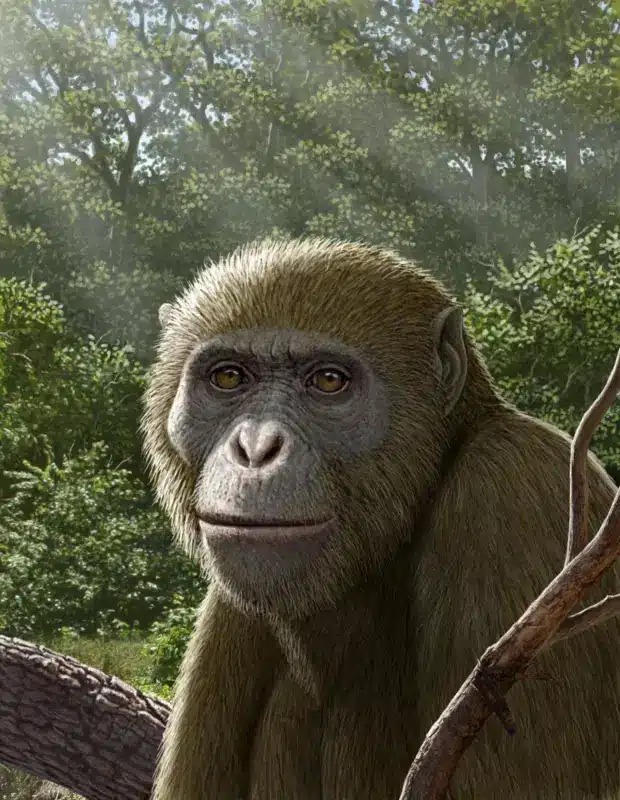
For decades, the search for the origins of the great apes, including the distant ancestors of humans, has focused primarily on East Africa. Now a new fossil from northern Egypt offers a way to expand that map. A team led by Shurouk al-Ashkar of Mansoura University in Egypt has described a new species of ancient ape, Masripithecus moghraensis Discovered in Wadi Mu'ara in the north of the country, this is the first unambiguous fossil of an ancient ape from North Africa from this period, according to the researchers, and may indicate that the region was much more important than previously thought in the early development of the entire group.
It is important to be precise: the study does not claim that man was “born in Egypt,” nor is it a direct ancestor of humans. The claim is more subtle and interesting: Masripithecus It may be particularly close to the lineage that led to all apes alive today—gibbons, orangutans, gorillas, chimpanzees, and humans. In other words, the find dates back to a very early stage in the evolutionary tree, before the much later splits that gave rise to hominins and the genus Homo.
Small fossil, big question
The fossil itself is modest: the remains of a lower jaw and teeth, about 17–18 million years old. But at a time when the fossil record of early apes in Africa is very sparse and geographically scattered, even such a partial remains can be very significant. The researchers note that the fossil record of Africa is uneven: some areas have been studied in depth, while large areas have been almost completely unexplored. So the reason that East Africa has so far been seen as the exclusive center of early ape evolution may be partly due to sampling bias.
To determine where it fits Masripithecus In the evolutionary tree, the researchers used a Bayesian “tip-dating” analysis method, which combines anatomical features with the ages of the fossils. According to their results,Masripithecus He is an ancient monkey (stem hominoid) which is particularly close to the lineage from which all living apes evolved. If this interpretation is correct, it strengthens the possibility that the origin of “modern apes” was not necessarily in East Africa, but perhaps in North Africa, the Levant, or the eastern Mediterranean.
Continental junction between Africa and Eurasia
The time he lived Masripithecus It was a particularly interesting period. At the beginning of the Miocene, land connections existed between Africa and Eurasia, which allowed animals to move between the continents. Therefore, northern Egypt was not an ecological “fringe,” but an important biogeographical junction. The researchers believe that it is precisely in this context that the new find has great significance: it places one of the closest representatives to the root of apes living precisely in the transition zone between Africa and Eurasia.
In the accompanying perspective article inScience , David Alba and Julia Arias-Martorell wrote that paleontologists may have been looking for the ancestors of living apes “in the wrong place.” That’s a harsh phrase, but it captures the central point of the study: The existing picture may not be entirely wrong, but simply too partial. If a diverse population of early apes did exist in North Africa in the early Miocene, then the group’s evolutionary history was geographically broader than we’ve tended to think.
Not a final answer, but a change of direction
As with any major fossil study, there is room for caution here. The fossil is partial, and drawing broad conclusions from a small number of teeth and jaws requires caution. The new study does not “close” the question of the origin of living apes, but rather changes the direction of the search. It highlights how large parts of North Africa and the space between Africa and Eurasia are still poorly represented in the fossil record, and how one significant discovery can shift the center of gravity of an entire scientific debate.
Still, the importance of Masripithecus moghraensis It’s clear by now. He’s not the first hominid, nor even a fully modern ape, but he may be very close to the point where the lineage that eventually led to all living apes—including us—began. So even if the small fossil unearthed in Wadi Mu’ara didn’t rewrite the entire evolutionary story, it certainly opened a new chapter in it.
Amp
badges:
Evolution, Ancient Apes, Egypt, Wadi Mu'ara, Masripithecus, Paleoanthropology, Paleontology, Great Apes, Africa, Miocene, Science
Key phrase:
Masripithecus, Egypt, origin of the great apes
persecuted:
Ancient ape from Egypt, Masripithecus moghraensis, origin of great apes, ape evolution, ancient ape fossil, North Africa and the origin of apes, Early Miocene, lineage of living apes
SLUG:
masripithecus-egypt-origin-of-modern-apes

3 comments
You really are wasting your time. According to Jewish tradition, those who built the Tower of Babel, the Holy One, blessed be He, turned them into monkeys, and their place in the Tower of Babel is the first generation of monkeys.
Not that I know of. Experiments are constantly being proposed to challenge it and they confirm it.
The theory was long debunked.
There is no such thing as evolution from ape to man.