
Possible signs of life on a distant planet? Not so fast. New research suggests the signal may be ordinary molecules, not alien biology.
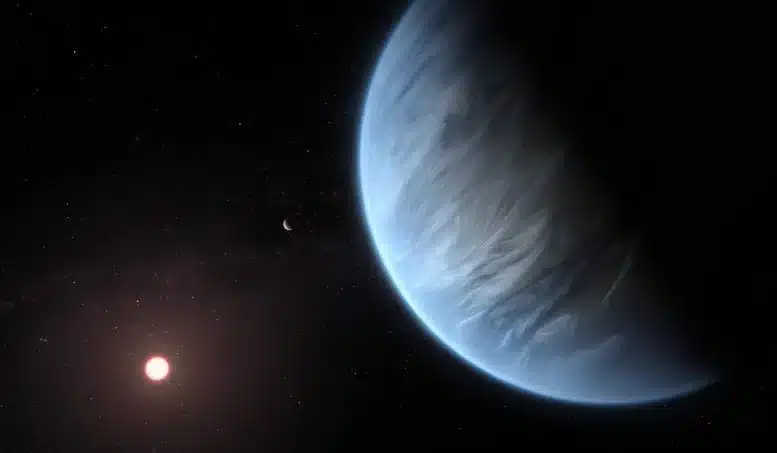
Scientists recently detected a molecule on a distant planet that they thought might indicate life. But now, a new study claims that reading was likely just an ordinary gas — and the evidence isn't as conclusive as it first seemed.
In April, scientists sparked excitement around the world with a bold announcement: They had detected a molecule in the atmosphere of a distant planet that could indicate alien life. But a new study from the University of Chicago casts doubt on that conclusion. After analyzing data from multiple observations of the planet, the team says the evidence isn’t strong enough to support such an extraordinary claim. In fact, other molecules—ones unrelated to life—could just as easily explain what the telescope picked up.
"We found that the data we currently have is too noisy to provide the necessary proof for such a claim," said Rafael Luca, a postdoctoral researcher at the University of Chicago and lead author of a paper detailing their findings, submitted to the journal Astronomy and Astrophysics Letters. "There's just not enough certainty to say one way or the other."
The puzzle of molecules
The original announcement, published on April 16 by a team from the University of Cambridge, focused on a planet called K2-18b, located 124 light-years from Earth. Using the James Webb Space Telescope, they reported signs of dimethyl sulfide or dimethyl disulfide – two molecules that are produced on Earth only by living organisms.
This claim made headlines. But a team from the University of Chicago decided to look into the matter in depth, understanding that extraordinary claims require extraordinary evidence.
Interpreting telescope data isn't easy. Planets like K2-18b are vastly distant and too faint to observe directly, so scientists rely on sophisticated techniques to measure things indirectly.
Light, molecules and clues from a telescope
In this case, the Webb telescope waits until the star passes in front of its parent star, then picks up the starlight that is filtered through the star's atmosphere. As the light passes through the atmosphere, different amounts of light are blocked at different wavelengths, depending on the molecules present.
Michael Zhang, a co-author of the study, explained that when working with such weak readings, it is very difficult to identify a particular molecule unambiguously. “Anything that has a carbon bonded to three hydrogens will show up at a certain wavelength,” he said. “That’s what dimethyl sulfide has. But there are countless other compounds that contain carbon and three hydrogens, and they will show similar characteristics in the ‘web’ data. So even with much better data, it would be difficult to be sure that what we are seeing is indeed dimethyl sulfide.”
Ethan, not aliens?
Their analysis concluded that many other molecules could match what the telescope saw. For example, another molecule with a similar profile is ethane, a gas found in the atmospheres of many planets, such as Neptune, and not indicative of life.
Carolyn Piola-Guraev, a co-author of the study, said that researchers typically favor the simplest explanation when analyzing data: “We should only bring exotic molecules into the interpretation after we have ruled out the molecules we would expect to find in the atmosphere.”
In this case, whether the sign could be dimethyl sulfide or ethane – a molecule we’ve seen around planets in our solar system – they assume the answer is the more common, not the most exciting.
Data gaps and exaggerations
Another doubt arises from the fact that the analysis reported in April was based on just one set of observations. Telescopes, including Webb and Hubble, have made multiple passes of this planet. If you include the data from all of those passes, the team said, the evidence for dimethyl sulfide looks much weaker.
The authors noted that their study was intended to provide a more complete picture of the findings.
Cautious progress in the search for life
"The question of whether there is life outside our solar system is the most important question in our field. That's why we study these planets," Luca said. "We are making tremendous progress in this field, and we don't want that to be derailed by premature statements."
More on this subject on Hayadan.com - Science news:

2 תגובות
Unfortunately, we invest endless resources in space exploration, and the products we have received to date are a few rocks and theories whose reliability is questionable.
Instead of exploring and exploiting these resources for what we have right under our noses and within reach, explore and exploit what lies in the soil, which is a precious resource with the potential to discover immense natural treasures, and explore the seas and oceans that would help the economy and well-being of all citrus on Earth.
The order of research priorities is illogical!!
The reason for this is probably that the budget does not belong to individuals but to countries, and in any case, wasting resources is not the researchers' top concern.
Since morals have deteriorated in the United States.
The ability to draw conclusions also decreased.
People create a commotion in order to get budgets.
Like fusion. They managed to last 18 minutes. I'm intentionally exaggerating. They managed half an hour and then it was all over.
Obviously this is a lie.
Who criticizes the times and who even trusts China?
We do not have the ability to do science today.
We need hundreds of years if we are to survive until then.