
After the historic landing on the moon, the American company is collaborating with Space Forge to develop a commercial return system – towards producing pure crystals in orbit around the Earth for the global chip market.
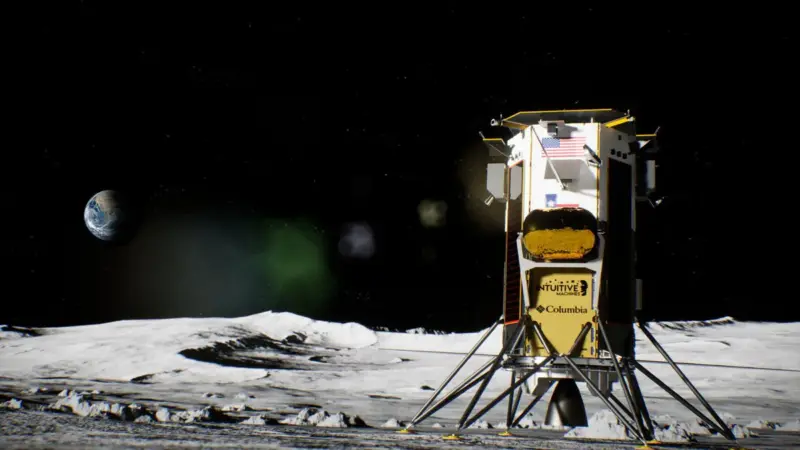
Will the next generation of chips be created outside the atmosphere? New collaboration between the American space company Intuitive machines To the British technology company Space Forge Designed to lay the foundation for the space chip manufacturing industry – including designing a commercial launch and return system that can return advanced microelectronic components manufactured in microgravity conditions.
In the past year, Intuitive Machines has gained widespread international exposure after making history as the first private American company to successfully land a probe on the lunar surface. The landing, carried out in February 2024 as part of NASA’s IM-1 mission, was also the first soft landing by the United States on the moon in more than 50 years. The achievement solidified the company’s position as a strategic partner to space agencies, defense industries, and advanced technology companies – and provides it with a broad base of trust to lead future space infrastructure, including commercial extra-atmospheric manufacturing projects and the return of scientific and sensitive payloads to Earth. This spacecraft is not yet capable of returning samples from the moon to Earth, but it was a demonstration of capability.
The Earth Orbit Sample Return Initiative is funded by a grant from the Texas Space Exploration and Research Fund and includes a 12-month initial phase to develop a prototype orbiter, including a critical design review (CDR) and construction of a full-scale ground model. This is a milestone toward commercial return flights, which will also be used for future projects such as lunar sample return and sensitive medical or biotech payloads.
Microgravity technology for precision manufacturing
One of the goals of the collaboration is to derive physical advantages unique to space conditions – primarily microgravity.Space Forge It is emphasized that the production of seed crystals in a weightless environment allows for a uniform and defect-free structure, unlike conditions on Earth. These crystals will serve as the basis for extremely precise wafers, from which thousands of advanced components can be manufactured without structural defects.
According to Michelle Fleming, President of Space Forge:
"Our vision is pure chips of a quality never before achieved on Earth. But for that to happen, there must be a reliable launch and return capability, which will close the production loop."
Adapting to the market, not just to the space
The project is unique in that it is designed in advance according to commercial requirements: the companies Space Forge and Rhodium Scientific (which specializes in space biotechnology) are developing dedicated payloads, which dictate the environmental, safety, and engineering requirements for the return vehicle. In other words, the system is not being built as a space technology alone – but as a transportation vehicle that will be integrated into an ecosystem of advanced industries that seek to produce components in extra-atmospheric conditions and return them safely.
Prof. Tim Crane, CTO of Intuitive Machines, explained:
"The value of space exploration is measured by what we manage to bring back from it. For this to be possible, a routine, accurate, and available return infrastructure is required. We are building this infrastructure with the support of the State of Texas and with world-class technology partners."
Strategic Context: Security, Industrial Independence, and Global Competition
Intuitive Machines emphasizes that the ability to return essential materials from space is not only a technological necessity but also a national strategic goal – especially given the dependence of Western markets on chips from Asian production. The ability to produce precise chip components in low orbit and return them to Earth in a controlled location could in the future constitute a commercial and security alternative for sensitive industries in the fields of electronics, biomedicine, energy, and more.
Where is it going?
At this stage, the plan is to complete the ground model and engineering review by early 2026. The companies are then expected to raise additional funding, expand the pool of partners, and move forward with building the first flight model. At the same time, a dialogue is underway with US government institutions regarding the adaptation of civilian landing infrastructure, investment encouragement, and appropriate regulation.
Absolutely, here is the scientific explanation of crystal defects and the advantages of manufacturing in space – formulated in clear, continuous paragraphs for publication as a follow-up article or addition to the main article on the site. Hayadan:
How do space conditions enable the production of chips of a quality never achieved on Earth?
The basis of most modern electronic components – from chips to sensors – is a crystal. It is an ordered structure in which atoms form a regular lattice, and its structural precision is critical to the electrical function of the material. However, when crystals are grown on Earth, structural defects are often created, which can disrupt performance and even cause malfunctions at the component level.
Such defects include, among others, point defects (missing or foreign atoms), row defects (deviations of rows of atoms), grain boundaries (transitions between crystal regions in different directions), and the confinement of contaminants such as oxygen or metals. The origin of the defects is often in the physical conditions of the growth environment: gravity creates currents of heat and material within the molten liquid, which cause non-uniformity in the composition of the material. In addition, heavy materials tend to sink downwards during the growth process, which causes varying concentrations and structural defects.
This is exactly where space comes into play. In orbit around the Earth, microgravity conditions prevail, meaning that the force of gravity is almost imperceptible. This means that phenomena such as convection, thermal convection, or the deposition of impurities have almost no effect. The material solidifies slowly and uniformly, without mechanical or thermal disturbances, and the result is clean, homogeneous crystals free from structural defects.
For the chip industry, this is a real breakthrough. For example, Space Forge plans to produce the highest quality seed crystals in space, and then use them on Earth to create defect-free silicon wafers. Each such wafer could allow the production of thousands of precise chips, compared to just a few dozen with regular crystals.
The technological implications of this could be broad: quantum computing chips, neuromorphic processors, high-resolution medical sensors, and components operating at extremely high frequencies. When you add to this the growing need for advanced chips in the artificial intelligence, national security, and communications industries, the potential for extraatmospheric manufacturing goes from an experimental idea to a real industrial infrastructure.
The bottom line is that space conditions are allowing for the first time the production of near-perfect crystals—a component that has been limited by the laws of Earthly physics. As launch and re-orbit capabilities improve, we may see the chip industry begin to “take off”—literally.
More on this subject on Hayadan.com - Science news:
