
An international group of astronomers reported the discovery of the third confirmed interstellar object to enter our solar system on July 3. Now they continue to monitor the approaching comet
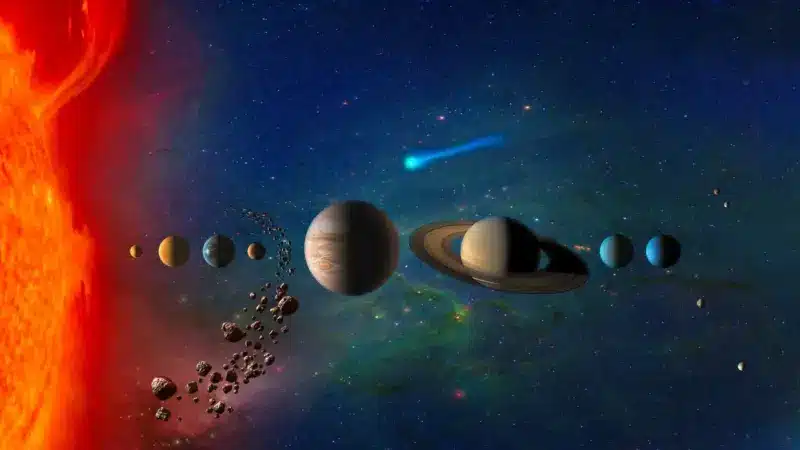
As we have already published, Astronomers have identified 3I/ATLAS, a rare interstellar visitor that may hold secrets from the galaxy's distant past. Its unusual speed, size, and possibility of being made of ice make it a tempting target for future observations with space telescopes. Credit: NASA/JPL-Caltech
An international group of astronomers was the first to report the discovery of the third confirmed interstellar object to enter our solar system. The announcement was made on July 3.
Following the discovery, Esther Taylor of the University of Michigan's Department of Astronomy and Daryl Seligman of Michigan State University co-authored a new study that begins to examine the properties of the newly identified object, called 3 I/ATLAS.
Unlike objects formed within our solar system, interstellar objects are formed elsewhere in the galaxy and pass by us without gravitationally binding to the Sun. The arrival of 3I/ATLAS, along with the two previous interstellar visitors, provides researchers with rare and valuable opportunities to study distant galactic environments.
Public interest and future disclosures
"That's exactly the goal – to find objects like this, to expose them to the public," says Esther Taylor,
Public enthusiasm is essential to sustaining support for funding and developing advanced technologies that enable future discoveries. An example is the Vera C. Rubin Observatory, which began operating this summer with support from the U.S. National Science Foundation (NSF) and the U.S. Department of Energy. Although it was not responsible for the 3I/ATLAS discovery, Taylor notes that the observatory is expected to detect one or two interstellar objects each year.
“This is a good time to find fascinating objects,” Taylor says. “We’re excited about three, but if we get to ten or more, that would be a reasonable sample size and it would be even more interesting and exciting.”
Both reports are available as pre-publication on arXiv.
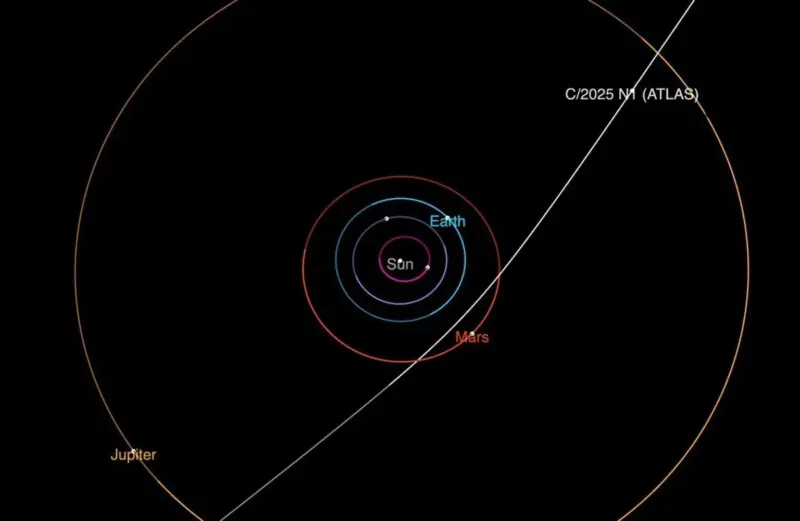
NASA's ATLAS (Asteroid Terrestrial-impact Last Alert System) system made the discovery of 3I/ATLAS possible. The system includes four telescopes – two in Hawaii, one in Chile and one in South Africa – that automatically scan the entire sky several times each night to detect moving objects.
As its name suggests, ATLAS is designed to detect potential threats to Earth, but in this case there is no danger. The object will not collide with Earth and will remain at a distance greater than the distance between the Earth and the Sun.
Taylor notes that 3I/ATLAS is likely a comet. It is surrounded by a coma – a blanket of gas and dust that forms around the solid nucleus. As it approaches the sun, the coma is expected to change, providing insights into the comet’s composition.
"It's likely that 3I/ATLAS contains ice, especially below the surface. These glaciers may start to boil as it gets closer to the sun," says Seligman, a postdoctoral fellow at MSU, "but until we detect specific gas emissions like H2O, CO or CO2, we can't determine for sure what types of ice and how much of each are present."
Waiting for answers from space telescopes
In the coming months, space telescopes, including the Hubble Space Telescope and the James Webb Space Telescope, will be able to focus on 3I/ATLAS to examine questions about its size, rotation, and response to heating.
"We have images of 3I/ATLAS where it's not all clear and it looks dimmer than the other stars in the same image," says Professor James Ray of the Georgia Institute of Technology, who co-discovered it. "The object is quite far away, so we just don't know."
Despite this, the researchers were able to characterize several important features from the initial observations. 3I/ATLAS is faster, larger, and older than its predecessors, 1I/I 'Oumuamua and 2/I Borisov.
3I/ATLAS has a hyperbolic velocity of just under 60 kilometers per second – about 130 miles per hour, which is about 209 kilometers per hour – compared to 26 for Oumuamua and 32 for Borisov. The diameter of 3I/ATLAS is currently estimated to be up to about 10 kilometers (about 6 miles), which is 100 times that of Oumuamua and 10 times that of Borisov.
However, Taylor predicts that these estimates will decrease as better observations are obtained. Such a large size suggests that galactic production of such objects is occurring at a rate that is physically improbable.
Finally, while the ages of Oumuamua and Borisov are estimated to be in the millions of years, the age of 3I/ATLAS is estimated to be 3 to 11 billion years.
"That's a wide range," Taylor says. "But 11 billion years is pretty old. Almost the age of the galaxy."
Here too, Taylor estimates that future estimates will be on the low end of the range. Either way, the finding is interesting, as it may shed light on how stars, planets, and other objects formed in our galaxy in the early stages of its development.
Race to verify the object
Taylor was recruited to the project while she was traveling to help confirm that 3I/ATLAS was an interstellar object and to perform early characterizations. Time was of the essence. If the ATLAS team had detected 3I, it was likely that other astronomers had noticed it too, and the team wanted to confirm their suspicions and get the news out first.
"I was on a full vacation in Fiji with my family when it was announced. When I heard, I thought, 'This is so exciting, but it's also more stressful than you think."
Seligman got a little more notice, but not much. The news started rolling around the group on July 1.
“I had heard something about the object before I went to bed, but we didn’t have a lot of details yet,” Seligman says. “When I woke up around 1 a.m., my colleagues Marco Miceli of the European Southern Observatory and Davide Fernuchia of NASA’s Jet Propulsion Laboratory had already sent emails saying it was probably real. I started sending messages to everyone to point their telescopes at the object.”
Final verification and follow-up
Larry Denau of the ATLAS team examined and sent the discovery observations from ESO's VLT telescope in Chile shortly after the observation.
“We’ve had false alarms about interesting objects in the past, so we know not to get too excited on the first day,” says Danao. “But the incoming observations were consistent, and by early tonight it looked like the real thing.”
John Tonery, an ATLAS team member and professor at the University of Hawaii, was instrumental in the design and construction of ATLAS – the survey that discovered 3I.
"It's gratifying every time our hard work scanning the sky reveals something new, and a comet that has wandered millions of years from another star system is a particularly intriguing object," he says.
After 3I/ATLAS was validated, Seligman and Karen Meech, chair of the Institute for Astronomy at the University of Hawaii, handled communications and worked on data collection for the paper submission.
“Once 3I/ATLAS was identified as likely interstellar, we acted quickly,” says Mitch. “We activated observing times at key facilities like the SOAR telescope and the Gemini Observatory to capture early, high-quality data and create a foundation for detailed follow-up studies.”

More on this subject on Hayadan.com - Science news:

3 תגובות
They say it's an alien spacecraft, according to most reports from around the world.
Maybe it's worth checking out anyway
Response to a Tel Aviv University article on the perception of truth:
Wonderful. This way we can be more careful about lying, and be more careful to "keep away from false speech" (Exodus, chapter 23, verse 7).
proofreading suggestions:
1) "Making it an intriguing destination" (first photo caption)
2) "Pending answers from space telescopes… will space telescopes be able to…" Does the first "telescopes" refer to ground-based telescopes?
3) "I1/Oumuamua and I2/Borisov"
4) "26 for Oumuamua and 32 for Borisov" – 26 and 32 what? Kilometers per second? Miles per hour? Kilometers per hour?
5) ""...When I heard, I thought to myself: " Taylor says." What did she think?
Could it be that artificial intelligence participated in writing the article?