
According to an analysis by researchers at Leiden University in the Netherlands, evidence in medieval chronicles indicates that the monk Aylmer of Malmesbury linked observations in 989 and 1066 to the same periodic comet — hundreds of years before Halley established the periodicity using data from 1531, 1607, and 1682.

Many associate Edmund Halley with the discovery of the recurring orbit of the comet that bears his name, but a new study suggests he was not the first to recognize its cycle. According to research by Professor Simon Porthuis Zwart and others, a medieval monk made the connection centuries earlier. In the 11th century, Aylmer of Malmesbury apparently realized that two comet observations separated by decades were of the same body.
References to these observations appear in the writings of William of Malmesbury, a 12th-century chronicler. Although preserved in historical texts, this evidence has been largely ignored by modern scholars until now. Porthuis Zwart of Leiden University in the Netherlands and his co-author Lewis argue that Aylmer, also known as Aethelmer, personally witnessed both appearances of the comet. Their analysis is presented in the book
Dorestad and Everything After. Ports, townscapes & travelers in Europe, 800-1100.
Halley identified the periodicity of the comet
Several centuries later, Edmond Halley used systematic observations and calculations to prove that a bright comet recorded in 1531, 1607, and 1682 was the same body that returned on a regular schedule.
This comet, later designated 1P/Halley, moves on an orbit that returns it to the inner solar system approximately every 76 years, a discovery that was a major step forward in the science of astronomy.
Observations around the world in 1066
One of the earliest returns of the comet occurred in 1066 and was recorded far beyond Europe. Chinese astronomers observed it for over two months, providing some of the most detailed early records. The comet reached its peak brightness on 22 April 1066, but observers in Brittany and the British Isles did not see it until 24 April.
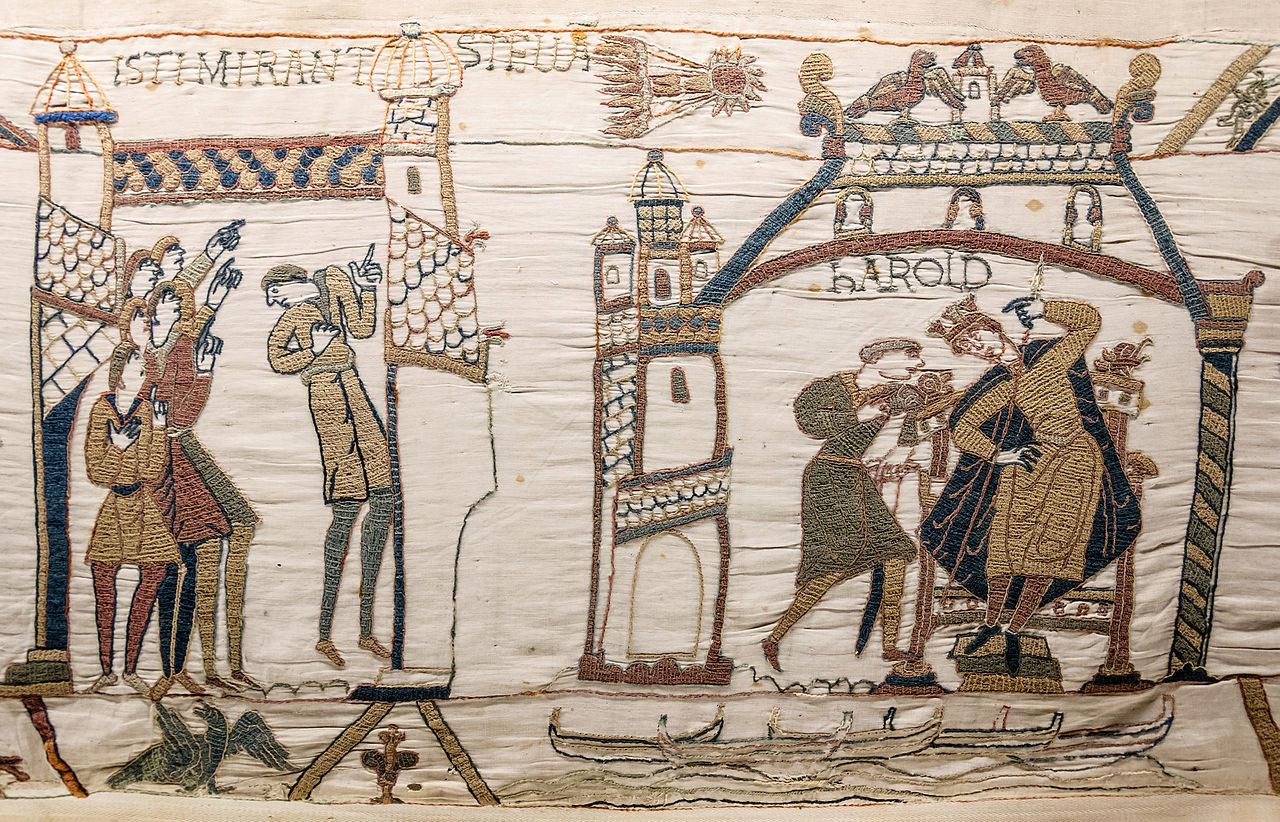
His appearance was later immortalized in a Bayeux tapestry, in which he appears as part of the visual record of the dramatic events of that year.

Appearances of comets as signs of things to come in medieval chronicles
The comet appeared during the short reign of King Harold Godwinson, from 6 January to 14 October 1066. A study of sources by Porthayes Zwart and Lewis shows that the comet was seen five times in the centuries surrounding this date. Oral tradition associates these appearances with the death of kings, war or famine in the British Isles.
An unrecorded comet, said to have appeared before the death of Archbishop Sigric of Canterbury in 995, could be interpreted as the historical equivalent of fake news, or as an exaggeration of events, apparently intended to frighten the British inhabitants with God's wrath for the sins of the people.
The monk Ilmar – or Ethelmar – of Malmesbury must have been old when he saw Halley’s Comet for the second time in 1066. He realized that he had seen the same comet before, in 989. Again, as was customary at the time, the king was warned of an impending disaster.
Change the name
The researchers argue that Halley's Comet should be given a different name, because it had already been observed twice centuries earlier. Porthuis-Zwaart says: "It was great fun to do this research, but it was also challenging to work on such an interdisciplinary project alongside a historian. Nevertheless, we intend to continue studying this type of periodic comet."
More on this subject on Hayadan.com - Science news:


2 comments
Beautiful article, and a thought-provoking argument. However, I still think that Halley's comet should be named after him. Halley had three observations and two time differences. So he could compare the time differences between the appearances, and conclude that this is a periodic appearance caused by a celestial object. In contrast, the monk had only two observations and one time difference. So he could prove that these are events that are merely similar, nothing more.
How could this monk prove that it was a comet? How could he prove periodicity? Halley had three observations and two time differences. So he could compare the time differences between the appearances, and conclude that it was a periodic appearance caused by a celestial object. In contrast, the monk had only two observations and one time difference. So he could prove that these were events that were merely similar, nothing more.