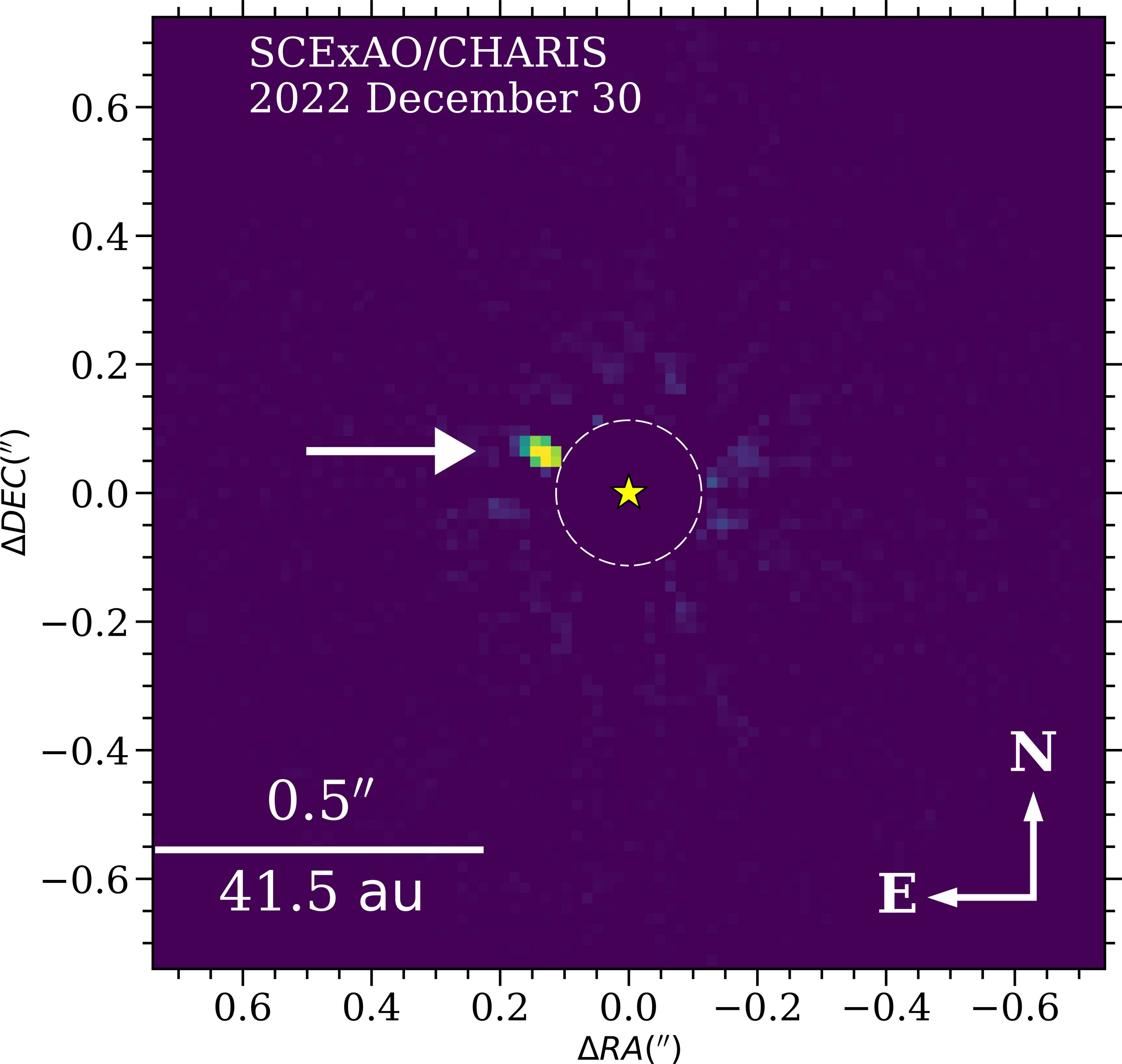
The discovery includes HIP 54515 b (a giant planet) and HIP 71618 B (a brown dwarf), both of which were directly imaged using SCExAO after detecting an “acceleration” in the motion of the stars in Gaia and Hipparcos data; the brown dwarf could serve as a key test target for the Roman Space Telescope’s coronagraph

Using the Subaru Telescope in Hawaii, astronomers have identified two distant companions: a giant planet and a brown dwarf, each orbiting its own star. These objects are the first discoveries of the OASIS project, which combines space-based measurements with Subaru's advanced imaging to reveal previously hidden worlds. Together, these findings are vital targets for NASA's upcoming Roman Space Telescope, which will use them to test critical technologies needed to image Earth-like planets.
Today, only about 1 percent of stars are known to have planets and massive brown dwarfs that can be directly imaged with existing telescopes. Even in young planetary systems where these bodies still glow with the heat left over from their formation, making them brighter and somewhat easier to detect, they are still much dimmer than the stars they orbit and are easily overwhelmed by the starlight. As a result, astronomers have a hard time figuring out where to look for these faint companions in the first place.
how OASIS finds the best candidates
This is where OASIS comes in. The program analyzes precise measurements from two European Space Agency missions, Hipparcos and Gaia, to find stars whose motions indicate the gravitational pull of unseen companions. Once such stars are identified, OASIS observes them using Subro’s SCExAO system, which provides the exceptional precision and image quality needed to directly image these hidden objects.

Massive planet in Leo וBrown dwarf in the bear herd
The newly discovered planet, HIP 54515 b, orbits a star 271 light-years away in the constellation Leo. With a mass nearly 18 times that of Jupiter, it orbits its star at about the distance of Neptune from the Sun.
But the star and planet appear very close when seen from Earth, about the size of a baseball from 100 km away. The SCExAO system produces very sharp images, allowing us to see the planet.
The second discovery, HIP 71618 B, is a brown dwarf 60 times more massive than Jupiter and located 169 light-years away in the Ursa Major constellation. Brown dwarfs are sometimes called "failed stars" because they form like stars but never gain enough mass to sustain nuclear fusion.
A critical target for NASA's novel telescope
HIP 71618 B is special because of its properties that make it well-suited for observation by the Roman Space Telescope. Roman will carry a technology demonstration to test coronagraph systems that future telescopes will need to image Earth-like planets around other stars—planets that are ten billion times fainter than their stars.
More of the topic in Hayadan: