
For years, "Pumlehut b" served as one of the most famous examples of a directly observed extrasolar planet. Now it has been discovered that the observed body was not a "mature" planet and that the observed light is the result of collisions in the planetary cloud in the forming system.

For years, “Pumlehut b” served as one of the most famous examples of a directly observed exoplanet: a point of light near the star Pummelhut, about 25 light-years from Earth, in the constellation of the Southern Fish. Pummelhut is more massive than the Sun and surrounded by belts of dust and debris, making it an excellent target for tracking. But now astronomers are offering a completely different explanation: not a planet, but a glowing dust cloud created by a violent collision between two large rocky bodies. Then came the twist: another cloud appeared in the system, remarkably similar, as if someone had turned on a new light inside the dust belt. The object was first reported in 2008 and became an icon of direct imaging. But even then, there were researchers who claimed that it was a spreading dust cloud, not a planet, in this system itself.
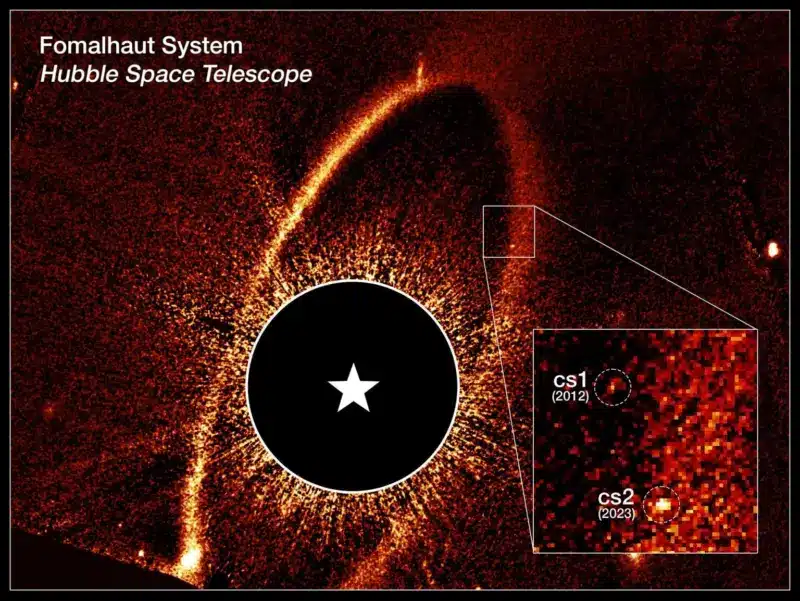
The discovery was based on years of observation by the Hubble Space Telescope. At first, the researchers thought the point of light was a planet reflecting the star’s light, perhaps shrouded in dust. But over time, it faded, as one would expect from a cloud that is spreading and expanding. In 2023, when the team returned to image the system, the original source of light was no longer visible. In its place appeared a different, slightly shifted point of light. “The original intention was to monitor Pummelhaut b, which we thought was a planet,” says Dr. Jason Wang of Northwestern University, “but when you carefully compare it to past images, it turns out that it is not the same source.”
Two collisions, two clouds of dust

The team, led by astronomer Paul Calles of the University of California, Berkeley, now classifies the two sources as debris clouds: Pummelhot cs1 (the vanished “star”) and Pummelhot cs2 (the new source). The two clouds are thought to have formed in two separate collisions of planetesimals—the rocky “building blocks” of planets, which are similar to asteroids but can be much larger. After the impact, fine dust becomes visible in reflected light, and starlight can even push the dust grains outward and change the shape of the cloud.
To check that the signal was not a hoax, Wang was one of four independent researchers who confirmed the detection of two short-lived events in the dust belt. “This is an unusual result, so it was important for us to make sure we could trust the data,” he says. The fact that two clouds appeared in just 20 years or so highlights how dynamic the system is. Simple theories would expect such an event to occur once every 100,000 years or so. So the “flashes” of Pummelhaut could suggest that the environment there is more collision-rich than we thought. Or it could be a rare case of “observational luck.”
What does this mean for planet searches?
Beyond the dramatic story, there’s a lesson here that’s especially important in an era when next-generation observatories are trying to image planets in reflected light, including in the world of giant telescopes like the Giant Magellan. A dust cloud can look just like a planet: a bright spot, in the right place, reflecting light. “What we learned from CS1 is that a large dust cloud can ‘disguise’ itself as a planet for years,” says Kals. This means that future measurements will need more rigorous tests. For example, long-term monitoring, color checks, and looking for changes in brightness and shape that are characteristic of expanding debris clouds rather than a solid body in a stable orbit.
The article, published on 12-18-2025 in the journal Science, also brings the question of the “materials” that make up planetary systems back to center stage. The collision of planetesimals releases dust and ice. In some cases, it can reflect processes that accompany the formation of planets. Wang notes that even in the context of planetary defense, there is value in better understanding collisions and rocky bodies, against the backdrop of missions like DART.
Next step: James Webb Space Telescope
Hubble provided the surprise, but the chemical and physical diagnosis is expected to be done by the James Webb Space Telescope. The team was given observation time with the NIRCam camera. It will be able to provide color data that helps estimate the sizes of the dust grains and their composition, including whether there is water and ice in the cloud. In this way, the researchers will try to determine which were the two “parents” that collided, and see how CS2 disperses over time.
If the tracking is successful, Pummelhot will become a rare natural laboratory: a place where we can see, on human timescales, the violent events that shape planetary systems. At the same time, it will remind the scientific community — and the public — that not every point of light near a star is a planet. Sometimes it’s simply the temporary signature of a celestial crash.
More on this subject on Hayadan.com - Science news:
