
An ultra-short-period (USP) planet is spiraling toward destruction in about 31 million years. Its extreme heat and high density hint at a violent past.
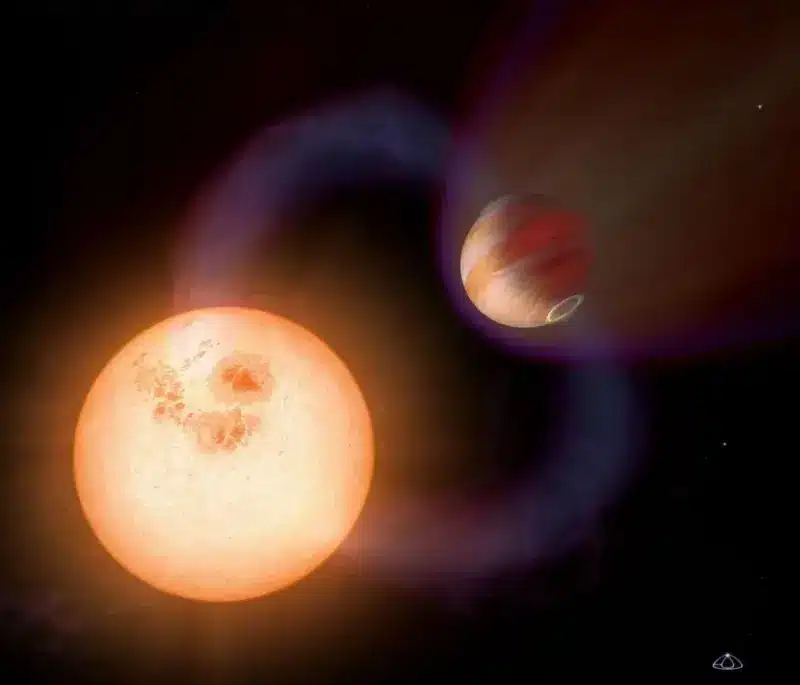
Our conditions here on Earth can distort our view of the universe. Our planet, with its blue skies and mild climate, is unusual. Nowhere else in the solar system has similar conditions, and research on planets outside the solar system points in a similar direction. There are very few planets that suggest compatibility with life. Most are harsh and hostile.
Ultra-Short Period (USP) planets are among the most extreme and uninhabitable categories. They complete an orbit in less than one Earth day, and are therefore very close to their parent star. At such distances, the surface is hot enough to melt, and any atmosphere that once existed has likely been ripped away by the star's intense radiation. This proximity is also dangerous: strong tidal forces can tear them apart or cause them to spiral inward until they are swallowed by the star.
Discovery TOI-2431b
Using data from TESS and other observatories, astronomers have identified an ultra-short-period planet with an extremely short orbital period of 5 hours and 22 minutes. The findings are detailed in a study submitted to Astronomy & Astrophysics under the title: “An Earth-Sized Planet in a 5.4h Orbit Around a Nearby K dwarf”. The lead author is Kaya Han Taş, of the Anton Panenkoek Institute for Astronomy, University of Amsterdam.
The planet TOI-2431 b stands out for its extremes. It orbits its parent star more than four times per Earth day. It has one of the shortest orbital periods known. Of the more than 6,000 confirmed planets, only a little over a hundred belong to the USP category.
Time scale for tidal disruption to planets USP
Among USP planets, TOI-2431 b has an exceptionally short predicted time to tidal disruption: about 31 million years. (Tas et al. 2025, A&A)
TOI-2431 b is definitely tidally synchronous: one side always faces the star. The temperature on its surface exceeds 2,000 Kelvin (≈1,700°C; ≈3,140°F), making it likely a molten lava world. Unlike Earth, which went through a brief phase of a magma ocean and then cooled to a solid crust, this planet remains in a perpetually hot state.
Evidence of a greater past
TOI-2431 b has a mass of about 6.2 Earth masses but a radius of about 1.5 Earth radii. The density indicates an intense history. The data suggest that it was once larger, but was flaked off to its rocky core due to prolonged exposure to intense radiation from its parent star.
According to the researchers, TOI-2431 b is on a trajectory toward a dramatic end: “TOI-2431 b’s short orbital period suggests strong tidal interactions with its host star, which could lead to tidal distortion and orbital decay,” they write. The star’s immense gravity warps the planet so that its short axis is about 10% shorter than its long axis.
Beyond being a rare example of extreme planetary conditions, TOI-2431 b provides an opportunity to study the physics of such environments. The brightness of its host star gives it a high value on the Emission Spectroscopy Metric (ESM) — 27 — making it, according to the authors, one of the most suitable USP systems for analyzing atmospheric phase curves. Emission spectroscopy measures light at different wavelengths to identify elements and molecules — in this case, in the planet’s atmosphere (if it survives). The metric ranks planets by potential for further atmospheric studies using instruments like the James Webb Space Telescope (JWST), which has limited operating time, so it’s important to choose targets carefully.
But the most important thing is the end of the battle.
Dangerously close to destruction
The Roche limit (Roche radius) is the distance from a massive body that a smaller body would not survive if it crossed. Within the limit, the star's gravity can tear the planet apart. The same is true for planets and their moons; some speculate that Saturn's rings are the remnants of moons that broke apart after crossing the limit.
Tidal interactions don't just distort. They also dissipate orbital energy, "leading to an inward spiral of the planet toward the parent star," the authors write.
TOI-2431 b is approaching this limit. “We estimate that the current orbital period is only about 30% larger than the orbital period at the Roche limit, and that the expected orbital decay time is about 31 million years,” the authors explain. In astronomical terms, that’s a very short time: 31 million years is a tiny fraction of the age of the Earth (about 4.5 billion years).
Why distant worlds matter
A distant planet like TOI-2431 b won’t change our personal lives. But it, and others like it, provide context for our existence. Each planet—however hostile and terrifying—is another piece of the cosmic puzzle. They remind us how lucky Earth is, and how extraordinary the emergence of life and intelligence is.
This understanding explains why it is important to build telescopes and study the universe. Even a hot, atmosphereless, lava world, elongated and racing toward destruction, teaches us beyond statistics and characteristics. Perhaps such “terrible” worlds will teach us humility—and stop taking Earth’s biosphere for granted.
Source
“An Earth-Sized Planet in a 5.4h Orbit Around a Nearby K dwarf” — Kaya Han Taş et al., July 11, 2025, arXiv.
DOI: 10.48550/arXiv.2507.08464
More on this subject on Hayadan.com - Science news:

3 comments
Really nonsense. The Earth itself is racing towards its destruction because humans pollute the environment, harm animals, and a long list that I don't feel like writing here. And you beautiful souls are writing here about another planet.
What is this nonsense? Conditions for existence on Earth, even on Earth there are impossible conditions for existence, and there are fish and monsters in the depths of the ocean. They adapt themselves. Even bats can see without light.
The Earth will be extinct long before