
Scientists are beginning to unravel how microbial systems, shaped by billions of years of evolution on Earth, might be recruited to build the first shelters on Mars. By examining how certain microbes communicate, mineralize their surroundings, and adapt to extreme conditions, researchers are investigating whether life itself could become a building tool in environments where conventional engineering fails.

New research shows how specialized microorganisms may transform Martian regolith into durable structures that support life.
Since humans first set foot on the moon, the idea of extending civilization beyond Earth has guided major space agencies in planning for long-term life beyond our planet. Of all the nearby worlds, Mars stands out as the most likely destination for future settlement. Its vast landscapes and Earth-like features make it an enticing target for exploration, but establishing a sustained human presence there remains one of humanity’s most ambitious scientific and engineering challenges.
The planet we see today is very different from the Mars of the distant past. Billions of years ago, it was enveloped in a thicker atmosphere, which has since dissipated, leaving behind conditions very different from those on Earth. Modern Mars offers thin, carbon dioxide-rich air, an atmospheric pressure less than one percent of that on Earth’s surface, and temperatures ranging from minus 90 degrees Celsius to about 26 degrees Celsius.
The combination of extreme conditions, pervasive cosmic radiation, and the complete absence of breathable air makes it clear that creating a shelter on Mars requires much more than just basic structures. Any future habitat must function as a protective and life-support system, designed to withstand an unforgiving environment. Because transporting building materials from Earth is very expensive and unsustainable, researchers are turning to in situ resource utilization (ISRU), which relies on converting local resources on Mars into useful building components.
Dr. Shiva Khoshtinat, a postdoctoral fellow at the Department of Chemistry, Materials and Chemical Engineering "Giulio Natta" at Politecnico di Milano, has contributed to the emerging research through work that draws on her broad multidisciplinary background in civil engineering, architecture, materials science and biology to transform local raw materials into Martian infrastructure.
Her research examines how natural processes, particularly biomineralization and microbial co-cultures, can serve as self-regulating building systems. In a paper published in Frontiers in Microbiology, Dr. Khoshtinat and her colleagues present a new concept for building on Mars, exploring how interactions between microorganisms could convert Martian regolith into strong and useful materials. Their findings outline the initial scientific foundation for building the first durable habitats on the Red Planet.
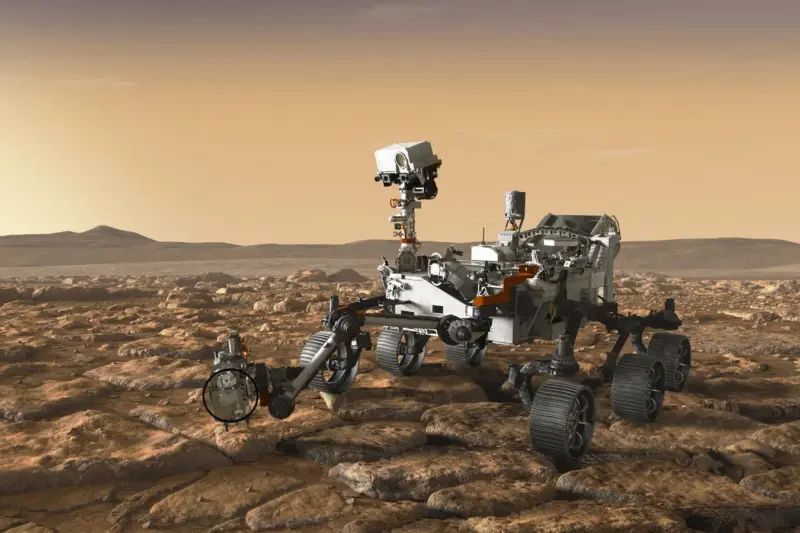
As NASA's Perseverance rover collects samples from Jezero Crater—a site shaped by an ancient river system—scientists continue to search for signs of ancient life on Mars. These efforts raise an intriguing question: If microorganisms existed on Mars in the past, could similar microbial strategies one day help humans build a future home there?
Billions of years ago, life on Earth began with humble microorganisms found in shallow ponds and seas. These “quiet engineers” transformed our planet from the ground up—from enriching the atmosphere with oxygen to building resilient coral reefs that endure to this day. Now, as humanity turns its gaze to the skies, these tiny creatures may hold the key to transforming a barren world into a vibrant home.
Our research is breaking new ground, inspired by nature. In a multidisciplinary international effort, we have come together to harness a fascinating natural phenomenon: biomineralization. In this process, microorganisms – including bacteria, fungi and microalgae – produce minerals as part of their metabolism. Such processes have shaped Earth’s landscapes for billions of years. The same microorganisms, which are able to survive not only in familiar waters but also in extreme environments such as acidic lakes, volcanic soils and deep caves, may reveal the level of flexibility needed to adapt to Martian conditions.
Drawing on data from Mars rovers on the composition of the (regular) Martian soil, our study examines different microbial mineralization pathways to discover which ones could create strong materials for building human habitats on Mars, without risking interplanetary contamination. Of the possible pathways, biocementation – using microorganisms to create natural cement-like materials, such as calcium carbonate, at room temperature – stands out as the most promising solution. At the heart of the study is a partnership between two unusual bacterial species: Sporosarcina pasteurii, a well-known bacterium that produces calcium carbonate through the process of ureolysis, and Chroococcidiopsis, a hardy cyanobacterium known to survive in extreme environments, including simulated Martian conditions.
Together they form a powerful partnership. As part of the respiration process, it releases oxygen into the environment, creating a more favorable microenvironment for Sporosarcina pasteuri. In addition, the extracellular polymeric substance that Chrococcidiopsis secretes forms a kind of shield that protects the sporosarcina from harmful UV radiation on the surface of Mars. In return, the sporosarcina secretes natural polymeric substances that encourage mineral growth and strengthen the regolith, so that loose soil grains become a solid material resembling concrete.
We envision such a bacterial co-culture mixed with Martian regolith as a raw material for 3D printers that would operate on the planet’s surface. At the intersection of astrobiology, geochemistry, materials science, structural engineering, and robotics, this synergistic microbial system could revolutionize the way we build on Mars. Thus, microorganisms for construction on Mars could redefine how we design manufacturing and construction for a planet with unique conditions.
But this microbial partnership offers benefits beyond the construction itself. Chrococcidiopsis, with its ability to produce oxygen, could contribute not only to the stability of the structure but also to life support systems for astronauts. In the longer term, the ammonia produced as a metabolic byproduct of Sporosarcina pasteurii could serve as the basis for the development of closed farming systems and, perhaps, in the distant future, also aid in terraforming efforts on Mars.
However, the journey is just beginning. Although international organizations plan to establish the first human habitation on Mars in the 40s, the Mars sample return mission has faced repeated delays, limiting the ability to experimentally validate Mars-specific construction technologies. As space agencies prepare for manned missions to Mars in the coming decade, we need to deepen our understanding of bio-based extraterrestrial construction so that we are ready for the day when the mission becomes a reality.
From an astrobiological perspective, we need to decipher how such microbial communities interact with Martian regolith and survive the stresses of the planet's hostile environment. Laboratory regolith simulants provide a practical way to test such co-cultures under conditions similar to those found on Mars, and to build predictive models of biocementation performance. This allows us to assess in advance how strong and safe Martian construction microorganisms are actually capable of producing materials.
In robotics, one of the biggest challenges is recreating the gravity of Mars on Earth, to test 3D printing processes and streamline autonomous construction control for future missions. Therefore, we must develop robust control algorithms and optimized procedures that will allow us to not only build more efficiently, but also redefine manufacturing and construction methods for the unique Martian environment. The road is challenging, but step by step – every discovery, every successful experiment, and every protocol tested – brings us closer to the day when humanity can call Mars “home.”
מקור: "From Earth to Mars: a perspective on exploiting biomineralization for Martian construction” by Shiva Khoshtinat, Jared Long-Fox and Seyed Mohammad Javad Hosseini, October 13, 2025, Frontiers in Microbiology.
DOI: 10.3389/fmicb.2025.1645014
More of the topic in Hayadan:
