
No creature has a chance of surviving in the focus of the bomb, but cockroaches have a good chance of surviving the fallout
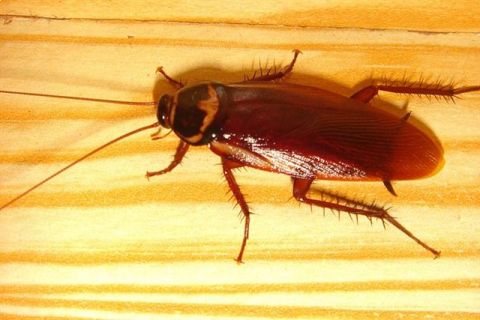
First and foremost, nothing can survive the intense heat that prevails in the affected area. For example, the 15 kiloton bomb that was dropped on Hiroshima ignited a firestorm at a temperature of about one thousand degrees Celsius, which destroyed everything in a radius of about two kilometers. However, the roach has a decent chance of surviving the fallout that follows.
The average cockroach can withstand radiation of 6,400 rads [an official unit of measurement for radiation exposure]. The lethal dose for humans, on the other hand, is only 500 rad - equivalent, more or less, to 42 full CT scans at the same time.
One theory attributes the cockroaches' resistance to the weekly molting of the larva, during which the rate of cell division is about half that of normal. In adults, the rate of division is even lower. Since radiation causes most mutations in replicating DNA—a phenomenon that occurs primarily in dividing cells—the slowing of the replication rate protects the cockroaches from radiation.
But even cockroaches are no match for the bacterium Deinococcus radiodurans, which is virtually immune to radiation. In 1956, scientists discovered that the organism thrived in a can of spoiled meat that had been irradiated with gamma rays. Subsequent studies have shown that the bacterium can survive doses as high as 1.5 million rads. That's probably enough to survive a 1.2-megaton bomb—which experts estimate is the largest in the U.S. arsenal.
Scientists are still unclear about the DNA repair mechanism that allows the bacterium Deinococcus radiodurans to withstand such high levels of radiation. One possibility is that once the bacterium's DNA chains break apart, proteins protect the ends of the chain long enough for it to reconnect (much like the ends of a torn rope that are immediately reattached, before they have time to separate and move away from each other). If this turns out to be the case, scientists may be able to offer a similar protein to human cells—which could survive even longer than cockroaches.
Questions and Answers
Can a cockroach survive the heat of a nuclear bomb?
No. According to the article, nothing can survive the intense heat in the impact zone, and the Hiroshima bomb ignited a firestorm of 1,000 degrees Celsius that destroyed everything within a radius of about two kilometers. A cockroach has a chance of surviving the fallout that follows.
How much radiation can a cockroach withstand, compared to a human?
The average cockroach can withstand 6,400 rads of radiation, while the lethal dose for humans is only 500 rads.
Why are cockroaches so resistant to radiation?
One theory attributes this to the slow rate of cell division, especially during the weekly molt of the larva and in adults. Radiation causes most DNA mutations in dividing cells, so slowing down replication protects the cockroaches.
What creature is more resistant to radiation than cockroaches?
The bacterium Deinococcus radiodurans, which is virtually immune to radiation and can survive a dose of 1.5 million rads, is still not sure what DNA repair mechanism allows it to do so.
By Avi Seif, published in the April 2008 issue of Popular Science magazine
More on this subject on Hayadan.com - Science news
- Atomic bomb: What is nuclear fission and how is it different from a hydrogen bomb?
- Are cockroaches dangerous to health and can they survive a nuclear attack?
- On bacteria and radiation
- Can exposure to low-dose ionizing radiation be healthy for us?
- Five super abilities that insects have that we could only dream of

17 comments
All in all, the human being is the most disgusting animal there is and the most annoying, better yet cockroaches..
The feeling of disgust is intended to deter us from things that have infectious potential
Look it up online
It is clear that God also created the cockroach (fixed for those who persist). After all, it is known that disgust is a basic emotion. And it needs to be evoked often even in such a modern environment. Without feeling disgust, how can we be balanced? In my opinion, a more interesting question would be why disgust was created in the first place, but that is already out of scope.
very beautiful The two most repulsive things in one thread. Jock and God. Thank you very much. And we'll move on to something completely different...
Elijah the prophet:
It is not God who created the GOK.
If anything then on the contrary.
Ami, maybe you can explain then why God created all this life???
to annoy us ??
In fact I didn't even say they shouldn't be investigated. Let them investigate, let them do what they want to do. This animal is disgusting. Her picture here in the science gives me strong feelings of disgust. I have a friend who is a doctor at the BS on the behavior of cockroaches after all kinds of electrical pulses that he gives them directly to the ganglia. He claims that it amazes him time and time again how the cockroach's reactions and behavior can be controlled, as if programmed, by those electrical pulses. He believes that on one level or another this is true for all animals. that with the right pulse in the right place you could make a conquering people, for example, love a conquered people and vice versa. It's all a question that a qualified electrician can answer.
All this still doesn't mean that the jock's nimble, hairy legs with its triangular head and light brown aren't nauseating.
Bye friends,
Ami Bachar
Hanan and Ami:
This is one of the cases where just making the claim proves it.
After all, Ami did not claim that cockroaches are disgusting cockroaches.
He claimed that cockroaches disgust him and there is no reason to suspect him of lying.
Your words - which are rational in this case - can convince Ami of what I believe he is also convinced of (even though he said the opposite - but it seems like a joke to me) and that there are many reasons to study the cockroaches even if they disgust him.
I still think they are disgusting
You are indeed right, my father. Most advertisements refer to cockroaches as "cockroaches" or "cockroaches"...
To be honest, the term "cockroach" is more appropriate since it refers directly to this insect and from my examination, it may have come via Yiddish...
And so that at night time the discussion will be more scientific and no less interesting, since the matter of the macaque has already been brought up, as far as I know, the species of macaque monkeys are a type of macaque monkeys.
We will leave the jokes here (and they will probably remain long after us) and we will leave the ideological discussion to the articles about UFOs, when they are published...
The main thing - have a good week 🙂
There is a very nice site for learning different languages.
Here is what he presents in the chapter "Insects" in Hebrew:
http://www.languageguide.org/im/insects/he/
Our friend is in the second row.
Cockroach is not a slang word (slang when used in Hebrew, it is actually a slang word).
Cockroach is a standard word synonymous with cockroach.
Two responses to Hanan.
First thanks for the comment. I take every comment to heart and try to implement it.
However, the article is from an external source and I need to take action to correct it.
In this specific case, I will consult with other parties because I am not sure that the claim is accurate, because otherwise all Snow's advertisements should be changed as well as the inscription on all the insecticides.
post Scriptum. Is it possible that a monkey is called a macaque and not a cockroach?
In any case, I'm glad that not all debates in talkbacks are ideological.
In this case, yes Michael. In my opinion, a translation must be in a standard way and not in slang, even though it is incorrect.
What's wrong with standard Hebrew anyway????
Hanan:
So again everyone is wrong? Also the author of the article, both the authors of Babylon's dictionary and the authors of the Oxford English-Hebrew dictionary?
In all these places "cockroach" and "cockroach" are synonymous words. Having a monkey named "cockroach" doesn't change that. The name "cockroach" in this case is not a Hebrew word at all.
It can be argued that replacing some word with the word "fixed" can be read as "fixing" the article, but I assume that is not what you meant.
To Ami Bachar: Maybe visually they don't look very attractive, but these are the fastest running insects known to us and the most durable in all respects. That's why the increased importance of the research done on them.
And the author of the article please correct: "cockroach" is a monkey, the insect known to us as "cockroach" (which is a Russian word in origin) is called "American cockroach" in Hebrew...
Best regards,
Hanan Sabat
http://WWW.EURA.ORG.IL
In the article on "Bacteria and Radiation" that was presented here not long ago, there is actually a good explanation for the reason for the wonderful resistance of Deinococcus radiodiurans to radiation.
See here:
https://www.hayadan.org.il/on-bacteria-and-radiation-0412073/
Nauseating! Hairy legs, triangular head, runs and flies in a very disgusting way... Poi. How can you study a cockroach? Filthy creature!
Greetings serious scientists,
Ami Bachar