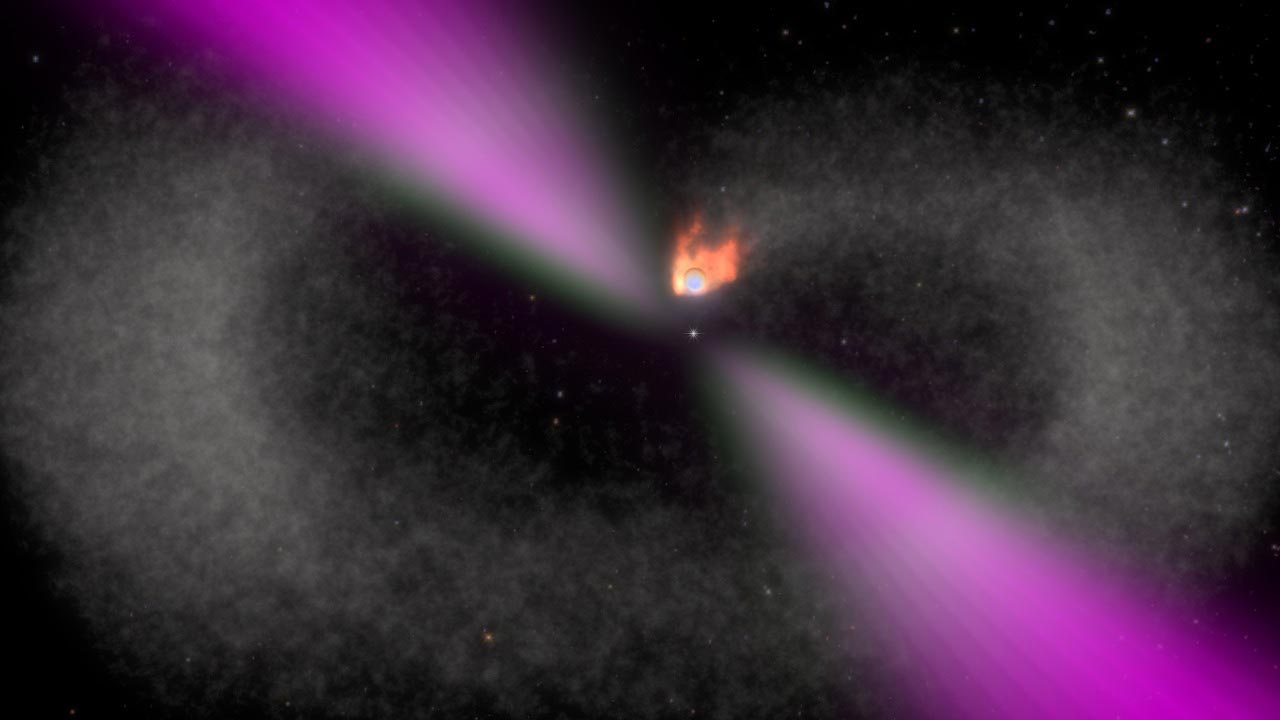
Webb finds planet with carbon atmosphere orbiting pulsar, challenging the Current models of planet formation

Science often advances because of data that doesn't fit our current understanding. According to this idea, first proposed by Thomas Kuhn in his book The Structure of Scientific Revolutions, paradigm shifts occur when current models can't explain evidence.
By this logic, scientists tend to embrace unexpected findings, especially those that force us to rethink how the world works. A new paper published on the arXiv website, based on observations from the Webb Space Telescope, may be such a moment. Researchers have examined an exoplanet orbiting a millisecond pulsar and found that its atmosphere is composed almost entirely of pure carbon.
"Black Widow" type pulsar system
The pulsar, PSR J2322-2650, belongs to a rare class of systems called "black widow" systems. These systems generate enormous energy by sucking material from a nearby companion star. Over time, the pulsar's strong gravity and radiation strip away the companion's outer layers, leaving a dense remnant the size of Jupiter.
In this case, the companion has probably shrunk to a "hot Jupiter" that completes an orbit around the neutron star every 7.8 hours. Normally, this two-step process begins when the neutron star (which also acts as a pulsar) absorbs material and ends when it bombards its companion with high-energy gamma rays, vaporizing most of its mass and creating a helium-rich planet.
Carbon-rich atmosphere discovered
The companion planet, PSR J2322-2650b, appears to be similar in size and density to other Jupiter-sized remnants formed in black widow systems, suggesting a helium-based composition. But Webb's spectral data reveal something completely unexpected: The planet's atmosphere is mostly carbon. This carbon exists in molecular forms such as carbon-tris(C3) and carbon-di(C2), making it different from any other known black widow companion observed to date.
These types of elements are usually found in the tails of comets, or in real flames here on Earth. Their existence in a planet's atmosphere, especially in such large quantities, is new to science.
Another interesting thing about the planet's atmosphere is the difference between the day and night sides. On the day side, which is constantly facing the pulsar because the planet is tidally locked, temperatures can exceed 2000℃ and there are very clear chemical signatures. But on the night side, there were almost no features at all, which suggests that this side is covered in soot or something similar that has no clear features.
To provide further evidence of the strangeness of this planet's atmosphere, the researchers calculated the ratio of carbon to oxygen and also carbon to nitrogen. The carbon to oxygen ratio was over 100, while the carbon to nitrogen ratio was over 10,000. For comparison, on Earth, the carbon to oxygen ratio is .010 and the carbon to nitrogen ratio is 40. There's definitely a lot of carbon on this planet.
A mystery in terms of the theory of planet formation
And that doesn't fit with models of how scientists think the planet should have formed. As part of the "black widow" process, the planet's outer layers would have been sucked up by the companion star or burned away by that star's radiation. The fact that such a carbon-rich atmosphere still exists is a mystery. There are processes that could create such an atmosphere, such as the merger of a white dwarf between two "carbon stars," but even that fails to explain how the carbon-to-oxygen ratio got so high.
However, other aspects of the planet fit the general theory. Rotation models predict that fast-spinning planets like PSR J2322-2650b will have strong westerly winds, which is different from the easterly winds typically found on tidally locked hot Jupiters. The data from Webb show that the hottest part of the planet is about 12 degrees west of the center, the first ever observational evidence of this westerly wind phenomenon.