
A team of researchers from the Hebrew University, the Technion, and Ben-Gurion University of the Negev has developed an artificial intelligence-based tool that identifies insects and assesses their ecological importance, enabling rapid decisions to be made about the conservation and management of agricultural areas.
By Yaakov Goldberg, Zavit – Science and Environmental News Agency

Are there only peppers in a field of peppers? If you look closely, you can see that they are not: quite a few creatures roam between the rows of seedlings. In the past, agricultural areas were considered poor and ecologically insignificant areas, a kind of "ecological desert" where only agricultural crops thrive. But over the years, and as part of the formation of a broader environmental concept, it has become clear that agricultural areas, despite their image as areas used solely for human needs, can fulfill a number of important ecological roles, especially when they are managed sustainably. Among other things, they serve as habitats for a variety of animals, some of which are essential to the ecosystem.
There are many ecological benefits to agricultural areas. They contribute to the preservation of biodiversity, help fix nitrogen and carbon, form a bridge between different natural areas and habitats, thus serving as ecological corridors, and also help protect against soil erosion. At the same time, as the population grows and development accelerates, the need to allocate more and more areas for purposes such as construction and infrastructure development, sometimes at the expense of agricultural areas, increases. This raises the need to understand the level of ecological importance of each area in order to prioritize which areas should be preserved for agricultural purposes. One of the most common ways today to conduct an ecological assessment of a particular area is using the animals that live there, and in a more focused way – insects.
Insects are the most species-rich group of animals, and they also play a number of critical roles in ecosystems such as pollination, pest control, and more. In this context, insects can serve as indicators of the ecological state of the area. The greater the diversity of insects in a given area, the higher its ecological value can be estimated. Liraz Kabra-Leikin, a doctoral student in the Department of Evolutionary and Environmental Biology at the University of Haifa, is leading the research, co-supervised by Prof. Tamar Kaiser from the University of Haifa and Prof. Yochai Carmel from the Technion, in which she is developing an artificial intelligence-based index to assess the richness and diversity of insects. Its goal is to optimize the human ability to measure and determine the ecological importance of different areas, and to be able to formulate a clear priority in a short time regarding which areas should be preserved for the purpose of agriculture based on their ecological function.
Who are you, an insect? Ask the artificial intelligence
The hypothesis behind the study that developed the index was that insect biodiversity would be reflected in a variety of visual features of the insects' bodies. During the study, approximately 350 classic glue traps were placed at 26 different sites across the country: in agricultural areas and in adjacent open nature areas. After ten days, the traps were collected and scanned at high resolution. The images were uploaded to a digital database of insect images called STARdbi, developed at Ben-Gurion University of the Negev by Prof. Chen Caesar. In the first stage, the system, based on Artificial Intelligence (AI), learned to identify and distinguish insects from other objects, such as pollen or pieces of leaves accidentally caught in a trap; more than 8,000 insect images were found.
In the next step, the insect images were analyzed using image processing tools, extracting visual characteristics of the insect body in each image (size, shape, and color tones), which were used to calculate the visual diversity of insects in each trap without necessarily identifying each and every species of insect. The results were then verified: 40 traps were randomly selected for manual inspection by experts who classified the taxonomic identity of the insects. The comparison revealed a high positive correlation between the automatic and human identification; that is, the automatic system was able to correctly estimate the diversity of insects.
Beyond the roles that different insects play in the ecosystem of the areas in which they live, the presence of certain insects in agricultural areas (for example, insects that prey on other insects) may prevent the spread of insect species that are harmful to agriculture, and this effect is amplified the greater the biodiversity of insects in the area. "We found that traps with low biodiversity were usually those that contained mainly one pest species," says Cabra-Leikin. "In contrast, traps with high diversity included a variety of insect groups, including natural enemies of pests. The more species there are in one area, the less the pest species dominate that area cell."
According to her, the system is not intended to completely replace the work of the entomologist (insect researcher), but to shorten and streamline time. "It is relatively easy to locate insects in the field, but it is difficult to identify what species they are," she says. "Identification requires high taxonomic expertise, and this is exactly where artificial intelligence comes into the picture. If in the past an expert had to invest 3 to 5 hours to identify insects in one trap, today it is a matter of seconds. In the past, we had to count each insect manually, sometimes hundreds on each trap. Now we can get this information at the push of a button. Currently, our laboratory is also working on automatic identification of key pests in agriculture and their natural enemies in order to allow farmers to accurately determine the necessary treatment in real time."
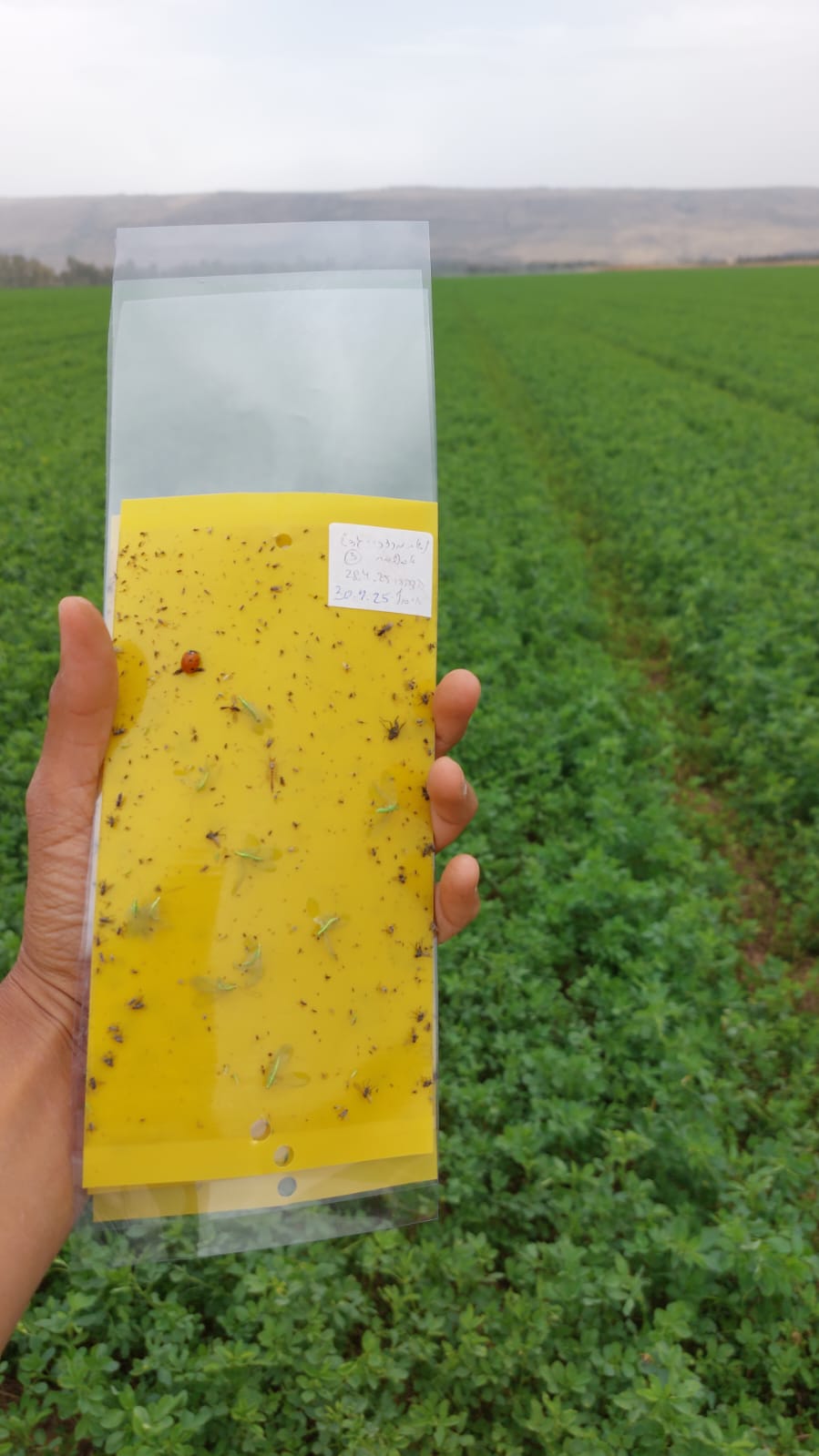
To preserve biodiversity, fewer pesticides can be used. Insect trap. Photo: Liraz Cabra-Leikin
Agricultural areas under development pressures
High biodiversity in agricultural areas can indeed help the health of the ecosystem, but it also sometimes creates quite a few headaches for farmers and damage to the agricultural area: various mammals that roam the field and damage irrigation pipes, or winged animals such as cranes that trample the crops and eat seeds and seedlings. "An integral part of developing the basic ecological concept is also ultimately producing creative solutions that aim to resolve the conflict as much as possible," emphasizes Kabra-Leikin. "At the same time that conflicts are increasing, environmentally friendly solutions are also increasing over the years. For example, in the Hula Valley, food is sprinkled in advance for cranes in certain plots, so that they are not tempted to enter areas of the field where they will cause damage. In certain places, water troughs are sprinkled, thereby reducing the pressure on the mammals to gnaw on the pipes in the heart of the crop plots."
At the same time, there are quite a few actions that can be taken in the field to preserve biodiversity. For example, you can use less pesticides (for example, by using biological pesticide), or reduce the fencing of areas, since fencing interrupts ecological corridors and thus interferes with the passage of animals from one area to another. Are these actions sufficient to preserve biodiversity? According to Kabra-Leikin, the changes in the area, such as the acceleration of development, require a deeper change in the management and advance planning of the areas we have and what we choose to do with them. "We are in a time when many areas around the world with high ecological value are disappearing," says Kabra-Leikin. "Changes in land use, especially the conversion of natural areas to agricultural areas, are one of the main factors in this. It is important to understand that agricultural areas are not only food producers, but also part of the fabric of open spaces that supports biodiversity. Any such planning decision should also be considered from an ecological perspective."
Kabra-Leikin's project is supported and funded by the Ministry of Energy and the JNF, as part of a study aimed at examining the ecological impacts of renewable energy practices such as solar panels in agricultural areas. "We are now continuing to examine whether such practices harm crops or actually contribute, and how they affect biodiversity. The tool we developed can help assess these impacts in real time, thanks to the relative speed with which it will be possible to estimate the biodiversity found in different areas."
Quite a few agricultural areas in Israel are under development pressure, hence the growing need to develop comparative tools that will assist in the ecological assessment of those areas, in order to formulate priorities for their preservation as agricultural areas. "In Israel, unlike many places in the world, less and less areas are allocated for agriculture, and are transferred for development purposes - such as expanding existing settlements and establishing new industrial zones," she says. "Solar energy also requires a lot of land. Therefore, it is extremely important that there are clear tools and indicators for prioritizing areas from an environmental and ecological perspective already at the planning stage. And we don't have much time, the pace of decision-making in planning institutions in Israel is often faster than conducting research. I hope that the index we developed will be integrated as a standard, accessible and fast tool for anyone involved in planning and managing agricultural areas."
More on this subject on Hayadan.com - Science news:
