
By Dr. B. Dan
Direct link to this page: https://www.hayadan.org.il/evo311004.html
The theory of evolution, attributed to the scientific legacy of Charles Darwin, developed and became one of the pillars of modern science. Evolution is a comprehensive scientific theory, which tries to embrace the world and bring together the life sciences - to answer the most basic questions: How did life originate? How did species of life evolve? When did man appear as a human being on earth and where did he come from? How does nature work and what are the principles of its operation?
These are poignant questions, concerning the basis of life, the "creation of the world", the essence of life and the role of human beings in the complex task of life on earth. Being fundamental questions, it is no wonder that the theory of evolution found many opponents among religious people, who saw evolution as a fundamental challenge to the religious concept of the essence of life, the origin of man and even to the very existence of God. Before we deal with the essential gap between the religious explanation of the universe and the evolutionary explanation - let us get to know, even briefly, the principles of the theory of evolution and its main claims.
The basic point of departure on which the theory of evolution is based derives from the very name of the Torah: evolution in the sense of the slow and gradual development of a living being, which changes over time and develops from an initial, primordial pattern to a different form or characteristic, based on the original pattern of that creature, but its form And its current features are different than they were in the past. The evolution approach assumes that this principle of "constant developmental change" is a basic natural principle upon which life is built. Moreover, evolution as a scientific-empirical framework (empirical = provable) makes it possible to explain the development of life, the origin of man, the human body and its properties and the structure of the brain, nature and life - all of which the theory can give empirical scientific explanations.
And the sequence of life history according to the evolution approach: in the beginning... there was the big bang - that cosmic explosion of energy that created and placed the planets in the universe and within them our earth (see a separate article on this topic on the Freedom website) and after the big bang the main basic conditions for life were created on The earth's surface and the evolutionary process began, beginning with the most basic and primitive single-celled organic beings. Amoeba and algae, algae and microbiological surfaces, primitive protozoa, living cells that meet and unite, develop and split into other creatures and change over time. As generation years, hundreds of thousands of years, millions of years pass - so the complexity of life develops in the process of evolution, which dictates changes and developments. In the timeline. From those primordial creatures, to the reptiles that invade the sea, from fish-like to lizards, From giant dinosaurs to birds, reptiles on land to sea creatures, from primitive creatures that operate according to rigid genetic prescriptions, to more complex animals, from simple mammals to complex social mammals, whole families of creatures that keep changing, keep developing.
This is how evolution explains the multitude of species and the enormous variety of creatures in nature. All living beings, all in a dynamic process of life in change - all share in the great evolutionary celebration called - life.
The operative process in which evolution works, the one that takes place in nature, in reality - is the process of natural selection which is the mechanism of change according to which evolution works. Natural selection is the preference of creatures that have suitable features for the environment, over creatures whose features are not suitable or less suitable. The "unsuitable" will not survive and will become extinct over time, while living beings that are suitable for their environment will continue, in their very survival, the evolutionary process of constant change and development.
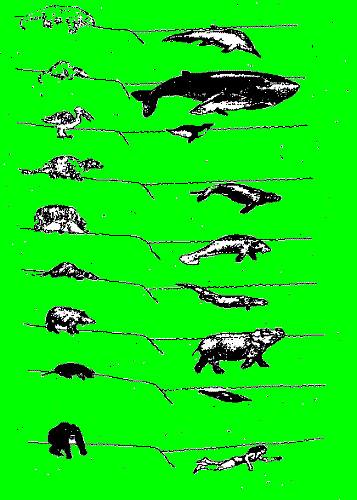
All the living creatures we know today have evolved over millions of years of history, from more primitive primitive creatures to their diverse form today. In this sense, the theory of evolution provides an explanation for the origin of living beings and their configuration today, alongside the explanation of the processes of change and development in the timeline. Being a world-wide theory, evolution touches every feature and feature of living beings, the structure of the body, the structure of the nucleus and the cell, the various organs of the body and the structure of the brain and its mode of operation. And just as the theory explains the origin of life and the processes of development, so the theory explains the "descent of man" from the creatures that preceded him. The modern man, the "homo-sapiens" - the thinking man, is the most developed and complex living creature that evolved from pre-human creatures that preceded him in the process of evolution, and are therefore our ancestors.
"Homo-sapiens" appeared as a human creature about 150,000 years ago and managed to survive and develop, while its ancestors, less suited to their environment, became extinct over time. These ancestors, whose scientific name is Astrolopipicus (from the subspecies A. africanus and A. habilis), underwent evolutionary changes and adaptations in the transition from the life of the great apes in the jungle to the upright existence of a pre-human, who went out into the expanses of the African savannah and began to develop mentally and socially. And from this proto-man (called "Homo-erectus - the upright man"), the modern "thinking" man developed with his physical, cognitive, social and cultural features. All these emerged, developed and took shape in the continuous and gradual process of evolution.
To illustrate the evolutionary development of a physical feature in the human body - let's examine the thumb, one of the body parts of special importance in the process of human evolution. The evolutionary explanation for the development of the human hand and the thumb in particular, begins with the exit from the forest where, as long as the monkeys lived in movement in the forest, among the trees, it was an advantage for those with a flat hand and a small thumb that did not hinder the hand from grasping and wrapping trunks and branches to move through the thicket of the forest. But in the open plains of the savannah, at the same time as the floor became upright, the hand began to pick, pluck, crack, push, lift, throw and throw - and those with a "three-dimensional" hand, in which the thumb stands and moves in front of the fingers of the hand, enjoyed a significant advantage: they could bring together the The thumb with the first finger and perform a "precise grip" - .
These basic properties, of the position of the thumb in front of the fingers and the ability to rotate the thumb, are what allow the human palm to hold an object, a stick or a stone, to wrap a stem like a hammer, or to weave a thread with a needle - properties that are the basis of all sophisticated hand operations - grasping, sewing, weaving, writing. And the more the evolved creature had a better "precision grip" (meaning a more upright, longer, and wider range of motion thumb), the more the human brain evolved and created, for the hand, more complex tasks based on "precision grip". And at the same time, the brain also developed and created appropriate cognitive (thinking) skills. As the palm could make more sophisticated uses of "precision grip", the brain needed to find ideas and ways to use this ability. And so, as the thumb developed, the brain also developed more and became "smarter" in a dialectical process (mutual feeding) between the thumb and the brain. And in a similar way all human traits developed and the patterns of human life and human culture were created, ways of thinking and ways of coping - all are traits that evolution "preferred" over other traits in the process of natural selection. This is how evolution explains the way the human baby is born (big head, small body) , the smooth faces of women compared to the beard that adorns men's faces, the different skin color of people - and in fact every feature and feature of all human beings or living creatures any.
"Homo sapiens", humans in the form we know today, spread and expanded their living areas in Africa, the Middle East, India, China and southern Europe. "Homo-sapiens" continued to go through stages in its evolutionary development: the beginning of the use of primitive tools, joining primary social groups, entering different climate zones (something that affected the color of a person's skin and the structure of the face). At a certain point, the gradual process of animal domestication begins (in the framework of which evolutionary changes are created in the "domesticated" animals that allow them to adapt to humans and live alongside them). And at the same time, the domestication of plants (the beginning of agriculture), and even before that, the "domestication of fire" and its use for cooking food, creating tools, preserving and processing leather and metals.
And from here the evolution is close to the cultural stage, the stage of civilization, which is identified with the great invention of the prehistoric period, in Mesopotamia (today's Iraq): the pottery jar. This technological invention occurred, probably by accident, from a fire pit dug into the clay soil of Aram-Nahreim. The meeting between the fire, the water and the clay soil, is what led to the "invention" of the first urn, which allowed the "homo-sapiens" to move from a nomadic-gathering life to food storage and the beginning of the modern economy. Starting from this stage, and thanks to the clay jar, people could keep the surplus production (wheat, barley, oil, salt) and carry out barter trade with these surpluses. This development obviously affected the social, cultural and political frameworks which are also in an evolutionary process of constant development and change.
And here we return to the fundamental contrast that exists between evolution as a theory that explains life and religion that also claims to provide explanations for the meaning of life, the "creation of the world", the origin of man and the meaning of his life. The conflict between religion and evolution is frontal and irreconcilable. Evolution, directly, does not recognize, and in fact denies, the very existence of God, and in any case denies the idea of the "creation of the world" as an event that took place at the magic headquarters of some great magician - God. After all, in its essence, evolution holds that life develops all the time, and originates from primitive living beings that change over time and gradually develop and take their current form. Evolution denies the existence of God and in fact dictates a different approach to man's origin, to man's destiny, to man's commitment to the ecological environment in which he lives and to the entire relationship between man and nature. As such, evolution advocates compatibility with the environment, friendliness towards nature and a controlled and respectful use of natural resources, and the modesty of man's being in nature - not the "glory of creation" nor "the separation of man from the beast" - but a living biological creature, belonging to nature, shaped in its properties by nature and changed by Nature according to the degree of its conformity to nature.
In our current era, the evolutionary approach emphasizes the importance of the survival of living things, plants and animals - some of which disappear in the natural process of evolution, but many become extinct as a direct result of the actions of humans. Of particular concern is the population density in the world (6 billion inhabitants of the earth today are expected to double to 12 billion in 2030), pollution sources
Water and the depletion of resources. These issues are at the forefront of modern science and the researchers preach the most disturbing evolutionary message and lesson: human beings, in their large numbers
And in their actions, they are no longer adapted to the environment in which they live because they harm nature, deplete its resources and create an unbearable burden on their natural environment - and the evolutionary principle claims that only creatures that are suitable for their environment will survive - and those that are not suitable, will become extinct and pass away from the world. And here, too, is the complete contrast between the religious concept that places Yahva in God ("... He will make peace upon us") and science and the evolutionary approach that addresses the scientific logic of man, the "thinker", and his sense of responsibility towards his actions and towards the nature from which he comes and to which he belongs . In the name of religion, man acts against nature and without regard for it. In the name of religion, the world's population is exploding to the point that the ability of human beings to exist in the world is in doubt. In the end, according to the principle of evolution, humans will disappear from the face of the earth if they do not stop harming the environment that sustains them, and if they do not adapt themselves to their environment - they will not survive!
- Freedom website recommends the following books:
- For youth and young adults - "The Ancient Man", published by "Maariv" - LIFE
- for all ages - "Evolution - from Darwin to the DNA," by Dr. Dan Graor, Broadcasting University Press;
- For all ages - The Hebrew Encyclopedia, Volume 102, pp. 117 to XNUMX
- For the in-depth: "The Origin of Species", by Charles Darwin, Mossad Bialik Publishing House, 1960
– In English: Charles Darwin: Time Line
Yadan Darwin - the man of a thousand
The article is presented courtesy of the Freedom website
https://www.hayadan.org.il/BuildaGate4/general2/data_card.php?Cat=~~~990742772~~~263&SiteName=hayadan

11 תגובות
I liked the bickering, it's healthy and good
Robin
Your rudeness is getting annoying….
"Characteristics that are the basis of all sophisticated hand actions - grasping, sewing, weaving, writing. And the more the creature that evolved had a better "accurate grip" (that is, a thumb that is more vertical, longer and capable of wider movement), the more the human brain developed and created, for a palm The hand, more complex tasks based on "precise grip", and at the same time, the brain also developed and created cognitive (thinking) skills. The more sophisticated the hand could use in "precise grip", the more the brain needed to find ideas and ways to use this ability. And so, as the thumb developed, the brain also developed and became "smarter" in the dialectical process (mutual feeding) between the thumb and the mind. And in a similar way, all human qualities developed and the patterns of human life and human culture, forms of thinking and forms of coping - all are qualities that evolution "preferred" them according to other traits in the process of natural selection."-
I've never heard so much nonsense and holes in a row of letters oh my head hurts just seeing these mistakes - there is nothing First of all don't just assume things to yourself if today there is no scientific consensus on why and how the human brain developed so relatively fast ( three times in less than two million years) Second thing - what are you squirming and saying that the brain evolved to help the thumb and grip more accurately....you are actually saying that the random mutations...do not act randomly....what It's a dialectic process "to feed each other" you hear the nonsense you write....no empirical proof and nothing and nothing like that has ever been said that was recognized as true by science....this is just speculation when the other speculations that telling the truth is not much different from saying....why am I cold...oh because There is a good spirit that solved the problem……no! You are cold because you have nerves and they can feel (or not feel more correctly) the absence of heat-cold....and you wrote that....there was simply a mutual interaction with the thumb and the brain and this is just a hypothesis...one more thing at the beginning of the twentieth century they neglected the connection between making tools Precise grip and brain enlargement and you can check it……. In short, he ended with a sentence that I really connected with that-
Before brains there was no color or sound in the Universe, nor was there any
flavor or aroma and probably little sense and no feeling or emotion
Roger W. Sperry
Eddie,
Thanks for the thorough explanation. I never thought that the Kabbalah, the Bible or any other ancient book, predicted any scientific discovery, before it was known to science.
This is a bluff that is often spread, and every time I come across this kind of bluff, I simply ask for an exact quote.
Needless to say, I haven't won a single one so far.
But innocents and innocents don't die, they just change - the same goes for scumbags.
Max Power:
Don't tell stories, your response 6 is an artificial interpretation of response 3.
You continue in your vulgar attitude from comment 3.
In addition, you pride yourself on your ignorance about a subject you pretend to relate to.
Think carefully if in this sense you are no better than the foolish followers of the type of 'acceptance to the people' believers - although in the opposite direction.
To commenter 5, Mr. Eddy, I fully admit that I am ignorant of Kabbalah, of Voodoo, of astrology, of fortune-telling by throwing African bones, of reading in coffee, in general I responded to the claim that everything appears in Kabbalah, they gave examples of the fact that in Kabbalah it is written that the earth is round, and this before science discovered that.
Max Power,
I don't know how much science you know. According to your response I can estimate that you have no idea about Kabbalistic teachings. Of course it's not a big shame, but on the other hand, in my opinion, it doesn't do you or anyone else much respect to respond to comments of the type of comment 3.
Noam and Nikki,
1.
There is no such thing as 'Kabbalah theory'. There is the Kabbalah theory of the Ari (and in fact five or six Torahs of the Ari), the central one of which has two versions (from the Rahu + a bit of immersed stone, with developments of the Rashash; and a knitted version), there is the Ramak theory (in both Versions - Pardes Standard + Or Yakar; Pardes Manuscript and Shefa Tal from earlier periods (Zohar, Avraham Abolafia, Kablat Girona, The Eyon circle, the Hasidic circles in Ashkenaz, the Sefer HaBahiroud) and from even earlier periods (halls) and antiquity (gnostic methods known from the second century BC).
That's why the talk about the 'theory of Kabbalah', in the broad essential sense, and certainly in the narrow formal sense - is a gross generalization, if not a blatant demonstration of a lack of knowledge, with your honor.
2.
The Big Bang has no expression in any Kabbalistic Torah. In general, Kabbalah refers very little to the material world ('the world of action') and its physical processes. What concerns the Kabbalists is mainly the divine worlds, and to a certain extent the worlds of creation, the theory of the soul, as well as the spiritual processes of man in his work in holiness and uniqueness. The talk about the world of action (more precisely - Malchut Dashia, which is 'here') is relatively rare, and extremely brief in any case. Preoccupation with the affairs of this world characterized what is commonly called 'practical Kabbalah', which was also not interested in physical processes (except for rare aspects of a kind of alchemy - which lusted after what today is perhaps beginning to achieve with the teachings and technologies of 'super atoms').
3.
The concept of the invention of the worlds in the Kabbalistic teachings (which relate to the issue of the invention of worlds) - is definitely essentially evolutionary (in central teachings of the Ari the process is, to a certain extent - also a crisis).
On the other hand; It is true that the concept of 'man' is an evolving concept ("Adam Kadmon', 'Adam Dazilot', 'Adam Debrea', Adam Detzirah', Adam Dashia') - and the numbers and faces at every level of reality are also evolving. But the principles are certainly different from those found in the theories of evolution biological, and we did not find in the teachings of Kabbalah any reference to the processes of 'biological evolution' in general, in the teachings of Kabbalah.
In general, it is better not to involve gender in non-gender (Kabbalah and science), and if in the 17th century the two topics are brought together in one discussion - it is advisable to study the relevant topics (mastering scientific knowledge, according to my opinion - it is not easy, and mastering Kabbalah knowledge, according to my opinion - it is definitely not either simple) and not everyone who wants to come and take - sometimes it's better to just keep quiet.
I also recommend a similar recommendation regarding the 'religion and science' discussion, which on this site always slips into low-level bickering, insults, incitement and vulgarization of the argument. The best thing on this site is to try to learn science, and not get involved in endless 'religion' clashes - when in most cases the commenters do not have enough control over science or religious knowledge, and usually neither.
Kabbalah theory (why not an invoice) reminds us of the prophecies of Nostradamus, it has everything and actually has nothing in it, anyone can find everything in it but in retrospect, after it happened, just like in the prophecies of Nostradamus,
Niki,
They worked on you.
Can you quote exactly the passages in the Kabbalah that talk about the big bang and the theory of evolution?
The intention is neither interpretations nor crooked explanations - original quote.
Fascinating article, thank you. Indeed, religion denies the development of processes, but if you read the accepted Kabbalah writings, they definitely explain and agree with the Big Bang billions of years ago and with the theory of evolution. You can read more information on the Kabbalah website
I would love to read more of your articles