
It is estimated that the construction and launch of a new satellite will take about two if not three years
Avi Blizovsky
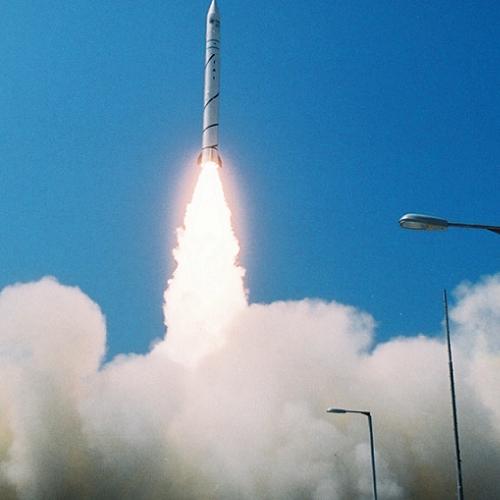
Ofek 6 launch, yesterday in Palmahim. Photo: the aviation industry. Estimate: The damage from the launch failure is 100 million dollars
Direct link to this page: https://www.hayadan.org.il/ofeq6dayafter.html
The defense establishment says that a special budget will be required to continue developing systems for launching satellites and they estimate that within three to four years it will be possible to assemble a new satellite in place of Ofek 6. Voice of Israel reported that security officials said that it is necessary to reexamine the spy satellite program. In the meantime, the defense establishment in the Air Force and the Aerospace Industry continue to examine yesterday's launch failure.
The Minister of Defense, Shaul Mofaz, commented on the failure: "We are not happy with the results, we are studying what happened, and we will draw the necessary lessons."
Mofaz also said: "It must be remembered that we are on the map of satellites in the world, and even if they ask to cut various budgets, there are areas that must be maintained. I believe they will find a way to learn from the lessons. I am sure that the defense industries will find a way to learn from the lessons and launch the satellite late, and we will release it." .
The failure of Ofek 6 will harm Israel's ability to warn against missiles
Amnon Barzilai, Haaretz, voila!
The launch of the "Ofek 6" intelligence satellite failed yesterday. Following the failure of the launch, the defense establishment will re-examine the spy satellite program and the schedules for the next launches. In addition, due to the cut in the defense budget, a special allocation requirement will be considered for the continued development of satellite launchers.
The satellite was supposed to improve Israel's independent ability to obtain early warning against a surprise attack by ballistic missiles. The "Shavit" satellite launcher, which carried "Ofek 6" in its bow, failed between the second and third stages of the launch to "throw" the satellite into orbit around the Earth, and it is estimated that the satellite fell into the sea. The financial damage from the loss of the satellite is estimated at about 100 million dollars.
The failure may result in strategic damage to Israel, due to the delay in establishing a permanent presence of Israeli spy satellites over the Middle East, and in creating a sequence in the transmission of images from space on military preparations in the countries of the third threat circle - mainly Iran.
The defense industry fears that the failure will also cause heavy damage to the reputation of the aerospace industry - the manufacturer of the launcher and the satellite - and to the reliability of satellite launchers from the Shavit family, which are intended for export. According to foreign publications, the Comet is a derivative of the Jericho surface-to-surface missile.
The Shavit satellite launcher was launched yesterday from the Palmachim Air Force Base at 13:53, with the Ofek 6 spy satellite in its nose. For the first few minutes, it seemed that the launch was a complete success: Shavit took off as planned, then the launch and the launcher moved along its flight path as planned. The personnel of the launch administration reported that the first engine of the launcher finished its job and the second engine was activated correctly (the end of the first stage and the beginning of the second stage). At this point, at a height of several dozen kilometers above the earth's surface, the comet left the atmosphere and continued its climb to a height of several hundred kilometers. In the third stage, the launcher was supposed to "throw" the satellite and put "Ofek 6" into an elliptical orbit around the Earth, at an altitude between 600-400 km. However, at this stage it became clear that the attempt to put the satellite into its orbit failed.
When the fault was discovered, an urgent consultation was held at the test site between the project engineers, in order to locate its source. The assessment emerging from the inspection of the launch reports is that the malfunction was caused at the moment of transition from the end of the operation of the second engine (the second stage) and the activation of the third engine (the third stage), which is intended to put Ofek 6 into orbit around the Earth.
Not the first failure
YNET reported that the failure of the Horizon 6 launch is not the first in the series of Horizon satellite launches. In January 1998, the launch of "Ofek 4", which was supposed to replace "Ofek 3", failed. The launch failed due to a malfunction in the launcher, and the damage was estimated at the time at tens of millions of dollars.
Ofek satellites are launched into space on "Shavit" rockets. It was the Aerospace Industry that developed and created the satellite and the launcher, in cooperation with other knowledge-intensive industries, including - the Military Industry, Rafael, Elbit Systems and the Elishara Group, at the request of the Ministry of Defense.
in the prestigious club
On May 31, 2002, the previous spy satellite, "Ofek 5" passed its first test and transmitted the first images from space to the Israel Aerospace Industries ground station, known by its name "Ayelet Hashar". "Ofek 5" replaced "Ofek 3", which ended its role in January 2001, after the gas that allowed it to correct its orbit in space ran out.
"Ofek 5" transmitted black and white photographs to the ground station, with an accuracy level of less than a meter. These photographs were distributed to all intelligence agencies that needed them.
The security establishment will re-examine the spy satellite program
Following the failure of the launch of the Ofek 6 spy satellite, the defense establishment will re-examine the spy satellite program and the schedules for subsequent launches. In addition, due to the cut in the defense budget, a special allocation requirement will be considered for the continued development of satellite launchers.
An examination reveals that all the malfunctions in the Israeli satellites were caused during the launch phase. To date there have been no malfunctions in the operation of the satellites or the electro-optical cameras. The inspection committee set up by the Ministry of Defense will have to examine whether it is necessary to freeze the planned launch program, until it can be verified that the launches using the Shavit satellite launcher are safe. The additional budget that will be required - to the extent of tens of millions of dollars - will probably be intended for the construction of several satellite launchers, some of them for experiments. Today, due to the high cost of building a launcher, the Ministry of Defense refrains from testing.
As part of the plan drawn up by the Space Administration at the Ministry of Defense, two spy satellites are currently being built simultaneously: "Ofek 7" and the radar satellite (TECHSAAR). These satellites represent a technological leap, and are planned to be launched into space in about two to three years. Ofek 7 - probably the last In the "Ofek" satellite family - will have a much higher level of separation than the current "Ofek 5" satellite The radar will be able to photograph day and night and in all weather conditions. The Ministry of Defense will back up its spy satellites with civilian satellites from the "Eros" family, which will be financed with funds raised by the "Imagesat" company, which owns Eros.
Simultaneously with the development of Ofek satellites, the Ministry of Defense invests in the development of miniaturized micro- and nano-sized spy satellites. In an interview with "Haaretz" last year, the head of the space program administration at the Ministry of Defense, Brigadier General (resp.) Prof. Haim Ashed, revealed that Israel is investing in the development and construction of constellations (clusters) of many satellites, in a wide variety of wavelengths, that will allow photography in the field Visible; taking infrared pictures with which objects on the ground can be distinguished due to temperature changes; hyperspectral photography of color, which makes it possible to distinguish among other things From the space between virtual self and real objects; 3D electro-optical photography or radar for mapping purposes; and radar photography.
The second field is the development and construction of the next generation of micro- and nano-sized satellite clusters. At the same time as developing these technologies, scientists at Rafael are working on developing technology to launch satellites into space from F-15 fighter jets.
Besides spy satellites, the defense system will also invest in the production of a military communication satellite from the "Amos" family, which will be twice the size of the civilian satellite, and its production will be completed in 2008.
Amnon Barzilai
The spy satellites
The schedule will be disrupted
By Amnon Barzilai
The failure to launch the Ofek 6 intelligence satellite, and the failure to put it into orbit around the Earth, disrupts the schedule of the Space Administration of the Ministry of Defense headed by Brigadier General (resp.) Prof. Haim Ashad. According to the plan that was designed about three years ago, there are supposed to be Israel will have between five and seven spy satellites in space by the end of the decade, an impressive satellite presence intended to give Israel - one of the few countries in the world capable of launching satellites - Independent early warning capability, and mainly to receive continuous and available information about what is being done in the backyard of Iran's missile program.
The failure must turn on a warning light in the security system. Of the last three launches of the spy satellites in the Ofek 5,4, 6 and 5 series, only the launch of Ofek 2002, in May XNUMX, was successful. This is a bad ratio of one out of three launches, a ratio that is not flattering to Israeli technology, and especially to the quality of the flagship products of the defense industries Israeliness: missiles and satellite launchers. These products are supposed to give Israel the essential qualitative advantage over all the countries of the conflict in the first, second and third circles.
However, Major General (Ret.) Prof. Yitzhak Ben Israel, formerly Chief Research and Development Officer in the IDF and head of the Defense Ministry's Weapons and Infrastructure Development Administration, and who was among those responsible for the space project from the beginning of the 90s, believes that there is a fundamental difference between the failure of the launch " Ofek 4" in January 1998 for the failure to launch Ofek 6, yesterday. Ofek 4 was launched to back up and reinforce the "Horizon 3". After the failure of Ofek 3, the State of Israel was left without a spy satellite. Today, Israel has two photography satellites: Ofek 5, and the "Eros" satellite, which owns a significant portion of its shares. Owned by IAI and "Elbit Systems". The two satellites - which orbit the earth at an altitude of 600-400 km - transmit to the stations. The reception in Israel of images of excellent quality, and at a high level of separation (resolution), from the entire Middle East, once every hour and a half.
Ofek 6 is an optical satellite, like Ofek 5. However, it was supposed to transmit images at a higher resolution level and has a higher storage capacity of images. However, it is not a technological leap forward. In addition to this, Ben Israel emphasizes that yesterday's failure does not leave Israel without satellites. Therefore, the failure this time is "a blow to technology, but not a strategic blow to the State of Israel", according to him.
From the moment the launch malfunction was discovered, tensions arose between the government defense industries that are responsible for the development and production of "Shavit" - the Aerospace Industry (the main contractor), the Military Industry (the manufacturer of the two large engines) and Rafael (the manufacturer of the third engine). However, the debate this time goes beyond matters of prestige. If it turns out, as it emerged from the initial test that was done immediately after the failure, that the fault in the launch was in an electronic component whose function was to ignite the third engine, the conclusion will be that the problem that was revealed is in Shavit's technological ability to put satellites into orbit around the earth.
Identifying the fault and locating it has far-reaching strategic significance for Israel's long-range missile project. Because, according to foreign publications, the first two stages of the Comet launcher are the derivative of the Jericho surface-to-surface missile. Therefore, if the final diagnosis of the malfunction is that the failure was in an electronic component whose function is to ignite the third engine, then it is not Israel's technological ability to launch missiles that was found to be defective, but the problem is in the satellite launcher.
After the failure to launch Ofek 4, the then defense minister, Yitzhak Mordechai, ordered the satellite development project to be halted. An expert committee headed by Col. (Res.) Dr. Aviam Sela was established, which examined all ways of working, quality control, organization and cooperation between the defense industries. The committee discovered that the fault in the launch at that time was in the second stage of the launcher, and following its findings, new work rules were established. The result was a successful launch of Ofek 5. Yesterday's failure will require the establishment of a similar committee to examine the cause of the failure. If indeed the malfunction is in an electronic component, and not in one of the three engines of the launcher, the responsibility for this falls on the "Melm" plant of the Aerospace Industry. The mishap in Horizon 6 is reminiscent of a similar mishap that caused the "Arrow" missile to fail to intercept an American target missile that simulated an Iranian "Shiyab 3" missile about two weeks ago. Even then, it turned out that the fault was in an electronic component manufactured at the Melam factory.
Commentary: Israel will know how to recover from the launch failure on the YNET website
Yidan Israel in space
https://www.hayadan.org.il/BuildaGate4/general2/data_card.php?Cat=~~~336816873~~~248&SiteName=hayadan
