
The Ohalo site provides data on human nutrition 23,000 years ago. Until now, it was generally accepted to place the roots of agriculture 13,000 years ago.
Avi Blizovsky
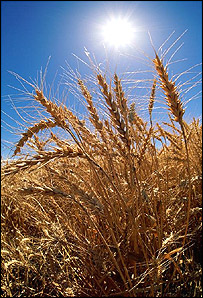
Wild wheat like this was found at a tent site near the Sea of Galilee
Direct link to this page: https://www.hayadan.org.il/earlyfarmingohalo.html
Hayadan was the first to report this on 6/28/2004
For some reason, about a month and a half later, the news also reached the daily press. In the following news from Haaretz
Research at the Oholo site on the Sea of Galilee: the origin of agriculture is 10,000 years old
Avi Blizovsky, 28/6/2004
Wild varieties of wheat like those found in Ohalo were the precursors to the first steps of agriculture 23,000 years ago, much earlier than previously thought, experts say.
Grass species including wild types of wheat and barley, which were the ancestors of the variety of grains grown today.
An Israeli-American team reported the findings in the Proceedings of the National Academy of Sciences.
The evidence comes from a collection of 90,000 prehistoric plant remains excavated at Ohalo in northern Israel. The Ohalo site dates back to prehistoric times and remained undisturbed until recent excavations by Ehud Weiss of Harvard University and his colleagues.
The low-oxygen environment has well preserved the remains of plants that were left there during the Stone Age. The archaeologists also found the remains of a hut, a bonfire, a human grave and stone tools at the site.
Most of the evidence indicates that the Near East was the cradle of agriculture. Indeed, all the basic food plants eaten by humans in their tent appear to be grasses, including the grains including wheat and barley.
The grass remains in Ohalo include a large amount of small-seeded grass. These small grains disappeared from the human diet about 13,000 years ago.
Anthropologists believe that agriculture began when small hunter-gatherer groups in Southwest Asia were under pressure from the explosion of the human population and the small size of the hunting grounds. This required them to rely less on hunting large animals such as deer, donkeys, and wild cattle, and expand their food basket to include small mammals, birds, fish, and small seeds. This turned out to be the first essential step towards agriculture.
The low-value food is so called because it required more labor to obtain than its added caloric value.
The studies done in the tent also show that the diet of humans was more extensive during the Stone Age than was commonly thought until now. "We can say that such a variety of nutrition has not been seen since the Levant, the researchers wrote in their article.
23,000-year-old wheat found near the Sea of Galilee
Monday, August 2, 2004, 12:38 by: Ran Shapira, Haaretz
The transition to a plant-based diet occurred with the agricultural revolution (archive photo) On the shores of the Sea of Galilee, the earliest evidence of the use of a large variety of plants for human nutrition was found: grains of wild wheat, barley and small-grain cereals
On the floor of one of the huts at the site of Ehlo II (in the Sea of Galilee), a hunter-gatherer-fisherman camp from 23,000 years ago, around a large stone supported by several pebbles, were found grains of wild wheat, Tabor barley, and several species of small-grained cereals. Dr. Ehud Weiss, Dr. Wilma Wettersrom, and Prof. Ofer Bar-Yosef of Harvard University, and Dr. Danny Nadel of the University of Haifa, who is directing the excavations at the site, believe that this stone was used as a grinding stone. According to them, the presence of plant remains at the site provides evidence that the first steps towards the agricultural revolution were taken about 10,000 years earlier than previously believed.
According to the accepted theory, the first step towards the domestication of grains such as wild wheat and emmer barley, which was a key part of the transition to the beginning of agriculture, took place in the Fertile Crescent about 13,000 years ago. Many studies dealing with the beginning of agriculture are based on the hypothesis known as the "Broad Spectrum Revolution", which was put forward by the American archaeologist Kent Flannery in 1969. Flannery hypothesized that the depletion of environmental resources forced the hunter-gatherer groups who lived in the region about 13,000 years ago to increase the diversity of their foods. The hunter-gatherers began to use food species that they had previously ignored. Various wild grains, which had not previously been part of the human food basket, became potential food. The collection of wild grains, especially wild wheat and emmer barley, led to their domestication and the beginning of agriculture.
Flannery hypothesized that a similar process led to the domestication of animals such as goats, sheep, and cows. But while various studies have provided evidence that hunter-gatherers were expanding the range of animal foods they consumed as early as 50,000 years ago, evidence that plant foods were part of that economic revolution has been lacking. This is because, until the excavation of Ehud II, plant remains had not been found in such large quantities in excavations of prehistoric sites, because weathering processes usually result in small amounts of botanical finds from ancient periods.
At the Ahalo II camp, which was discovered in the 1990s on the southwestern shore of the Sea of Galilee, the remains of the oldest sukkots in the world to date were found. According to Dr. Weiss and his colleagues, the camp went through several cycles of settlement and abandonment 23,000 years ago, until it was completely abandoned. Shortly after the last abandonment, the water level in the Sea of Galilee rose and the camp has been covered with water since then. The lake water and the clay that it deposited sealed the site, preventing it from being exposed to oxygen and helping to preserve it.
The good preservation conditions allowed the researchers to find a rare collection of plant and seed remains and seeds at the Ahalo II site, from which a sample of about 90,000 was studied. In a recent article published in the journal "Academy of Sciences Proceedings of the National," they write that a significant portion of the plants were small-grained cereals such as short-grain ryegrass, common foxtail, hairy barley, blue barley, and convolute. The grain dimensions of these cereals are significantly smaller than those of wheat and barley. Its volume in most of them does not exceed five cubic millimeters (the volume of wheat grains is about 48 cubic millimeters and barley grains reach a volume of about 42 cubic millimeters). In addition, the height of small-grained cereals is about half the height of wheat and barley plants. These differences mean that in order to collect the same amount of food, one has to work longer, bend over, and kneel.
In ethnographic studies on societies that included small-grained grains as part of their menu, it was found that such seeds were eaten in a variety of ways: chewing the grains as they are, roasting or searing in the heat of the fire, cooking (by inserting a hot stone into a leather, stone, or wooden vessel in which grains and water are placed), soaking in water to soften without Cooking, grinding, crushing or crushing with stones. At this point, the researchers do not have unequivocal proof of how the residents of the Ahalo II site consumed the grains. Despite this, they believe that these plants were part of the diet of the inhabitants of the site.
From an analysis of botanical findings from a selection of prehistoric sites in the Middle East, Weiss, Wetterström, Nadel, and Bar-Yosef concluded that small-grain cereals disappeared from the human diet about 13,000 years ago. Then, with the agricultural revolution, the transition to a diet based on cultivated plants took place.
For news at the BBC
They knew evolution - the rise of man
https://www.hayadan.org.il/BuildaGate4/general2/data_card.php?Cat=~~~881403697~~~201&SiteName=hayadan
