
Scientists believe that Phoebe migrated to the interior of the solar system and was captured by Saturn's gravity billions of years ago. Several of Saturn's small moons may be fragments of Phoebe formed as a result of impacts from other bodies
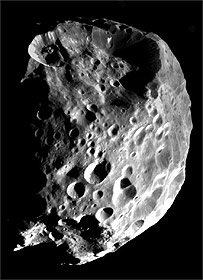
Images of Phoebe, one of Saturn's moons, taken by the Cassini spacecraft show that it is likely a remnant of objects formed billions of years ago in the outer region of the solar system.
The images probably show snow inside the craters, thus strengthening the theory that Fube is more similar to comets and other distant objects in the solar system, than to asteroids.
Scientists believe that Phoebe migrated to the interior of the solar system and was captured by Saturn's gravity billions of years ago. Several of Saturn's small moons may be fragments of Phoebe formed as a result of impacts from other bodies.
"As battered and battered as it is, Fovea gives us clues about its origin and history," says Dr Torrance Johnson of the Jet Propulsion Laboratory (JPL) in Pasadena, USA.
Phoebe is probably covered by an ice-rich layer covered by a thin layer of darker material 300 to 500 m thick.
"Based on the images, it appears that Fovea contains a lot of ice and probably originates in the distant part of the solar system and is more similar to comets and objects from the Kuiper belt than to asteroids." says Dr. Carolyn Porco, head of the Cassini spacecraft's image analysis team. Objects from the distant Kuiper belt are considered the building blocks of the outer planets.
Phoebe's face is covered with craters showing glowing streaks and rays of light. These are probably openings or cracks in the outer dark matter layer, revealing the ice layer below.
Dr. Alfred McEwan of the University of Arizona in Tucson, a member of the Cassini spacecraft's image analysis team, comments: "Phoebe is a world of dramatic shapes, with craters everywhere, land folds, and linear structures such as grooves, ridges and rows of pits. These are clues to the internal properties of Phoebe which we are carefully examining to understand the origin of Phoebe and its evolution."
Phoebe orbits Saturn in the opposite direction to the larger and closer Saturnian moons. This has led a number of scientists to hypothesize that a number of other small moons of Saturn orbiting it in the same direction - originate from Phoebe. Those moons were splashed from him as a result of the injuries he suffered.
The Cassini spacecraft - a joint venture of the American, European and Italian space agencies - will enter orbit around Saturn on the first of July. Next year it will launch a probe into the atmosphere of Titan - Saturn's largest moon.
Recent images of the moon Phoebe by the Cassini flyby were released this weekend
16.6.2004
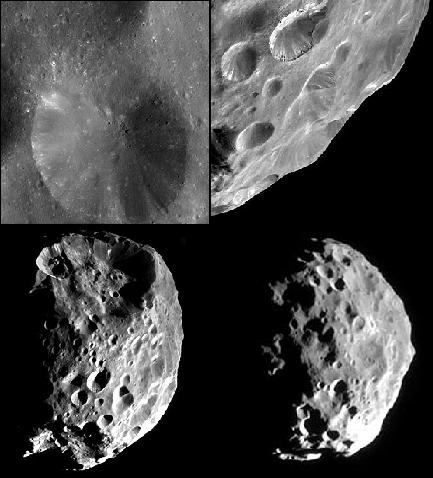
Saturn's moon Phoebe - four different photographs taken by the Cassini spacecraft from different distances, the closest of which is 2,000 kilometers. photograph: NASA
The Cassini spacecraft, which should soon reach the planet Saturn, passed at the end of last week at a distance of only about 2,000 kilometers from Pova, one of Saturn's moons, and sent photographs of it.
Fovea is a relatively small object (about 200 kilometers in diameter) and dark (it reflects only 6% of the light that reaches it from the sun). "On the surface of this strange moon there is little ice and a lot of black matter. Other than that, we know very little," said Dale Cruickshank, a NASA scientist who will analyze the information sent by "Cassini" to try to determine the moon's chemical composition. The many craters Phoebe is apparently impacted by large chunks of ice and rock. One of Phoebe's strangest features is that the moon orbits Saturn in the opposite direction than 30 The other moons that move around the planet.
First images from Cassini's approach to the moon Phoebe
Photos from the closest approach that took place last night near midnight Israel time have not yet been published, but even in these photos you can see new details
12.6.2004
By: Avi Blizovsky
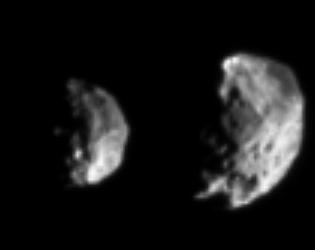
A distant photograph of the moon Phoebe by Cassini * Clearer photographs will be received today
Direct link to this page: https://www.hayadan.org.il/phoebe110504.html
The Cassini spacecraft, which is making its way to meet Phoebe, has sent more details about the interesting moon. The latest images on NASA's website were taken 13 hours apart on Thursday, the day before maximum approach. The images show a dramatic increase in the level of detail. The spin axis of the moon Phoebe is about 13 degrees to the left of the day-night boundary. Phoebe completes one revolution on its axis. At 9 hours and 16 minutes, two completely different crescents are visible in the two images.
A large crater with a width of about 50 kilometers, can be seen in the left picture. The right image shows a body dotted with craters in a variety of sizes, including very large ones, as well as many types of surface brightness. It seems that these are cliffs that are actually on the borders between large craters. Despite the extreme topography, a fovea is more round than irregularly shaped.
Both images were taken at an angle of 87 degrees between the spacecraft and the Sun. The left one was taken from a distance of 956,000 kilometers and the right one from a distance of 658,000 kilometers. The scale varies – in the more distant image it is 5.7 kilometers per pixel and in the right one 3.9 kilometers per pixel. To aid viewing, the images were magnified 3 times using linear interpolation, but no improvement in sharpness was achieved.
Fovea is a body with a diameter of approximately 220 km. Additional photos were taken (according to Israel time) on the night between Friday and Saturday, when the time of greatest approach was 23:56 p.m. Israel time, nine hours before this news was written, but the photos have not yet been published.
We will continue to follow.
For information on the JPL website
Cassini approaches a strange moon today * The mysterious moon Phoebe is about to be revealed soon
11/6/2004
The Cassini spacecraft, which is on its way to enter orbit around Saturn at the beginning of July 2004, i.e. in about a few weeks, is about to make a flyby of the mysterious moon Phoebe. Pova is only 220 kilometers in diameter and has never been explored in depth. The images taken by Cassini will be at least twice as good as those taken by Voyager 2 in 2. Pova was discovered in 1981. It is a small, dark moon.
So far, sunlit mountain ranges and deep dark craters have been discovered on the moon's surface. Today, Friday, Cassini will pass 2,000 kilometers from it.
Varied and interesting surfaces
Photos taken by Cassini before the approach show a clear contrast that scientists say may give an indication of a varied and interesting terrain. Long-distance images taken by the Voyager spacecraft on its one-time approach to Saturn in 1981, but Cassini's images with a resolution of a few tens of meters would be much better.
Phoebe orbits Saturn in the opposite direction to that of the larger and closer moons to the planet. It is believed to be a body captured by Saturn's gravity and originating in the outer solar system, perhaps none of the building blocks of the outer planets. If true, observations of Phobos will provide vital information about how the variety of worlds that populate the cold book regions of the Solar System formed.
Cassini-Higgins approaches the rings
The Guardian's Tim Redford reports that after seven years and more than three billion km, the Cassini-Higgins research spacecraft is very close to the mysterious planet Saturn
A seven-year, $3.3 billion journey into space is nearing its climax, when a space shuttle the size of a small bus will pass through Saturn's rings and begin a four-year investigation of one of the most mysterious planets in the solar system.
The Cassini-Higgins shuttle - a joint project of NASA, the European Space Agency and the Italian Space Agency - was launched from Florida in 1997 and has already traveled more than three billion kilometers. These sorties are intended, among other things, to help put the spacecraft into an orbit that will bring it to Saturn.
On July 1, it will pass at a speed of 5.15 km/s between Saturn's two outer rings, come within 20,100 km of the stormy giant's cloud tops, fire its engines for 96 minutes to slow down and become trapped in Saturn's gravitational field. On December 23rd, it will launch the Higgins Research Shuttle, which is the size of a wardrobe, into a 22-day collision course with Titan, one of Saturn's moons.
On Jan. 14, a camera and sensor suite will drop through the orange photochemical smog mantle within which the planet-sized moon resides. The moon has a compressed atmosphere and lakes and maybe even frozen oceans of carbon and hydrogen based molecules.
The Voyager and Pioneer shuttles have already made flybys of Saturn; Voyager made two such sorties and Pioneer made one. But Cassini will be the first shuttle to enter the coffee orbit around the star. It will explore the atmosphere, examine the structure of the ice powder and the rocks that make up the rings, measure the magnetic field and make approach missions to the moons Titan, Enceladus, Hyperion, Dion, Rhea and Laptus.
"Cassini-Higgins faces a crucial milestone in an admirable mission," said Ian Halliday, head of the UK's Particle Physics and Astronomy Research Council. "Saturn is considered the diamond of the solar system. It has fascinated us for hundreds of years. We are on the verge of a scientific discovery with the removal of the lot from Saturn's secrets. The more we learn about the planet and its moon Titan, the better we will understand our place in the universe."
Saturn is a huge ball of gas, which may contain a rocky core. Its core may even be made of metallic hydrogen. no one knows Equatorial storms rage in it, the speed of which reaches two thirds of the speed of sound, and it emits 80% more light than it receives from the sun. So it's clear that mysterious forces are at work beneath the hydrogen and helium mantle that hides it.
His rings are also a mystery. According to the theories, rings could form around a planet the size of Saturn, but some researchers predict that such rings are expected to fade after about 4.5 million years. The solar system, on the other hand, is at least XNUMX billion years old.
Titan has also intrigued astronomers for decades. This moon is larger than the planets Mercury and Pluto, and is the only moon in the solar system equipped with an atmosphere. Most of it is made of nitrogen, but the surface of the moon may be covered with frozen liquid methane and ethane. John Zarensky of the British Open University said: "Titan's atmosphere is similar to the early Earth's atmosphere, four billion years ago. When we look at Titan, it is our opportunity to go back in time and examine some aspects of the early age of the Earth."
Cassini-Huygens, weighing 5.3 tons, is the heaviest spacecraft ever launched into space. Scientists from 17 countries were involved in the project. During the mission, which will include 70 orbits of Saturn – as well as a close-up of its moon Phoebe – the spacecraft will send back 300,000 color images of Saturn, its rings, Titan and its other moons.
It will also transmit up to 1,100 images from Huygens as the small research shuttle makes its suicide dive into Titan's atmosphere. It is not known whether Higgins will land, at the end of a two-hour descent, on an icy ground or on a liquid bed; Zarenetsky speculates that Saturn's liquid methane days may even have waves. In any case, the research teams hope that the shuttle's sensors will continue to transmit information during the descent for up to half an hour, before the batteries stop working.
Cassini-Higgins progress can be followed at http://saturn.jpl.nasa.gov
The images from Cassini's approach to Phoebe have been published
