
A new study from MIT suggests that fasting may help regenerate stem cells in the gut, but also increase the risk of developing cancer when returning to eating
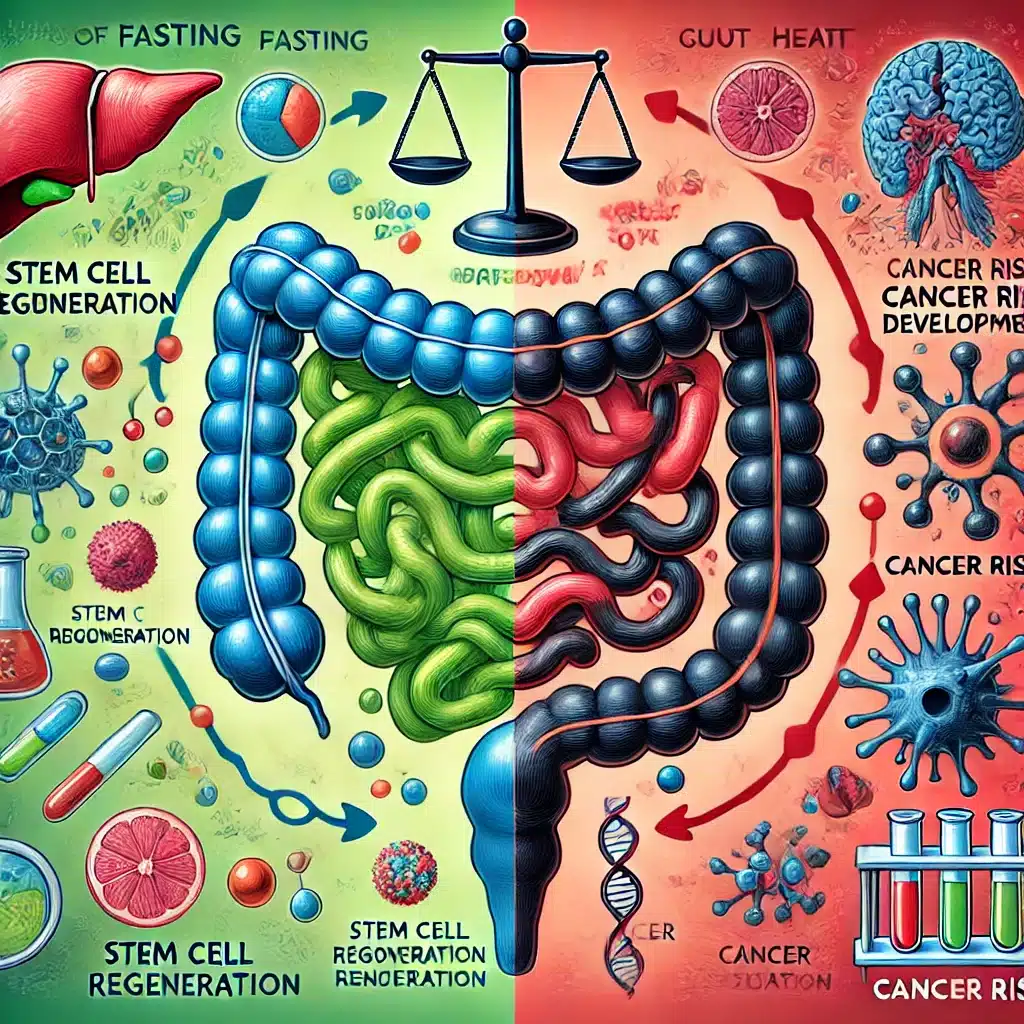
Intermittent fasting and a low-calorie diet stimulate the renewal of stem cells in the gut, a process that aids in recovery from injuries, but may also increase the risk of cancer when mutations occur during the return to eating phase. Researchers from MIT discovered the pathway that promotes cell renewal at this stage in mice, which also increases the risk of the stem cells becoming cancerous.
MIT researchers reported that fasting helps regenerate and heal stem cells in the intestines of mice, but may also increase the risk of developing cancer.
A low-calorie diet and intermittent fasting have been shown to have many health benefits: they can delay the onset of age-related diseases and extend life span, not only in humans but in other creatures as well.
This phenomenon has complex mechanisms. Previous research from MIT showed that one of the ways in which fasting improves health is by improving the regenerative capacity of stem cells in the gut, which helps the gut heal from injuries or inflammation.
In a study conducted in mice, MIT researchers were able to identify the pathway that enables this increased renewal, which is activated after the mice start eating again after fasting. They also found a downside to this renewal process: when cancerous mutations occurred during this time, the mice had a higher risk of developing early intestinal tumors.
"Excess activity of stem cells can be beneficial for regeneration, but increased activity over time can lead to less desirable results," explains Omer Yilmaz, associate professor of biology at MIT, member of the Koch Institute for Cancer Research, and senior author of the new study.
Yilmaz adds that more research must be done before conclusions can be drawn as to whether fasting has a similar effect on humans as well.
"We still have a lot to learn, but it is interesting to discover that exposure to a mutagen while fasting or returning to eating may significantly affect the risk of developing cancer, at least in mice," he says.
The article was published in the journal Nature.
Cell renewal
For several years, Yilmaz's lab has studied how fasting and a low-calorie diet affect gut health. In a 2018 study, the team reported that during fasting, intestinal stem cells begin to use lipids as an energy source, instead of carbohydrates. They also showed that fasting results in a significant increase in the ability of the stem cells to regenerate.
However, questions remain open: how exactly does fasting stimulate the improvement of the ability to renew, and when does the renewal begin?
"Since that study, we have focused on understanding what exactly during fasting causes cell renewal," Yilmaz explains. "Is it the fast itself that leads to renewal, or the return to eating after the fast?"
In the new study, the researchers discovered that the renewal of stem cells in the intestine is suppressed during the fasting itself, but bursts forth during the phase of returning to eating. They followed three groups of mice - one that fasted for 24 hours and then ate normally, another group that fasted for 24 hours and then ate without restriction for 24 hours, and a control group that ate freely throughout the experiment.
The researchers tested the ability of the stem cells to spread in the intestine at different time points, and found that the spread of the cells reached its peak at the end of the 24-hour return to eating period. These cells were even more active than stem cells in the intestine of mice that did not fast at all.
"We believe that fasting and returning to eating represent two different situations," Shinia Imeda explains. "In the fasting state, the cells' ability to use fats and fatty acids as a source of energy allows them to survive when the nutritional sources are scarce. Then, in the phase of returning to eating, cell renewal is significantly enhanced when food is available again."
The researchers discovered that the cells activate a cellular signaling pathway known as mTOR, which is involved in cell growth and metabolism. One of the functions of mTOR is to regulate the translation of messenger RNA into proteins, so that when it is activated, cells make more proteins. The production of this protein is essential for the renewal of stem cells.
The researchers showed that mTOR activation in these stem cells also led to the production of large amounts of polyamines - small molecules that help cells grow and divide.
"During the period of returning to eating, there is increased cell renewal, and more protein is required to build new cells," explains Saleh Khavald. "These cells continue to build cells that have differentiated into intestinal cells that function and line the intestinal walls."
Too much of a good thing can be bad
The researchers also discovered that when the stem cells are in a state of increased renewal, they are more likely to become cancerous. The stem cells in the intestine are among the most dividing cells in the body, as they help renew the intestine every 5 to 10 days. Because of this, they are the most common source of pre-cancerous cells in the intestine.
In this study, the researchers found that if they activated a cancer-causing gene in mice during the refeeding phase, they were more likely to develop pre-cancerous polyps than if the gene was activated while fasting. Cancerous mutations that occurred during the refeeding phase led to a higher chance of polyps formation compared to mutations that occurred in mice that did not go through the fasting and refeeding cycle.
"It is important to emphasize that all of this was done in mice, using well-defined cancer mutations," emphasizes Yilmaz. "In humans, the situation will be much more complex. But this leads us to an interesting conclusion: fasting is very healthy, but if by chance you return to eating after fasting and are exposed to a mutagen such as charred meat, the chance of developing a lesion that may become cancerous may actually increase."
Yilmaz also noted that the innovative benefits of fasting may be significant for people undergoing radiation treatments, which may damage the intestinal walls, or who suffer from other injuries in the digestive system. Now his laboratory is testing whether polyamine supplements can encourage such renewal, without the need for fasting.

One response
In all cell divisions there is a danger of incorrect replication, mutations and possibly even cancer. When considering all the options, it is clear that increased regeneration of the cells and removal of damaged cells is preferable, even at the cost of a marginal increase in risk. This claim is not clear at all, except perhaps an attempt to forcefully create a sensational headline, and discourage people from acting for their health.