
Universe Today
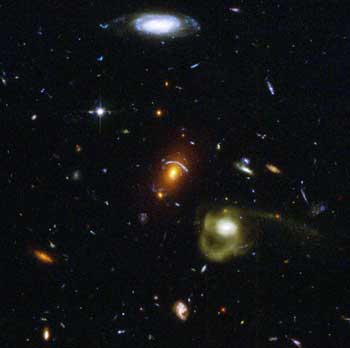
A collection of galaxies photographed by Hubble
Direct address to this page:
https://www.hayadan.org.il/hubbleeclectic0704.html
Like a photographer taking random pictures of a crowd of people, NASA's Hubble Space Telescope took an image of a collection of galaxies. Hubble's advanced camera wasn't looking for a specific target when it took this image. The camera simply captured a typical region of the sky, while the infrared camera Hubble's Adom looked at a target in a nearby region rich in galaxies.
The night of the galaxies in the image, taken in September 2003, includes a yellow spiral galaxy whose arms have been stretched, possibly as a result of a collision (bottom right of the image); A young blue galaxy full of newborn stars (top of image) and several smaller red galaxies.
The strangest-looking galaxy in the bunch, with the blue bow in the center of the image, is actually an optical illusion. The blue bow is actually the image of a distant galaxy, which has been distorted into a strange shape by a phenomenon called gravitational lensing. This "hall of mirrors" effect occurs when light from a distant object is bent and stretched by a mass between us and the object. In this case, the gravitational lens, or the mass causing the distortion, is a red elliptical galaxy about 6 billion light-years from Earth. The galaxy's red color indicates the presence of older, cooler stars.
The distant object, whose shape is like a leopard's eye in the long blue arc, is about 10 billion years away from us. This ancient galaxy existed just a few million years after the Big Bang, when the universe was about a quarter of its current age. Its blue color indicates the presence of young, hot stars in the galaxy.
Gravitational lenses can be seen in many places in the sky, as the universe is littered with galaxies. Hence, a pine of distant galaxies cannot move through space without encountering another galaxy along the way. It's like walking through a crowded airport. In space, light from a distant galaxy will pass through a galaxy on the way, but if the galaxy is massive enough, its gravity will bend and distort the light from the distant galaxy.
Long arcs like the one seen here are a common sight in large clusters of galaxies due to the huge concentration of mass. However, the arcs are not so common in the case of single galaxies such as the one in the picture. For the gravitational collapse to occur, the galaxies must be almost perfectly aligned.
Gravitational lensing provides important information about galaxies. They are a unique and particularly efficient way to directly determine the mass of the galaxy, including the mass of the dark matter in it. Galaxies are not made up of stars, gas and dust only. Most of the mass of the galaxy is an invisible type of matter, called dark matter. A study of this galaxy system, discovered not long ago and named J033238-275653, was published in the Astrophysical Journal Letters. This study, along with other observations, may help astronomers directly measure the masses of bright, nearby galaxies for the first time.
Translation: Dikla Oren
The article in Universe Today
Knowledge of astrophysics - stars and galaxies
https://www.hayadan.org.il/BuildaGate4/general2/data_card.php?Cat=~~~906878017~~~181&SiteName=hayadan
