
Universe Today
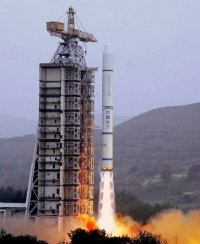
The Chinese scientific satellite Tan Sa 2 was successfully launched. Credit: ESA
Direct address to this page:
https://www.hayadan.org.il/doublestar0704.html
On July 25, the Chinese National Space Administration successfully launched the "Tan Ce 2" satellite, the second "Double Star" scientific satellite. The launch is an important milestone in the scientific cooperation between China and the European Space Agency ESA.
The Tan Se ("Explorer") 2 was launched from the Taiwan Spaceport, located west of Beijing, with the help of a "Long March 2C" rocket. The launch, initially scheduled for July 26, was brought forward a day to avoid unfavorable weather conditions expected in the coming days. The spacecraft will join Tan Sa 1, which was launched on December 29, 2003, and will complete the Double Star array.
About eight hours after launch the two solid piles, which hold the magnetometers, were successfully deployed. In the coming weeks, all subsystems of the spacecraft will be tested, after which the scientific instruments on board the satellite will begin to function.
The Double Star will work with the four Cluster satellites to study in detail the relationship between the solar wind and the Earth's magnetic field. Together, both tasks will provide the most accurate information so far. 1-TC already sends a wealth of scientific information. In January of this year, the two missions followed coronal mass ejections and collected invaluable information about the shock wave on Earth.
Tan Sa 2 enters its orbit, with its closest point to the Earth at an altitude of 682 kilometers, the farthest point at a distance of 38279 kilometers and the inclination angle of the orbit is 90.1 degrees. The positions and orbits of the Double Star satellites were determined after a lot of computer work to allow a more extensive study of the magnetosphere than with the help of the cluster satellites alone. One example of coordinated activity between the satellites is the study of storms
which cause the appearance of the aurora borealis.
It is still not clear what is the exact area where the aurora borealis was created, but the exact measurements, which will be conducted simultaneously by the two missions, should yield an answer to this.
The European Space Agency contributed eight scientific instruments to the mission, seven of which are related to the Cluster mission.
These are the first European experiments, flying on top of a Chinese satellite. The European Agency will also provide ground support for periods, four hours each day, with the help of the satellite tracking station Villafernsa in Spain.
The scientific cooperation between China and the European Space Agency began a long time ago. The first agreement, signed in 1980, facilitated the exchange of scientific information. Thirteen years later the collaboration focused on a specific mission, Cluster, whose goal is the study of the Earth's magnetosphere.
Then, in 1997, another step forward was made. The Chinese Space Agency invited the European Space Agency to take part in the mission of the two Double Star satellites, which aims to study the Earth's magnetic field from a different but complementary angle to that of the cluster. The agreement to carry out the joint mission was signed on July 9, 2001 by the director of the European agency at the time General Antonio Rodota and the director of the Chinese agency Luan Enjie.
Professor David Southwood, ESA's program manager, said: "Today's successful launch marks the culmination of these joint efforts and another step forward in the historic cooperation between China and Europe."
Translation: Dikla Oren
The article in Universe Today
The press release from ESA
They knew space missions outside the United States
https://www.hayadan.org.il/BuildaGate4/general2/data_card.php?Cat=~~~908781852~~~200&SiteName=hayadan
