
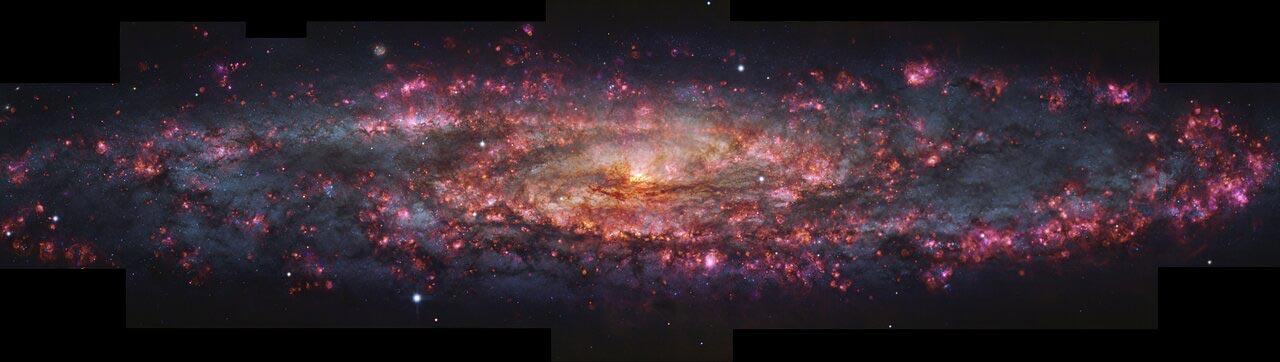
Using the MUSE instrument on ESO's VLT telescope, researchers have created a rich color map that reveals the life of stars, their formation processes, and the structure of gas and dust in NGC 253.

Astronomers have revealed a stunning new view of the Sculptor Galaxy, creating a highly detailed image that reveals details never before seen. The achievement comes from observations with the European Southern Observatory’s (ESO) Very Large Telescope (VLT), which captured the galaxy in thousands of different colors at once. The team collected vast amounts of data from each region and pieced together a complete picture of how stars live and evolve throughout the Sculptor.
“Galaxies are very complex systems that we still have a hard time understanding,” said ESO researcher Enrico Conjo. Galaxies span hundreds of thousands of light-years and are very large, but their evolution depends on what happens on a much smaller scale. “The Sculptor Galaxy is in an ideal spot,” says Conjo. “It is close enough that we can decipher its internal structure and study its building blocks in great detail, but at the same time, large enough that we can still see it as a complete system.”
The building blocks of a galaxy, including stars, gas and dust, shine with different colours of light. The more distinct the colours captured in an image, the deeper the insights into its internal processes. Standard images usually show only a few colours, but Pessel's new map contains thousands. At this level of detail, astronomers can determine properties of stars, gas and dust such as their age, chemical composition and motions.
To create this map of the Sculptor Galaxy, located 11 million light-years away and also called NGC 253, the researchers observed it for more than fifty hours using the MUSE spectroscopic instrument on ESO’s VLT. They had to stitch together more than a hundred exposures to cover an area of the galaxy about 65,000 light-years across.
Zooming in and out tool
According to co-author Catherine Krekel, the map is a powerful tool: "We can zoom in to study individual regions where stars are forming on a scale close to that of individual stars, but also zoom out to study the galaxy as a whole."
Because of the properties of planetary nebulae, they can be used as distance markers to their host galaxies. "Finding planetary nebulae allows us to verify the distance to the galaxy – critical information on which other studies of the galaxy rely," says Adam Leroy, co-author of the study.
Future projects using the map will study how gas flows, changes its composition and forms stars throughout the galaxy. "How such small processes can have such a large impact on a galaxy that is thousands of times larger is still a mystery," said Kunjo.
More on this subject on Hayadan.com - Science news:

2 comments
Response to the article about the discovery of the Davidson and Sheba Institute: I have already written this, but I will write it again: If you are sure that this will save a human life – do not delay with it. “Whoever saves one soul of Israel – it is written for him as if he saved the entire world!” (Mishnah, Seder Zeraim Tractate Sanhedrin, Chapter 4, Mishnah 5) Blessed are you!
Response to Roy Tsezana's article on the decline in youth employment: The days of the Messiah have arrived! Here is the end of the curse "In the sweat of your face you shall eat bread" (Genesis, Chapter 3, Verse 19)