
On April 13, 2029, the large asteroid will pass about 32 thousand kilometers above Earth's surface. There is no risk of collision, but Earth's gravity could change its rotation, its orbit, and possibly its surface.
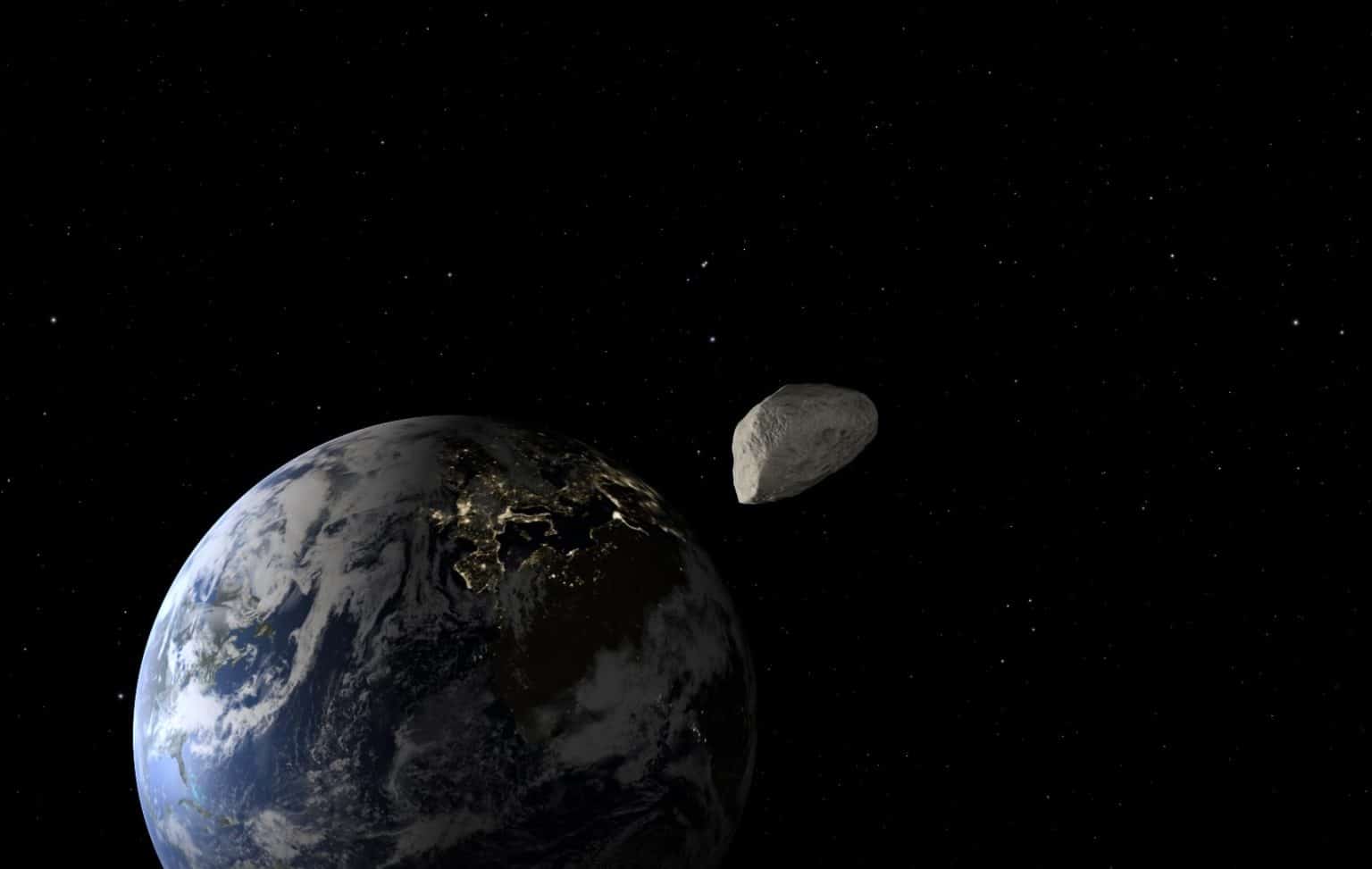
On April 13, 2029, an extremely rare encounter will occur between Earth and a large asteroid. Apophis, estimated to be about 340 to 375 meters in size, will pass at an altitude of about 32 thousand kilometers above the Earth's surface – closer than the orbit of geostationary satellites.
Despite its proximity, Apophis will not hit Earth. Its orbit is calculated with great precision, and NASA states that it does not pose a collision risk for at least the next hundred years. The importance of the pass stems precisely from the possibility of observing up close what the gravity of a planet does to a large asteroid, which is likely to have a loose structure.
A review published in the journal Space: Science & Technology summarizes what is known about Apophis and the questions researchers hope to examine during the flyby. Among other things, scientists will try to measure changes in its orbit and rotation, the movement of rocks and dust on its surface, possible reactions of its internal structure, and the emission of dust particles.
Very close – but not dangerous
Reports of the flyby sometimes give two different distances. About 38 thousand kilometers is the distance from Earth's center to the asteroid's center; subtracting Earth's radius gives an altitude of about 32 thousand kilometers above the surface.
This is an unusually close pass for an asteroid of this size. Apophis will be closer to Earth than some artificial satellites, but still much further away than the International Space Station. In some areas, under suitable conditions, it will be visible without a telescope as a moving point of light in the sky.
Apophis was discovered in 2004, and initial calculations raised a worrying possibility of impacting Earth in 2029. Additional observations ruled it out, and radar observations conducted in 2021 also made it possible to remove the risk of impact previously calculated for 2068.
A natural test for an asteroid that is a “pile of fragments”
Based on available measurements, Apophis is an elongated, asymmetrical asteroid, rotating in a complex motion rather than around a single, stable axis. Its relatively low density suggests that it may be a “rubble pile” – a collection of rocks, stones, and dust held together by weak gravity.
Such a structure makes the close pass a natural experiment. Earth's gravity does not act equally on all parts of the asteroid. The difference between the force exerted on the side near Earth and the force exerted on the far side creates tidal forces.
The forces are not expected to break Apophis apart, but they could change its rotation rate and the direction of its axis of rotation. Models included in the review suggest a change of a few hours in the rotation cycle is possible, but the actual magnitude of the change depends on the asteroid's shape, the distribution of mass within it, and its precise state of rotation.
Precise measurement of the change will allow researchers to indirectly learn about the internal structure: whether Apophis is a relatively uniform body, whether it consists of several large lumps, and where its center of mass is located.
Will the surface move?
Earth's gravity could also cause local landslides or the movement of dust grains and rocks. The simulations do not predict a complete change in the asteroid's shape, but material could move in small areas, especially on unstable slopes.
Such a movement could expose material that has not yet undergone extensive space weathering. Comparing the color and composition of Apophis before and after the transit could help test the hypothesis that close passes by planets “refresh” the surface of the moon. Asteroids.
Another intriguing possibility is the ejection of dust particles. The gravity on Apophis is very weak, so small particles that break away from the surface could escape. However, this is a prediction dependent on models at this stage, not a guaranteed occurrence.
A spacecraft before the transition and a spacecraft after it
The most important measurements will be obtained from comparing Apophis' condition before, during, and after the encounter.
mission RAMSES of European Space Agency, in collaboration with Japan, is intended to reach Apophis before the encounter and monitor it closely. The spacecraft is scheduled for launch in the spring of 2028, and it will also carry two small cube spacecraft. If the mission goes as planned, it will be able to record the asteroid as Earth's tidal forces act on it.
NASA's OSIRIS-REx spacecraft, which returned samples from the asteroid Bennu to Earth, has been given a new mission and renamedOSIRIS-APEXShe will arrive at Apophis after the transition and investigate its new state. She won't be there to take close-up photos of the transition itself, but she will be able to see what changes remain after it.
Alongside them, telescopes and radar systems around the world will operate. The International Asteroid Warning Network is planning observation missions in the years leading up to and during the transit. The observations will also be used to test cooperation between observatories, space agencies, and warning systems.
General rehearsal without emergency
Apophis provides the planetary defense community with a rare opportunity to conduct a dress rehearsal when it is known in advance that there is no risk of impact. Researchers will be able to test how quickly observations from different countries are collected, how to reduce orbital uncertainty, and how to coordinate spacecraft, radar, and ground-based telescopes around a rapidly approaching object.
The information could also help plan future emergency missions to asteroids that are found in dangerous orbits. To deflect an asteroid, you need to know whether it is solid rock, a porous body, or a loose pile of debris. Apophis' response to Earth's gravity could provide a rare test of these models.
So the story of Apophis is no longer a story about “an asteroid that threatens Earth.” It is a story about an asteroid that is not threatening, but comes close enough to teach us how to deal with one that could threaten in the future.
Questions and Answers
Will Apophis hit Earth in 2029? No. Its trajectory has been measured with great precision, and a collision in 2029 has been ruled out. NASA states that it poses no threat of impact for at least the next hundred years.
How close will it pass? About 32 thousand kilometers above Earth's surface, or about 38 thousand kilometers from Earth's center. This is below the orbit of geostationary satellites.
Could Earth's gravity break it apart? The models do not predict breakup. However, gravity may alter its rotation and cause local movement of material on the surface.
Why the transition is important toPlanetary protection If there is no risk of injury? It allows for testing international observation and coordination systems and learning how a loosely structured asteroid responds to strong gravitational forces – information needed for planning future deflection missions.
Read more on the news website
- Approaching an asteroid: Exploring Apophis using advanced minisatellites
- Britain planned a spacecraft to explore Apophis
- Asteroid 2024 YR4 and the Chances of Colliding with Earth
- More articles on planetary defense
Sources
- The article in Space: Science & Technology
- NASA: Asteroid Apophis and the 2029 Transit
- European Space Agency: RAMSES mission to Apophis
- International Warning Network: Apophis Observation Campaign
- Jet Propulsion Laboratory: Planning Radar Observations in 2029
For the original publication: Opening the original publication
More on the subject on the science website
- Vera Rubin Observatory begins operations and has already discovered more than 11,000 new asteroids
- A giant asteroid hit Australia 11 million years ago – but where is the crater?
- NASA's DART mission deflected an asteroid – but released a swarm of space rocks
- Three 'hidden' asteroids behind Venus highlight the danger of uncharted skies
- Asteroid 2024 YR4: Chances of collision with Earth in 2032 increased to 2.3%
