
Dancing in the Bible: an external expression of inner feelings and experiences, from manifestations of worship to victory in battle
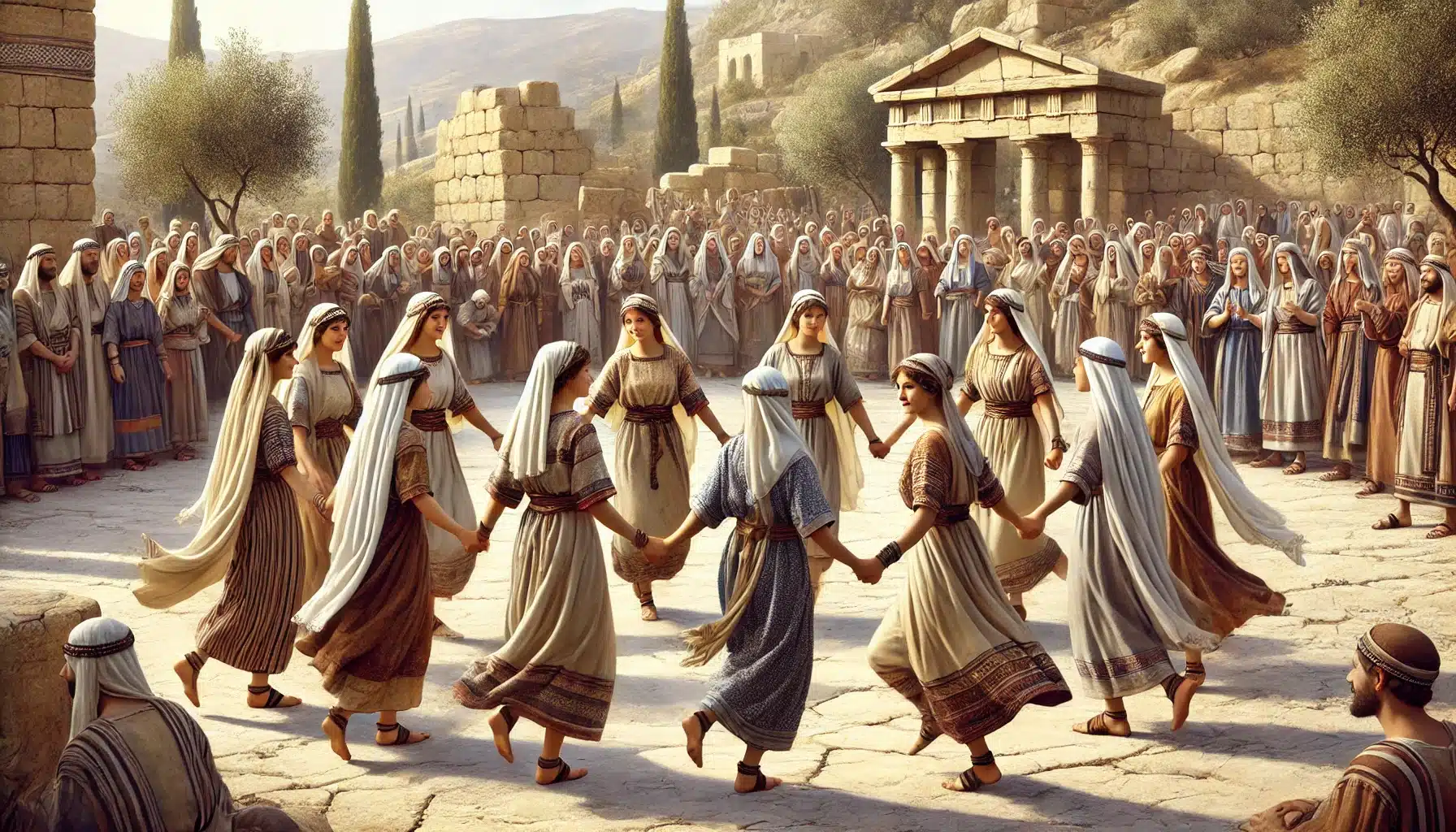
the dance
The dance, which is a motor response and an outlet for the creature of movement, drew its satisfaction from the rhythmic movement itself. As such he was close to music, when in certain situations there was a mutual tension between the two, one that enriched both of them together.
As for music, a boundary can be drawn between the Biblical period and the days of the Second Temple, the Mishnah and the Talmud.
Biblical period 1
One of the more central problems that affected all the research approaches focused on the chronological questions, since the Bible was not at all subject to historical/chronological touchstones and was not written with any chronological trend in mind, and as a result we find ourselves drowning in a problematic quagmire between many chronological layers with almost no key that can distinguish between a period one to another. However, we will roll up our sleeves and try to find some proper and appropriate chronological key.
During the biblical period we witnessed many manifestations of dance, and to such an extent that it can be said that dance, as an external expression and public manifestation of all inner feelings and experiences, occupied a prominent place in the lives of the people, either as an expression of joy, of devotion to God, as part of the holiday, especially in processions, or as an expression of the joy of victory in battle and more. The dances during this period were imbued with foreign, Egyptian and especially celestial symbols. It should be noted here that the dance for clear and understandable reasons was also a sexually stimulating factor and in the fertility cult dances were interwoven that were intended to stimulate the sexual urge.
The fact that dance in the biblical period is discussed in three separate terms such as "dance", "sand" and "play" may teach us about the diversity of dance and its various manifestations in the context of special situations:
Dance - may have been derived from the root "sand", meaning a rotation, or a circular movement. In most cases this word referred to a physical movement produced by women. Or is it possible and derived from the "flute" (or the other way around?!). That is, the reference to the musical instrument that was the foundation of this dance, and this alongside the drum that sometimes appeared with the dance as an instrument that gave the beautiful rhythm to the dance, although its melody was different and the purpose of the change from the drum.
Dance - comes in the Bible when it comes to jumping and playful movements.
Play, laugh - comes in the Bible as a general bodily outlet and an expression of joy.
The dances in the Bible were usually performed by women, and they abounded with a great musical rhythm, which was characteristic of this period.
As for the form of the dance, it is not known whether it is circle, line or single dances. It is commonly believed that the common dance was a dance of answer, such as a response, in which a male or female dancer would create and the large group would imitate them.
We will quote here some of the most well-known cases in the Bible in order to present the dance/dance/game as an inseparable part of the ancient existence in its various components.
"Abduction" of women/girls/virgins
I will make a preliminary remark here: the word "kidnapping" is surrounded by double quotation marks and for good reason. And about that later.
In the book of Judges (21:XNUMX ff.) the Bible tells a seemingly strange story about the sons of Benjamin that "the sons of Benjamin came out of the hill and destroyed in Israel on that day two and twenty thousand men to the ground. And the people of Israel grew stronger and they continued to wage war in the place they held there." As a result, the Israelites swore not to marry their daughters from here and bring them to the tribe of Benjamin. Over time, they realized the magnitude of the confiscation under oath and the fear that an entire tribe, like Benjamin, might cease to exist. But what, the oath must not be answered except with a "counter-oath" that nullifies the curse above. The solution found was as follows: "And they (the House of Israel) said: Behold the feast of Yahweh in Shiloh (Shilah) from Mim-Yimima which is from the north of the house to the east of the sun to the track that goes up from Beit El Shechema (in the direction of Nablus) and sweeps to Lavona (what precision in the orientation of the site, similar to displaying coordinates for reading The topographical map, due to the sanctity of the place, is an alternative to a vow made to God and considering the expected, traditional holiday, considering Yamim-Yimima) and commanded the sons of Benjamin to say: Go and lie in wait in the vineyards and behold, the daughters of Shiloh came out to the sand and you came out (from your hiding places) from the vineyards and you kidnapped (the) wife of the daughters of Shiloh and you went to the land of Benjamin (in the territory of your tribe). Let their fathers or brothers (of the "kidnapped" ones) come to quarrel (fight) with us (with us), and we said To them: We bribed them because we did not take (captured, captured, abducted, robbed) a man his wife in war, because you did not give them, and now the sons of Benjamin will do so, and they will take women among their number from the women who plundered (in quotation marks) and they will go and return to their inheritance and build the cities. and sat in them."
A charming and amazing story about solving a menacing and deadly curse. how? By another practice, it is also sanctified for carrying women, having a religious goshpanka, a kind of ritual, and one that has become a practice of hundreds of years as confirmed in the sources of sages. That is, the creation of romantic relationships, a kind of seemingly forced promotion of marriage in a strange way of kidnapping. This is not an activity Brutal but acceptable violence, a refined kind of "prenuptial agreement" between the "kidnapper" To be "abducted" and all with God's blessing through the above custom. Before us is therefore a physical, visual way of creating pre-wedding connections.
The quasi-romantic meeting, but my aforementioned friend, between the women, or rather the virgins, who have not yet found grooms for them, and the potential "kidnappers", is really interesting and even, forgive me for my sentimentality, even moving, when a cruel vow "bent" in front of a need Something sexual, familial, tribal... under the auspices of a female choreographer at the time, i.e. dance and dance.
It should be noted that such phenomena, despite their kind of artificiality, are known to us throughout history. Female courtship dances in the presence of men and even for "kidnapping" them are known from the Bedouin, Georgian (Georgian) and American tribal traditions among some Indian tribes. And remember the exciting American musical film titled "Seven Brides for Seven Brothers" played in 1954 with the participation of Jane Powell and Howard Keel regarding the "kidnapping" of the brides. Including "Eskimo Lemon", "Sapihas", "Permanently Going Out". And on a personal, somewhat nostalgic note, I met my lovely wife at one of the ballroom parties (the "closed") ones in Tel Aviv in the mid-60s and since then we have been a dancing couple...ballroom dancing of course and even competitively.
An expression for victory in battle
In the book of Exodus 21:20-XNUMX it is told about Miriam the prophetess, sister of Aaron who "... took the drum in her hand and all the women went out after her with drums and dances. And Miriam answered them: Sing to the Lord, for he is proud. A horse and its rider rose in the sea." It is a sung dance led by Miriam the prophetess and the daughters of Israel in front of her. Between the leader, the conductor, and the women, a song develops about the victory of the Israelites over Pharaoh's army in such a way that Miriam opens with a sentence and the daughters of Israel respond to her in song and dance. Such a phenomenon was called a "response song" or "response dance". "Answer by examination" an answer along which hangs the plot of the war between Moses and Pharaoh in the examination of an army against an army.
In the book of 7 Samuel 6:XNUMX-XNUMX we read that: "And it came to pass when they came, when David (the former king) returned from smiting the Philistine, that she went forth from all the cities of Israel to sing and (make) the dances for King Saul with drums, with joy and in tridents. And the dancing women were interested and said to them: 'Smite Saul with his harp and David with his harps.'" Even here we have another picture of women singing and dancing at the event of the end of a battle and after the victory of Saul and David. This is probably also about choirs and dancers in what is called "response songs" or "response dances" of theatricality between two groups that call from one another and respond from one another, as well as those that approach each other and move away accordingly (where In the youth movement, we also added for the benefit of the dance steps and the song... "Ben Yishai is alive and well").
A similar image emerges from the victory of the judge Yiftah against the army of the Ammonites and his return to his home in the Mitzpe settlement, which has the ritual affiliation, his daughter, Yiftah's daughter, precedes him "with drums and dances." Probably also here with the accompaniment of the Mitzpe Girls' Choir.
In the book of Samuel 20 (XNUMX:XNUMX) one or more lines from the song of the defeat of the discrimination are alluded to, such as: "Do not say in Gath. Do not preach in the streets (probably markets) of Ashkelon, lest you encamp the daughters of the Philistines, lest the daughters of the desert be made merry." The song is sung by David lamenting the death of Shaul and his son in the war, in the burning disaster. The song was probably intended to express the cry of the burning discrimination at the hands of the Philistines.
Later and on the occasion of the victory over the Philistine army and during the bringing of the ark of God in royal-royal ceremonies as he leads the jubilant crowd, "...and David crooned with all his might (singing and dancing) before Jehovah. And David girded on a cloth vest and David and all the house of Israel raised the ark of Jehovah with rejoicing and with the sound of a trumpet..." (15 Samuel 14:16-21). And Michal daughter of Saul watched David from the window "and she saw King David frolicking and frolicking before Jehovah..." and she despised him in her heart" (ibid. XNUMX). And she mocked him and David's overwhelming answer was "...and I played (that is, I danced and sang and perhaps even imagined as a kind of personal role) before Jehovah "Ibid., XNUMX) In particular, a great honor fell to me and this was said in front of the public and the people.
A phrase that betrays a connection between women and dance in a social context
Another poem is hidden, similarly, behind the verse in the book of the Song of Songs in this language: "Return, I return to the Shulamite. Return, I return, and we will see you. What will you see in the Shulamite? Like the pain of the swords" (Song of Songs, 1:XNUMX). Again the connection between the song and the dance is emphasized and perhaps even hinted here as a kind of response song between the conductor and the dancer perhaps leading the group of generators.
Another song is probably hidden behind the verse in the book of Jeremiah: "Yet you will build and a virgin of Israel will be built. You will beat your drums and you will go out in a game dance. You will plant vineyards in the mountains of Samaria. They will plant and desecrate" (4:3-XNUMX). And again the connection between the drum, the song and the dance emerges. the dance as an accent and as a dramatization of an image, some plot from the battlefield or the liturgical-temple performance.
Most of the times and it seems very clear that the women are the ones who took a dominant place in dance and song as well as in the use of musical instruments. We emphasize that the woman's body, unlike the man's, allows her excessive mobility and a connection between the choreographic performance and the content of the presented matter.
More dance phrases
Before us is an abbreviated collection of biblical terms/phrases that interpret an interesting picture of various dance formations, performed either by women, or in a female context, beyond the implication that women, due to their physical characteristics, had an interesting and special movement ability, as well as by men and in the various images they expressed, This is similar to the nature of the particular dance, which part is very physical and even in imitation of natural phenomena as well as the movement of animals such as: "The mountains, dance like hill rams like sheep. Before the lord of the sick (dance) of the earth" (Psalms 6:XNUMX), when here the dance is contrasted with the dance.
And in Joel 5:6 it is said that "On the tops of the mountains I will dance like the sound of a blade of fire consuming straw..." to indicate the enthusiasm for dancing and also in the Psalms (21:10) the verse appears: "And they danced like the calves of Lebanon..." and in Isaiah (7:7) the verse appears : "...and hairy people will dance there". And besides the dance, the dance appears in its various linguistic forms, such as: "Sickness and comfort, the daughter of Zion as her child" (Micah 9:4), "Before the Lord of the sick of the land" (Psalms 4:3), "And sing as blasphemers" (Psalms XNUMX:XNUMX) , "Yahweh's voice will bring forth a doe" (Ibid., XNUMX:XNUMX, "Praise be to His name in dance" (Ibid.: XNUMX:XNUMX). And in a kind of interesting combination between dance and acting, although sacrifice Among them it is not imaginary as in Jeremiah (XNUMX:XNUMX-XNUMX) and more and more such as the dispersals of various kinds.
Well, of course we are not talking about dances in the style of ballroom courtyards such as the minuet from this one and the folk Krakowiaki from this one. Not even in classical modern dance, or one or another ballroom. The style was closer, thus similar, to ancient African or South American folk dances and maybe-perhaps to the "da-da" style of Ohad Naharin or some other ecstatic dances.
In any case, the dance/play was a physical expression, mainly feminine but also masculine, of the direct and indirect relationship between man and God, between man and natural phenomena, between man and rivalries and wars, and so on in these various images and contexts to nature and beyond.
More of the topic in Hayadan:

One response
Thanks