
Between Hod Hasharon and Kfar Saba, they live in a pleasant green area near the water, about five turtles, who spend their lives in a pleasant peace disturbed only by seagulls and seagulls who come to visit from time to time. Surprisingly, this pastoral habitat that the turtles chose for themselves is none other than the sewage treatment plant - Samaria rivers and the turtles in question are softshell turtles, a species that is in danger of extinction in the world and in Israel
By: Neta Nissim, Zwata - Science and Environment News Agency
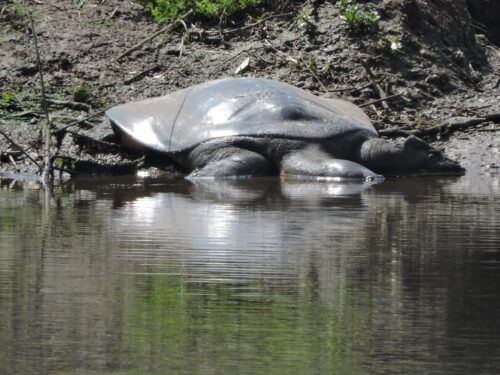
Between Hod Hasharon and Kfar Saba, they live in a pleasant green area near the water, about five turtles, who spend their lives in a pleasant peace disturbed only by seagulls and seagulls who come to visit from time to time. Surprisingly, this pastoral habitat that the turtles have chosen for themselves is none other than the sewage treatment plant - Samaria rivers and the turtles in question are softshell turtles, a species that is in danger of extinction in the world and in Israel.
The common softshell turtles (Trionyx triunguis) live in Israel mainly along the coastal streams. In ancient times, the soft turtle family included hundreds of species that thrived around the world, but today only 22 species remain. Most of them live in Africa, Asia and the Middle East, and a minority - in the Americas. The soft-shell turtle is common in the Middle East, in Africa along the Nile and in Central and West Africa and is defined as a "vulnerable species" by the IUCN organization - it faces many dangers and threats, whether it is direct effects such as hunting and fishing or indirectly, in the form of environmental development, continuous pollution and drying The humid habitats where the turtles live.
At the beginning of the 70s, the condition of the soft-shelled turtles in Israel was very serious due to the pollution of streams and accelerated development, so the legendary Israeli zoologist Heinrich Mendelsohn initiated the transfer of them to Lake Hula in order to keep them there. The species thriving in an unexpected place like a sewage treatment facility is nevertheless an unusual and very positive event.
The presence of the turtles in the MTS is not a new matter, but recently nests were also found in the area, a sign that the turtles in the colony not only enjoy wading in the purified sewage water but also take care of the continuity of the species.
"Over the years we knew that there were softshell turtles in the Pelagi Sharon police station, but only when the Nature and Parks Authority began conducting surveys to monitor the softshell turtles along the coastal streams did we realize that right under our noses we have an entire colony of turtles that is also breeding," says Gadi Burd, an inspector at the Nahal Yarakon Authority "It's a big deal to me that an endangered animal has been growing, multiplying and surviving for many years right here, in a sewage treatment facility. global".
The turtles at the Tash are concentrated in one of the purified effluent water ponds, where the water is of a quality suitable for use in irrigation ("secondary treatment"). After the water undergoes tertiary treatment that makes it even suitable for irrigating field crops, it is regularly discharged into the Hades and Cana streams, which are near the Tash And they are part of the sources of Nahal Yarkon.
"Before we fenced off a designated place for turtles within the Mtash, the turtles would go into empty ponds so that they and their eggs were very exposed to predators such as crows, mongooses and jackals that roam the area," says Itzik Tamm, director of the Sharon Pelgi Purification Institute. "So that the turtles don't go there anymore We covered the pool with a net and fenced off a place for them near the wastewater pool."
"In addition to the soft-shelled turtles in the Mtash, we are visited throughout the year by ducks, seagulls and skuas, species of carnivores, and you can find aquatic plants here, such as Nahanronit, which is also an indicator of the good quality of the water," adds Tamm. ".
jackals against turtles
The soft-shelled turtles in Israel need someone to look after them, not only in the Pelagi Sharon police station. Today, the largest populations in Israel are found in the Hula Reserve and the Nahal Alexander National Park, and in each of these habitats there are only a few dozen turtles. The situation in other coastal streams is even more worrying: in Nahalim, Kishon , Crocodiles, Ada and Yarkon have been counted since the 1970s. Additional soft-shelled turtles are also found in the Jordan system (incl in the Hula reserve) - this is due to the transfer of softshell turtles to this system in the late sixties.
"There are several stable populations of softshell turtles in the streams of the country and we are working in collaboration with various researchers in order to learn about the genetic diversity of these populations so that we can know how to best treat each population," says Dr. Dana Milstein, aquatic habitat ecologist at the Nature and Parks Authority "One of the main problems of the soft turtles are the predators that destroy their nests. In Nahal Yarkon, for example, predation is very high, and may reach one hundred percent of the nests in a season (in the past the main predators were mongooses and in recent years jackals are the main threat to the turtles, N.N.). The high percentages of predation are problematic since the population in the stream is small."
Over the years, the population of softshell turtles in the Yarkon has been maintained at varying sizes, even during periods when the pollution levels of the Yarkon water were higher than today, and every year between 15-5 nests of softshell turtles are observed in the stream, but most of them are killed.
"Another danger they face is fishing along the length of the Yarakon streams. We have had unpleasant cases where we found turtles that had swallowed a hook by catching the fishermen's bait. If we are able to find them in time we try to remove the hook, but this is a serious health injury and a problem that is not so common in public awareness," adds Yonatan Raz, the ecologist of the Nahal Yarakon Authority.
"In order to preserve the mollusc turtle populations in the coastal streams, we carry out nesting surveys to monitor the nests of the mollusk turtles along the length of all the coastal streams, and this is how we arrived at the nests at the Pelagi Sharon police station," says Milstein. the number of nests on the banks and trying to understand what the preferred nesting places are, so that we can protect them, adapt them to the population the turtles and keep them maddening."
"It is important for us to keep these turtles. They are like a kind of cleaners of the streams, they clean the streams by eating carcasses and rotten material and it is fun to know that they live in the water," says Raz.
Should the turtles be returned to the stream?
The soft-shelled turtles apparently arrived at the Pelgi Sharon watershed from one of the streams in the area. "The tributaries of the Yarkon used to be dry, but in recent decades high-level wastewater has been flowing into them from the watershed. This means that a continuous water connection has been created between the Pelagi Sharon watershed and the Yarkon," he explains Raz. "This turns these tributaries into a wet ecological corridor, which invites animals such as turtles as well as various plants."
According to Raz, the presence of the soft-shelled turtles in the Mtash highlights the importance of using streams in Israel as ecological corridors and shows that even wastewater treatment facilities can serve as a refuge for turtles and other animals.
But wouldn't it be better to move the softshell turtles from the MTS to another coastal stream in the area? "We would be happy if the population of turtles in the MTS lived in their natural environment, but since they are doing well there right now, we can use them as a breeding ground and a great gene pool for the future," he says a rose "It is true that moving them to another place where there is a population of turtles - the Yarkon, for example - can increase the population and perhaps this way a greater genetic diversity will be created that will strengthen the population of soft-shelled turtles that is there," says Milstein, "but for the moment we have decided not to touch and keep the population in its current location In the MTS because it reproduces and the products of reproduction (nests and eggs) can be moved back to the stream."
By the way, even though the turtles spend most of their time in cleaned sewers, unfortunately the professionals who follow them have yet to report that they have developed impressive ninja abilities or a special fondness for pizza.
More on this subject on Hayadan.com - Science news:
- The bacteria that restore the the stream
- Do all streams flow to the sea?
- Researchers from Tel Aviv University found evidence of eating turtles 400 thousand years ago In a magic cave in Rosh Ha'Ain, not far from Yarkon

4 תגובות
overpowering…
Good luck to those involved in the craft.
It's just lovely, I really like turtles, please take care of them!
Thank you for a special and exciting article,
I thought there would be no more continuity for turtles in Nahal Alexander, glad I was wrong
Very unwise to post the location.
In curious days... lovers of the destruction of nature...
Either the turtles will disappear or they will be killed.
Too bad.