
A study by researchers at the Miguel Research Institute who reviewed various methods for extending shelf life using artificial intelligence and chose the most appropriate protocol will help save money and reduce depreciation in fruits and vegetables
Due to the climate crisis that is challenging fruit and vegetable growers and the trend to extend their shelf life after harvest, and further to the global trend to reduce waste in fresh food (it is estimated that 25%-40% of fresh food is thrown away) - research in this field is most relevant to growers, cold storage and freezing houses, marketing chains and consumers.
The research achievement at the Miguel Research Institute is a breakthrough in scientific research to extend the shelf life of fresh fruits and vegetables in particular, and the use of artificial intelligence to increase productivity in agricultural crops in controlled growing structures in general. The research was supported by the Ministry of Innovation, Science and Technology and the Ministry of Agriculture and Rural Development.
The research was led by Prof. Ofer Shir, Head of the Department of Computer Science at Tel-Hai College and researcher at the Miguel Research Institute, a computer scientist who has been researching the computer's ability to contribute to scientific research and integrate into laboratory experiments for over a decade, and Dr. Dani Germasani, a plant science researcher and a lecturer at Tel-Hai College, specializing in post-harvest and fruit physiology - researching the field of the condition of vegetables and fruits from the moment Collected/harvested, and witnessed in general.
The two researchers combined artificial intelligence algorithms in scientific research to optimize and extend the shelf life of fresh agricultural produce.
In the field of extending shelf life - there are treatments and recommendations for the preservation of fruits and vegetables in the world, research groups have published recommended treatments over the years, in light of a scientific understanding of the chemistry of the treatment and the physiology of the fruit and reported on their effect. But the new study examines combinations of several treatments of different strengths, and the optimality of the proposed treatments in relation to the best that can be achieved - which have not yet been tested in research institutes in the world.
nutritional security
David Zigdon, CEO of the Miguel Research Institute: "Prof. Shir and Dr. Gemarsani's research is a significant milestone on the way to solving one of the most significant problems in our world - food security." Along with the growing population, the means of production, land and water are small. The desire to grow food products efficiently in the same form of resources is increasing and along with it the need to significantly reduce the waste of the fresh produce. This research addresses both of these challenges using artificial intelligence. This is a significant milestone in the use of artificial intelligence in agriculture.'
Prof. Shir and Dr. Gamarsani were involved in the artificial intelligence research and tested combinations of all possible treatments, in any strengths, and running advanced search algorithms to offer such combinations that would actually turn into significantly more complex treatment protocols than the protocols known today.
The fruit chosen for the experiments is the cucumber, which suffers the highest depreciation in the marketing chains in Israel and the world, a vegetable of high commercial value and a good source of antioxidants, magnesium, vitamin C and dietary fiber. Extending the shelf life of the cucumber is a real global post-harvest challenge, which became the research goal of Prof. Shir and Dr. Gemarsani.
Cucumbers have a limited post-harvest potential of less than 14 days of storage, as a result of loss of mass, skin discoloration, softening, fungal infection, and other visual defects. Also, cucumbers are extremely sensitive to cold damage when they are stored at temperatures lower than -7°C—10°C, -which lead to a rapid deterioration in their condition.
For the purpose of the experiments, fresh cucumbers were transported immediately upon picking to the Postharvest Innovation Center at the Miguel Research Institute,
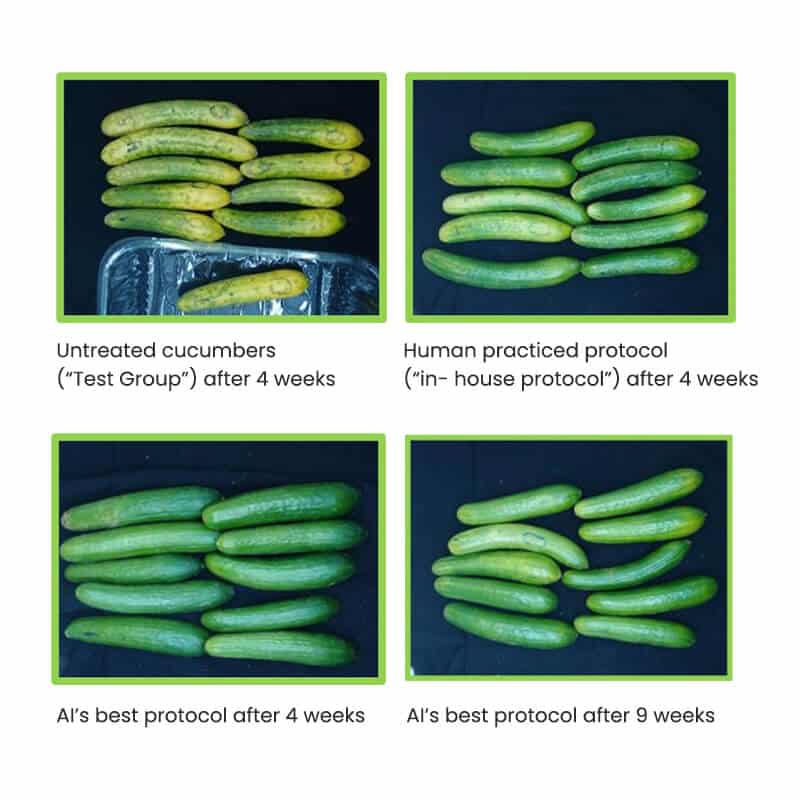
They underwent strict measurements, and were treated by the laboratory staff in accordance with the treatment protocols suggested by the artificial intelligence and were stored for 4 weeks, according to the conditions defined by the algorithm, and at the end they were taken out and underwent strict measurements of their condition.
The success index of the protocol was defined as the minimization of the change in the state of the fruit since the harvest. That is, prevention of mass loss, reduction of color change, degree of hardness, etc.
At the end of the set of experiments, with the help of the algorithm, several different protocols were found, according to which success was recorded for storing the cucumbers and bringing them to a significantly better condition than the treatments that were known until now (and in particular, the reference treatment of the laboratory that was used until this research and experiment). In addition, cucumbers in good condition were re-stored for a further period of 5 more weeks, and at the end were measured again. The result - the cucumbers maintained a surprising post-harvest quality, compared to the reference treatment which failed to prevent rot. This is an international post-harvest achievement in storing cucumbers for 9 weeks!
Following the success of the research, the researchers at Miguel are now examining options for expanding the operation of the optimization algorithm and assembling complex protocols using artificial intelligence in other areas of agriculture as well. One of them is an adjustment to create protocols for growing in the fields of vertical farming and intensive farming in controlled growing structures, where there are effects of lighting, the composition of gases, temperature, the composition of fertilizer solutions and water temperatures, etc. In the world, the cultivation field and the cultivation protocols have not yet been studied in a controlled environment while examining a large number of parameters and with the help of a computer to predict the optimal combinations.
Hila Haddad-Khamelnik, CEO of the Ministry of Innovation, Science and Technology: "This is a scientific achievement by the researchers of the Miguel Research Institute, which will have a positive effect on everyone's salad plate. This is a clear example of the impact of the research and development institutes of the Ministry of Innovation and Science, which carry out innovative and important research in the geographical peripheries of the country using their increased accessibility to the agricultural areas nearby. Israel is a leading country in research in the fields of food-tech and agriculture, and we are proud to lead significant breakthroughs in the field."
This research was supported by Ministry of Innovation, Science and Technology Through the Miguel support budget and postdoctoral funding for this topic. Recently the researchers received another grant from the Ministry of Agriculture To deepen the research and shorten the number of repetitions of the experiment.
More on this subject on Hayadan.com - Science news:
- Ahead of the Nano Israel Conference: Technion researchers have developed packaging based on nano technology that will extend the shelf life of bakery products
- A new polymer extends the shelf life of food and pharmaceutical products

One response
For the information of our readers who skipped the core studies: post-harvest is "after the assembly".