August 10, 2026

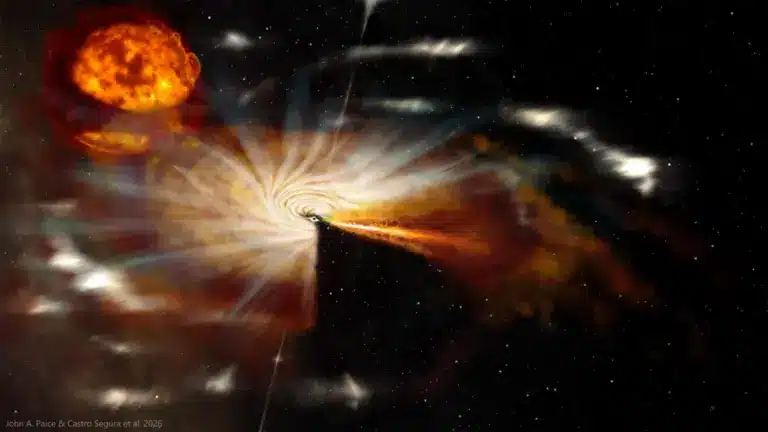
Not everything was swallowed: Black hole system continued to eject material even after the outburst died down

Not everything was swallowed: Black hole system continued to eject material even after the outburst died down

Observations with the Very Large Telescope have followed the outburst cycle of Swift J1727.8−1613. Even as the X-ray intensity has declined to a quarter of its peak, a dense wind from the accretion disk has been observed, whose mass loss rate may be comparable to
Illustration of the two sets of chromosomes received from the mother and father and combined into one diploid genome. Credit: Illustration: The Knowledge Website using artificial intelligence.

A nearly complete diploid genome of a living human has been assembled with exceptionally high precision

Telomere-to-telomere consortium independently reconstructed chromosome sequences obtained from both parents of donor HG002. The result covers 99.4% of the diploid genome and adds more than 900 million DNA letters to the standard that were not included in previous tests
Model: Additional gravitational force between dark matter particles may actually suppress the growth of structures in the universe

Model: Additional gravitational force between dark matter particles may actually suppress the growth of structures in the universe

The study does not discover a new force, but rather examines a family of models in which dark matter particles are attracted to each other by a hidden field. Contrary to expectations, the additional attraction does not necessarily create a more lumpy universe,
Physics class at the Hebrew University of Mount Scopus, 1935. The article reignites the debate over whether the primary role of most lecturers is to research or to teach. Credit: Zoltan Kluger, National Photo Collection; Public Domain.

Should most academic research be stopped? Controversial article calls for professors to be brought back to classrooms

A new article argues that most college professors should devote their time to teaching, not publishing research that almost no one reads. Behind the provocative title lies an important critique of the incentive system in academia —