A few days ago the State Comptroller published A serious report describing the seeming intentional neglect of the fight against smoking by the Ministry of Health. The prices of cigarettes in Israel are relatively low in the world and the ministry does not have a comprehensive agency, and the few inspectors are unable to deal with the propaganda of the tobacco companies, and the result is an increase in the number of smokers in recent years, and what is most worrying is that the tobacco companies have taken advantage of the lax supervision to appeal to teenagers and young adults, who will be their customers for many years , even if 10-13 years shorter than they could have had they not smoked.
The report shows that the tactic of the tobacco companies is simply to castrate the regulators, because their main tool for fifty years - denying the connection between smoking and cancer - fell out of use in the late XNUMXs when they had to reveal internal documents.
"In mid-December 1953, a meeting was held at the New York Plaza Hotel between the presidents of the four largest US tobacco companies and John Hill, founder of the public relations (PR) firm, Hill and Knowlton (H & K)."
"The tobacco industry was in crisis. Three years earlier in Great Britain, two respected epidemiologists, Richard Dole and Austin Bradford Hill, published an article on a causal link between smoking and cancer. Afterwards, Ridge's Digest, then the most famous journal in the world, He published an op-ed called "Cancer by the Cardboard," in which he brought the scientific findings into mainstream news.
"The tobacco companies feared that many would quit smoking. The answer: the most creative and original public relations campaign ever seen. The public relations strategy invented at the Plaza in 1953 was all about a bilingual public relations campaign to "pull the industry out of the hole" and stop the "public panic" ". One memorandum stated: "There is only one problem of how to create security among the public".
"In January 1954, the industry published a so-called announcement - 448 media outlets throughout the US, which together reached a circulation of approximately 43 million people. The statement cast doubt on the science linking smoking and disease and the tobacco companies expressed a commitment to research the issue and hire the best scientists to get to the truth. What is not said is that the committee will support, almost without exception, projects that are not directly related to smoking and lung cancer. Obfuscation and diversion were key to the strategy, as well as "alternative facts".
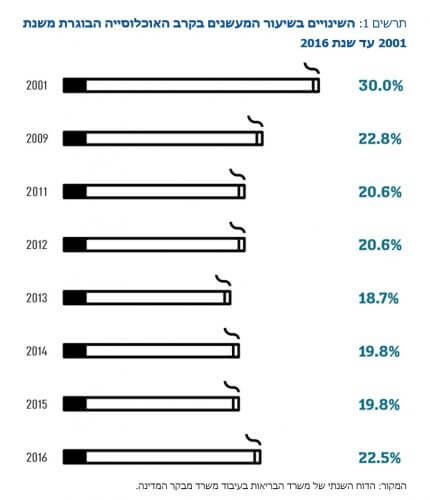
Chart 1: The changes in the proportion of smokers among the adult population from 2001 to 2016. Source Ministry of Health data, graphic processing - State Comptroller's Office
smoke screen
"The campaign to deny any health damage due to smoking has lasted for decades and will be replicated by the oil and coal companies, and in the food and beverage industry. Despite heavy criticism, these methods are still successful to this day. Politicians talk about climate change (instead of calling it warming) and there have been successes for those who have convinced the The public against the scientific positions - Brexit in the UK and the election of Trump."
"During the second half of the 20th century, the tobacco industry, under the guidance of the public relations gurus Snow at H & K, learned to divert attention all the time. In 1968, an executive from H & K repeated the best communication angles for a magazine of The tobacco industry: "The most important kind of story is the one that questions the theory of cause and effect in the relationship between disease and smoking. The headlines that catch the eye should convey that this is a dispute! contradiction! Other unknown factors!"
"The following year, one of the well-quoted internal memos of Brown Williamson, a subsidiary of British American Tobacco (BAT), described how: Doubt is our product because it is the best way to compete with the "body of facts" that exists in the public's mind. It is also the means of creating discord."
"The industry kept the controversy alive by sowing doubt. There was no "substantial evidence," "no clinical evidence." The debate was "unresolved" and "still open," nothing was "statistically proven" or "there was no Scientific proof." It was clinical and cynical. "A demand for scientific proof is always a formula for inaction and delay and usually the first reaction of the guilty," admitted the head of research at BAT in 1976."
"Another way was to look for alternative facts. In 1970, Helmut Wickham, head of Philip Morris' research and development department, wrote: "Let's face it. We are interested in evidence that we believe refutes the claims that cigarette smoking causes disease."
"In the late 1970s, the tobacco industry also began to deny the evidence of health damage due to passive smoking. Again, the industry established organizations to conduct research and divert attention from the truth. To further confuse the debate, it established front groups that acted on its behalf and smoker's rights organizations to advance the industry's arguments. "
"The public began to understand the true extent of the truth hidden by the tobacco industry through the 1998 settlement, which forced the companies to release internal and private documents. The panel of judges also forced the closure of the Tobacco Industry Research Commission, which was described as an example of a 'sophisticated public relations tool based on A premise of independent scientific research, to prevent smoking restrictions and to reassure the public."
"In 2004, a study by British epidemiologist Sir Richard Dole was published in which he estimated that during the industry's fifty-year denial campaign, approximately 6 million people died due to smoking in Britain alone."
" Whereas in the past, when the tobacco industry courted both Brexit supporters and Trump were quick to attack experts. "People in this country have had enough of experts," said Michael Gove at the height of the Brexit campaign."
However, according to the researchers, there is one important difference between the tobacco companies' activity in denying science and the supporters of Brexit and Trump. While the tobacco companies tried to give their findings a scientific edge, today's alternative facts people simply attack the scientists and try to undermine the very importance of scientific advice. Trump and his advisers have apparently taken the spectacle to a new level. After the debate over the size of the crowd at his inauguration, Trump adviser Kellyanne Conway was widely criticized for using the term "alternative facts."
Are you sure the article was not translated by Google Translate?
Lots of wording and even spelling errors.
This is of course beyond the impressive conclusions about the lack of connection between smoking and Trump.
I didn't invent the title, go to the article I relied on in THE CONVERSATION
How did you manage to connect Trump and death, you are a genius
You will receive a Clinton Award
Already from the title it can be seen that you sacrifice scientific truth for the sake of the politician in you.
I didn't even bother to read the article!



4 תגובות
Are you sure the article was not translated by Google Translate?
Lots of wording and even spelling errors.
This is of course beyond the impressive conclusions about the lack of connection between smoking and Trump.
I didn't invent the title, go to the article I relied on in THE CONVERSATION
How did you manage to connect Trump and death, you are a genius
You will receive a Clinton Award
Already from the title it can be seen that you sacrifice scientific truth for the sake of the politician in you.
I didn't even bother to read the article!