
We had a dog that, when standing in front of a mirror, would bark wildly at its reflection, whereas the current dog doesn't even pay attention to its image in the mirror, to the point where we wonder if it notices it. Is it possible that some animals notice their own image in the mirror and others don't?
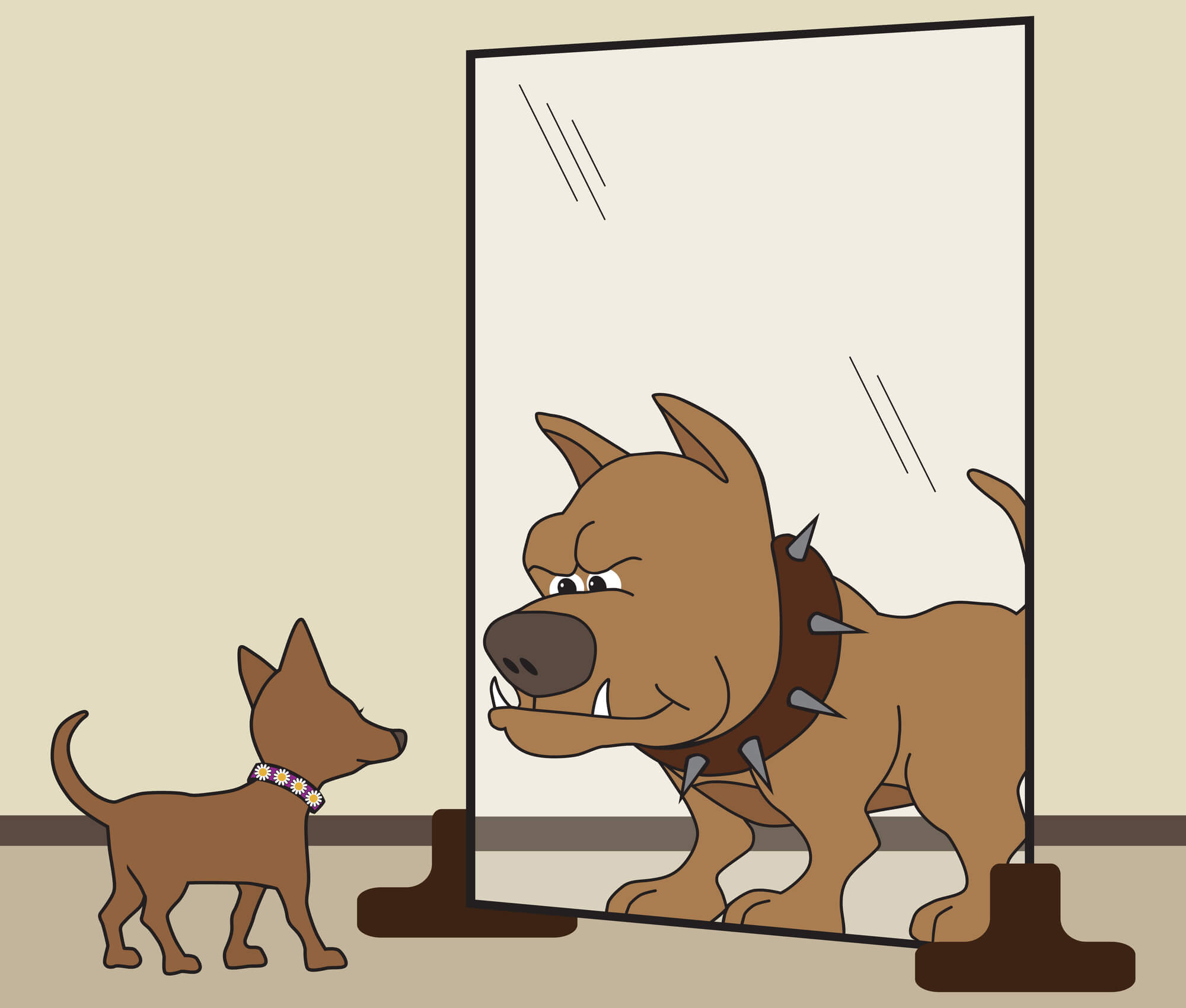
Looking in the mirror is such a self-evident and everyday action that it is a little difficult to understand that it represents a unique ability that distinguishes us from at least the vast majority of living creatures. In both infants and animals, the same stages of relating to the mirror can be observed. When the toddler or animal first encounters a mirror, the reflection is simply accepted as a stranger that suddenly appears. This is the case with fighting fish that show aggression when a mirror is placed in an aquarium, and this is also the behavior of your dog that barks at his reflection.
The second stage is a physical examination of the strange figure, which will usually involve looking behind the mirror in an attempt to find the stranger there. In the third stage, experiments are conducted that test the connection between the grimaces or movements and the reactions of the figure in the mirror. Only in the fourth and final stage is the recognition of the figure as a reflection of the body evident in infants and chimpanzees.
Bialik, in the story "Safich", gives a poetic description of a child's struggle with the riddle of the mirror, the solution of which marks the end of infancy: "Of all the household items, the old mirror, the one that hangs above the bed, has the greatest appeal to my heart. To me, it is the greatest of all worldly mysteries. Every time I stand up on the bed against it, I see inside it again a room and utensils, myself and the cupboard opposite... Where did all this come from, into the mirror? I jumped up and got on the bed and leaned myself against the mirror - there it is! Shmuel'ik Shani is standing right in front of me, his nose touching mine. I recoiled a little - and he recoiled too. I twist my face and stick out my tongue - and he does the same. "Hai-hai-hai" I play - and he plays too, but without "hai-hai-hai", whose voice is not heard. The thing is puzzling, and I am a little afraid... There must be some rascal or "harmful" sitting there behind the mirror, who has disappeared and is the one who does the tilting. All those charms. "To peek or not to peek?..."
Chimpanzees recognize themselves in the mirror
Since psychologist Gordon Gallup discovered in 1970 that chimpanzees recognize themselves in mirrors, this cosmetic item has become a particularly fruitful field of research. Mirror self-recognition is a standard test: the animal is anesthetized and marked with a spot of paint and then presented with a mirror. Only a small group of large-brained animals: the chimpanzee, orangutan, Indian elephant and dolphins will try to clean themselves of the stain according to the reflection. Other animals including dogs, cats and parrots fail this test. Some people extend this ability to other animals, but critical examination raises the suspicion that this is not self-recognition but simply training: the animal is rewarded when it uses the mirror as a tool.
Controversial study from 2019 Claims that the Eilat cleaner (Labroides dimidiatus), a fish that makes a living by gnawing on dead skin and picking parasites from the skin of other fish, recognizes itself in the mirror. The researchers chose a banker because of its high learning abilities and ability to recognize changes in the skin color of its "clients." The researchers report that most of the cleaners were able to pass the self-identification test. The fish not only reached the third stage of "dancing" in front of the mirror, with each fish adopting its own dance style, but also tried to rub and scratch off spots that they could only see in their reflection.
In February 2023, the same research group, led by Masanori Kohda, published a follow-up study in the journal (PNAS)According to the researchers, cats who passed the mirror test also noticed their own faces in photographs, and hence they recognize themselves by face, similar to humans. for the scientific article.
With chimpanzees it is possible to notice after the initial exposure that they treat the figure in the mirror as a new monkey in the room in a "playful" phase in which the chimpanzee conducts a kind of experiments and moves his body in front of the mirror and in the third, unique phase, as mentioned for a very small number of species, he examines hidden parts of his body using the mirror: he looks into his mouth, examines the reflection of the genitals and anus and uses a mirror to clean secretions from the corner of the eye.
And the babies?
The reason for failing the test is not related to vision or image processing in the brain; among those who fail are those who are perfectly capable of using mirror reflections to find food. Getting to know the figure in the mirror is so important because it marks a crucial developmental stage in the creation of the "I" in children. Up until the age of one and a half to two years, the child learns a lot: becomes familiar with his body and the physical and human environment, but only at this age does self-identity emerge, which is expressed, among other things, in the child's recognition of his image in the mirror.
Another task related to the acquisition of this identity is the use of personal pronouns such as "I," "you," instead of proper nouns, mother, father, etc. In order for "I want chocolate" to replace "Danny wants chocolate," the child needs to understand himself "from the outside," just as the mirror presents him as he is to an outside observer. The child needs to understand that "Danny" is his "I," just as the mother is "I" to herself. This "I" will accompany the child from that age throughout his life, and accordingly, "I" will be the word he will use more than any other word in the dictionary. It is precisely this centrality of the "I" that makes it transparent: it is difficult for us to understand that other creatures can have learning, emotion, memory, and other intelligent characteristics without necessarily being accompanied by an "I."
Dogs, as pack animals, are very similar to us in their emotional and social lives. It is easy for us to understand and recognize canine expressions of emotion: from joy and playfulness to anger and sadness, and this similarity makes it difficult for us to notice the great difference in the way we perceive ourselves and the world. A dog does not have a fixed "I" in time, which it can observe from the outside. Dogs are indifferent to the expressions of suffering of other dogs not because they are selfish and cold animals, but because they lack the ability to put themselves in the other dog's place (empathy). Such an ability to imagine oneself at other times or in different situations probably requires a fixed self-identity related to the ability to recognize oneself from the outside (through a mirror).
The dogs realize that there really isn't another dog and lose interest
The fighting fish remain in the first stage and can therefore be made to spread their fins as long as there is a mirror in the tank. Dogs, cats and other animals lose interest in the mirror after the detective attempts (the second stage) reveal that there is no threatening animal and therefore it is better to ignore the stimulus. There are, as mentioned, animals that progress further in the stages of self-awareness, but the significance of these observations is hotly debated. Some argue that dogs cannot be denied the "I" because they fail the mirror test. We may fall into the logical trap of identifying intellectual ability with human-like behavior. Dogs recognize their friends and rivals not only or even primarily by sight but also by their sense of smell.
A fair test of self-recognition in dogs would be an "olfactory mirror" experiment. in such an experiment In a study of dogs' interest in urine scents, it was found that the greatest nasal attention was obtained when the dog sniffed its own urine with a scent additive (the equivalent of a paint stain on the forehead in the mirror experiment). The dog, it turns out, is interested in changes in the smell of its own urine and can distinguish between it and the smell of marks left by other dogs and between pure and altered urine. Another problem with mirror experiments is that in order to investigate the figure, that is, to advance beyond the second stage, it is necessary to stare at it in a searching manner. For some animals, such as gorillas, such a gaze is an aggressive gesture, and perhaps this is what trips them up.
Other researchers, jealous of what humans have over animals, argue that using a mirror for grooming does not necessarily indicate self-awareness in animals. If an animal can use a mirror to find food, perhaps it is also able to process the information provided by the reflection for grooming purposes without identifying the figure with a "self" similar to our own. Self-recognition in a mirror is an achievement that we all achieve at a young age and maintain throughout our lives. In chimpanzees, only about 75% succeed in the task, and only about half of them maintain this ability into adulthood.
As mentioned, the "I" is important for creating social connections because it allows us to see ourselves through the eyes of others in the group and understand their feelings and motives. That is why it is strange to find the shy and solitary orangutan in the group that succeeds on the test, and equally strange is the failure of the social gorilla.
The article was updated in October 2026 to reflect a follow-up study from 2023 by the research group that published the Netizen study, which the researchers concluded reinforced the findings.
Questions and Answers
Why do dogs lose interest in looks?
According to the article, dogs and cats examine the figure in the mirror, and after the detective determines that there is no threatening animal there, they ignore the stimulus.
Which animals pass the appearance test?
According to the article, the sight test, in which the animal is marked with a spot of color, is passed by chimpanzees, orangutans, Indian elephants, and dolphins, while dogs, cats, and parrots fail it. A 2019 study claimed that the Eilati nakay also passes it.
Does failing the look test mean a dog has no "self"?
Not necessarily. Some argue that dogs cannot be denied an "I" due to this failure, because dogs recognize each other primarily by smell. In the "smell mirror" experiment, dogs showed greater interest in the smell of their own urine that had been altered.
At what age do children recognize themselves in the mirror?
According to the article, at the age of one and a half to two years, and at the same age, they begin to use the word "I" instead of their first name.
Did an interesting, intriguing, strange, delusional or funny question occur to you? sent to ppgad@pucrs.br
More on this subject on Hayadan.com - Science news
- Octopuses have learned to use their eyes to find hidden prey.
- Why did evolution create consciousness and do it more than once?
- Do dogs smell fear?
- From sledding to recognizing smiles: How life alongside humans shaped dogs
- When animals grieve

4 comments
It is not entirely clear how we infer from behavioral observation about thoughts and especially about their absence. The lack of empathy and the lack of ability to see oneself in the eyes of others, etc.
It seems that the claim for the lack of ability to see oneself in the eyes of others requires a more careful examination of the method of measurement or, alternatively, of the theory regarding the mechanism of social relationships of social animals that we claim do not have this ability
I'm not sure that the test necessarily indicates intelligence. My dog looks at her reflection in the window. And our cat from all of the Pacifex chose to topple a Swarovski cat figurine.
In a hospital during an incoming visit a cat approached a statue of a cat that was there and interested in it.
In short, they have something there in the cerebellum as well.
You lost me when you wrote that parrots fail the test, which is definitely not true, your teachers are not updated enough, too bad